
Lieferung heute & morgen

Qualitätsgarantie

Willkommens-Angebote freischalten: KOSTENLOSE Lieferung | Bis zu 80 % RABATT | Kostenlose 30-Tage-JoyPlus-Testphase
App herunterladen
A shared fire pot, also known as a hot pot or shabu-shabu, is more than just a meal—it's a communal experience. Friends and family gather around a steaming pot, each person cooking their ingredients to their own liking. A dual-chamber hot pot takes this experience to the next level by allowing you to prepare two different broths simultaneously—for instance, one mild and one spicy version.
However, the purchasing process is fraught with pitfalls. Many buyers only discover after getting home that their new pot doesn't work as expected. As your Joybuy Product Recommendation Officer, I'm here to help you identify the crucial features and make an informed decision.
Before you decide on a model, you should be aware of the typical flaws that often only become apparent during use and can spoil the culinary fun.
To avoid the problems mentioned above, you should check three technical aspects before making a purchase. These factors are key to the functionality and longevity of your fire pot.
The material affects both heat conduction and durability. Most pots are made of stainless steel, but you must pay close attention to the base construction. For even heat distribution, especially on induction and ceramic hobs, a multi-layer encapsulated base (also called a sandwich base) is essential. This consists of several layers of different metals (often stainless steel and aluminium) that absorb heat quickly and distribute it evenly across the entire base. A simple, single-layer steel base is prone to warping and creating hot spots.
The choice between an electric model and a pot for an external heat source depends on your habits.
The quality of the divider is critical. A solid divider is firmly welded to the pot's base and side walls, not just pressed in. You can identify a high-quality weld by its smooth, continuous join with no visible gaps. This ensures that no broth seeps from one chamber to the other, even when the liquid is boiling.
Here are some models tailored to different needs and usage scenarios.
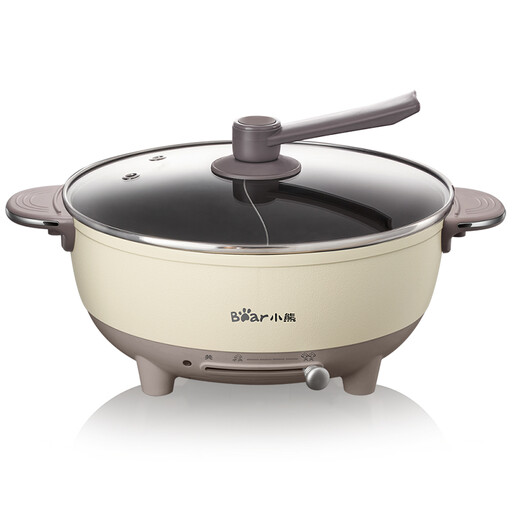
Why This Fits Their Persona: Ideal for anyone who wants a hassle-free hot pot experience right at the dining table. With a 6-litre capacity, it's large enough for families or groups of friends.
As an electric hot pot, it bypasses issues with hob compatibility and uneven heating. The integrated element is perfectly matched to the pot.
Variable temperature control (0–210°C) for precise cooking; detachable power cord for easy storage.
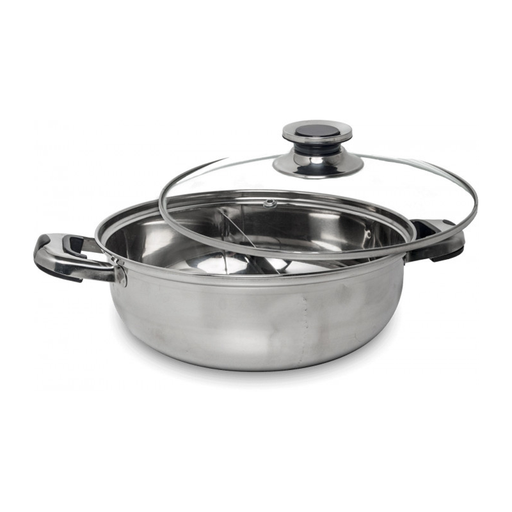
Why This Fits Their Persona: A great choice for those looking for a classic, stovetop-based pot. Its 28 cm diameter is suitable for 2–4 people and can be used on an existing hob.
This model focuses on the core function: a divided pot for the hob. With no electronics, there are fewer potential points of failure.
Classic design with two compartments and a lid; lightweight (approx. 1.3 kg) for easy handling and cleaning.
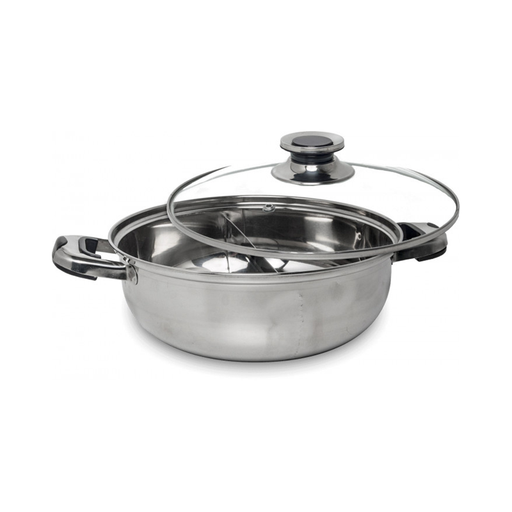
Why This Fits Their Persona: When you regularly have more than four people at the table, volume is crucial. With a 32 cm diameter, this pot offers ample space for large quantities of broth and ingredients.
It addresses the often-overlooked issue of insufficient capacity. A pot that's too small for a large group means the broth needs constant refilling.
Large 32 cm diameter for maximum capacity; includes a lid to retain heat.
We have compiled a complete, real-time list of products that fully satisfy these strict selection criteria and UK safety regulations.
1. Can you use a dual-chamber hot pot on an induction hob? Compatibility depends on the material and construction of the pot's base. A pot is only suitable for induction if its base has ferromagnetic properties. Pay attention to the manufacturer's specifications and the symbols on the packaging or the bottom of the pot. Models with a thick, multi-layer encapsulated base generally work reliably as an induction hot pot.
2. How do you clean a Yin Yang hot pot without damaging the divider? Clean the pot by hand with warm water, washing-up liquid, and a soft sponge. Avoid abrasive cleaners or steel wool, as these can scratch the surface and, in particular, the divider's weld seam. For electric models, the main unit must never be submerged in water; only the removable inner pot should be cleaned.
3. What size is suitable for a family of 4? For a group of 4, a pot with a diameter of 28 cm to 30 cm and a capacity of about 4 to 5 litres is generally sufficient. This provides enough space for two different broths and the ingredients without becoming overcrowded. For larger groups of 6 or more, a model with a diameter of 32 cm or more and a volume of 6 litres is recommended.