
Lieferung heute & morgen

Qualitätsgarantie

Willkommens-Angebote freischalten: KOSTENLOSE Lieferung | Bis zu 80 % RABATT | Kostenlose 30-Tage-JoyPlus-Testphase
App herunterladen
A Dual-Color LED Lightbar Offroad typically combines a white light beam with an amber additional function. This can be practical for off-road driving, work areas, manoeuvring, or improving your vehicle's visibility. At the same time, lightbars differ significantly in voltage, light distribution, heat dissipation and mounting.
If you only focus on lumen ratings or advertised beam distance, you risk overlooking important details. Three common buying pitfalls are:
For cars, SUVs, motorcycles and many ATVs, a 12-volt system is standard. Lorries and work vehicles, however, may operate on 24 volts. A suitable LED lightbar 12V 24V should therefore either be expressly designed for both voltages or specify an input voltage range such as 9–30 V DC.
A safe installation includes:
With a 120-watt lightbar at 12 volts, the current draw is approximately 10 amps. At 24 volts, the current is lower for the same power. The fuse and cable cross-section must still match your specific vehicle installation.
A dual-colour version can combine several light functions:
A spot beam focuses the light further into the distance. A flood beam spreads it more widely in front of the vehicle. With a stated ratio of 30° spot and 150° flood, a lightbar can illuminate both a central long-range area and the surrounding sides. For narrow forest tracks, side illumination is often more important than a pure distance rating.
The amber light should not automatically be interpreted as approved driving or warning lighting. Its specific use depends on the vehicle type, installation location and applicable regulations.
A 6063 aluminium housing can dissipate heat from the LED module via cooling fins. This is relevant at high power levels, as sustained heat can stress the electronics and seals. Some of the models listed here state a lifespan of more than 50,000 hours according to the product specification. This figure is not a guarantee of the same operating life under all conditions.
The IP68 rating describes a high level of protection against dust and temporary submersion under the test conditions defined by the manufacturer. According to the product specifications provided, water resistance is stated to a depth of 1 metre for 30 minutes. After off-road trips, you should still check the connectors, cable glands and brackets.
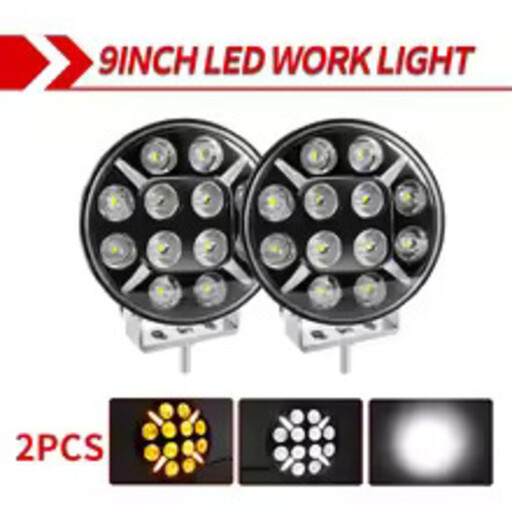
Why this product fits the profile: The 9-inch version is designed for front bumpers, grilles or roll bars and supports both 12- and 24-volt vehicles. This makes it suitable for users looking for a compact solution for an SUV, ATV or 4x4.
The stated compatibility with 12–24 V reduces the risk of choosing the wrong voltage. The IP68 rating and combined spot/flood operation provide additional checkpoints before purchase.
9 inches, 120 watts according to the product specification, DRL function and a stated beam distance of 956 metres at 1 lux.

Why this product fits the profile: The 10-inch LED lightbar combines white driving light, amber DRL and position light functions in a slim housing. It is of interest for front mounting on SUVs, ATVs and work vehicles when multiple light functions are needed.
The product specification mentions an integrated pressure equalisation vent to prevent condensation, plus IP68. Separate aluminium and stainless steel brackets allow for adjustable mounting.
According to the product specification, the light reaches up to 970 metres at 1 lux. A DT wiring kit with relay and fuse box is included in the scope of delivery.
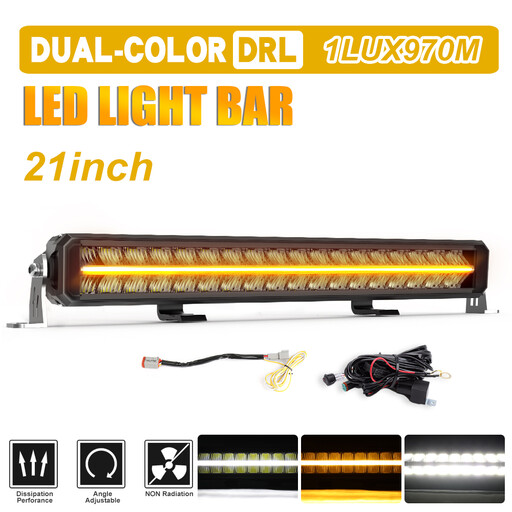
Why this product fits the profile: The 21-inch LED lightbar offers a wider design for lorries, larger SUVs, boats, trailers and stationary work areas. The stated voltage range of 9–30 V DC is designed for various vehicle classes.
The specifications for 9–30 V, IP68, aluminium housing and stainless steel brackets make it easier to check voltage, protection and corrosion resistance before purchase.
180 watts plus DRL according to the product specification, 30° spot and 150° flood beam, plus a bracket with approximately 45° adjustment range.
An LED auxiliary headlight installation should be as vibration-free as possible. Crossbars, front bull bars or roll bars must be compatible with your vehicle's construction. Before drilling, check the cable routing, earthing point, fuse position and the clearance of the bonnet or suspension.
The electrical power affects energy consumption. A 120-watt light draws approximately 10 amps at twelve volts, while a 180-watt lightbar draws around 15 amps. If the light is only used briefly, the consumption remains manageable. However, during long work sessions, the battery, alternator and cables can be more heavily stressed.
For an LED work light 12V 24V connected to a stationary 230-volt supply, a suitable DC power converter is required. The product specifications for the 21-inch model explicitly mention a transformer for conversion to 12 volts DC for indoor applications.
We have compiled a complete, regularly updated list of products that fully meet these strict selection criteria and the safety regulations applicable in the EU.
Not every off-road LED lightbar has approval for use on public roads. The design, approval marks, installation position and vehicle type are all decisive factors. Therefore, a light should not be considered road-legal solely because of its IP68 rating or 12–24-volt compatibility. You should check the relevant regulations before installation.
A 10-inch lightbar requires less space and is more suitable for compact front ends, ATVs and smaller SUVs. 21 inches offers a longer light surface and may be suitable for lorries, larger 4x4 vehicles or stationary applications. The deciding factors are the available mounting width, cable routing and the desired light beam pattern.
For the models mentioned, a lifespan of over 50,000 hours is stated according to the product specification. However, the actual service life depends on operating temperature, vibration, voltage, cleaning and the quality of the electrical installation. Cooling fins should be kept clear, and connectors should be checked regularly after use in dust, mud or water.