
Lieferung heute & morgen

Qualitätsgarantie

Willkommens-Angebote freischalten: KOSTENLOSE Lieferung | Bis zu 80 % RABATT | Kostenlose 30-Tage-JoyPlus-Testphase
App herunterladen
Investing in a dual-zone wine cooler is a significant decision for anyone who wants to store and serve their wines at the perfect temperature. However, the market can be overwhelming, and many products fail to live up to their promises. Before you buy a wine cooler, it's crucial to understand the most common pitfalls to avoid a costly mistake. This guide will help you cut through the noise and find a unit that truly meets the needs of your collection.
Many buyers are swayed by marketing claims that often disappoint in practice. Pay close attention to these three points to avoid expensive errors.
To make the right choice, you should focus on objective technical features. The following three parameters are crucial for the functionality and longevity of a wine cooler.
A dual-zone wine cooler is the ideal solution for red and white wine. Each zone can be set to a specific temperature independently.
A high-quality glass-door wine cabinet protects your collection from harmful environmental factors, with the door being the most critical component. An effective door should feature multi-layered insulated glass. Often, an inert gas like argon is filled between the panes to improve insulation. An additional Low-E (Low Emissivity) coating reflects UV and infrared radiation, preventing light and heat from penetrating the interior.
Most models are designed as freestanding wine coolers. This means they require sufficient clearance on the sides and back for ventilation, allowing heat to dissipate. Factor this in when choosing a location. The noise emission, measured in decibels (dB), is another important criterion. Models with a rating below 40 dB are considered quiet and are suitable for use in kitchens or living areas. An anti-vibration system, where the compressor is mounted on rubber dampers, minimises vibrations and protects the wine.
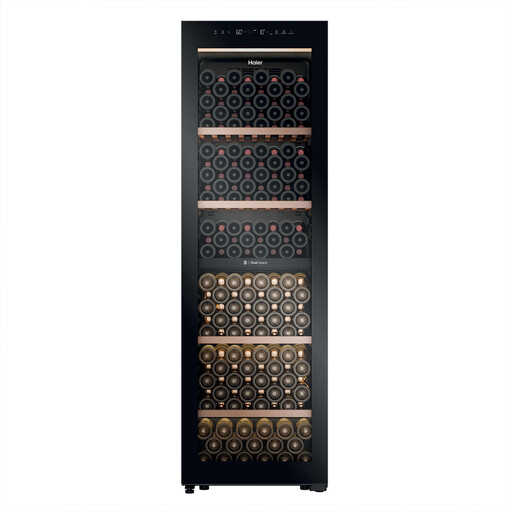
Why This Fits Their Persona: For collectors with an extensive collection, this model offers professional-grade storage conditions. Its high capacity and precise control settings are ideal for the long-term maturation of valuable wines.
The unit features a UV-protected glass door, an anti-vibration system, and active humidity control. Its capacity of up to 201 bottles solves the problem of limited space for various bottle shapes.
Two separate temperature zones (5–20°C), humidity control (50–80%), and quiet operation at around 37 dB make it a solid choice for professional wine storage.

Why This Fits Their Persona: Ideal for wine lovers with a growing collection who value flexibility and modern technology. The capacity is well-sized for home use, and the app control offers added convenience.
This model features an anti-UV and Low-E glass door and is very quiet at 37 dB. The two zones can be controlled independently, allowing for flexible storage of red and white wines.
Offers a balanced combination of capacity (46 bottles), dual-zone functionality, and smart features like control via the ConnectLife app. The activated carbon filter also protects against external odours.
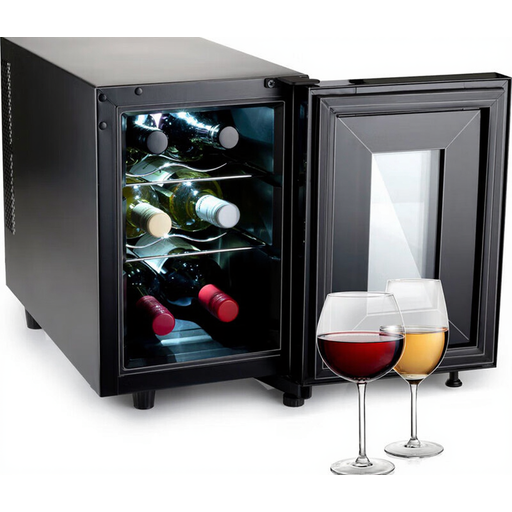
Why This Fits Their Persona: A compact and cost-effective solution for wine novices or households with limited space. It's perfect for keeping a small selection of wines at their ideal drinking temperature without a major investment.
This model operates without a compressor (thermoelectric), making it extremely quiet and vibration-free. It thus bypasses the noise and sediment disturbance issues common in budget compressor units.
Very quiet, vibration-free operation and a compact design. Note: This is a unit with a single temperature zone (11–18°C), ideal for users who primarily want to chill one type of wine.
We've curated a complete, up-to-date list of products that fully meet our strict selection criteria and all relevant safety standards.
A wine cooler's noise level is measured in decibels (dB). Models rated below 40 dB are considered quiet and are suitable for living areas. Compressor-based units tend to be louder than thermoelectric ones but often offer superior cooling performance. A freestanding wine cooler should be placed with 5-10 cm of clearance from walls and other furniture to ensure adequate air circulation and prevent overheating.
The terms are often used interchangeably. Technically, a wine cooler (Weintemperierschrank) is primarily for bringing wine to its optimal serving temperature. A wine cabinet or wine storage cabinet (Weinklimaschrank or Weinlagerschrank) is designed for long-term storage and simulates cellar conditions, including constant temperature, humidity, and protection from light and vibration. A dual-zone wine cooler can perform both functions, with one zone used for storage and the other for chilling to serving temperature.
A wine cooler does not need to be completely full to operate. However, it runs most energy-efficiently when it is well-stocked. The stored bottles act as a thermal mass, which helps to keep the temperature stable, meaning the compressor has to run less frequently. If you only partially fill the unit, your energy consumption may be slightly higher, but its functionality will not be affected.