
Lieferung heute & morgen

Qualitätsgarantie

Willkommens-Angebote freischalten: KOSTENLOSE Lieferung | Bis zu 80 % RABATT | Kostenlose 30-Tage-JoyPlus-Testphase
App herunterladen
For wine lovers, proper storage is crucial to preserve the aroma and quality of every bottle. A dual-zone wine cooler is an ideal solution, as it allows for separate temperature control for red and white wines. However, the market is flooded with models whose marketing promises often don't hold up to reality. Inaccurate temperature readings, loud operating noises, or inadequate protection can compromise a valuable collection.
This guide highlights the most common pitfalls to avoid when buying a wine cooler and explains which technical parameters you should look for to make an informed decision.
Many buyers focus on aesthetics or advertising claims that later prove to be problematic. Pay close attention to these three points to avoid a poor purchase.
To avoid the problems mentioned above, you should check the following technical specifications before making a purchase. These define the performance and longevity of your appliance.
Most wine coolers use compressor-based cooling. This technology is powerful and efficient, even at higher ambient temperatures. Modern compressors are also designed to be low-vibration to avoid disturbing the wine. Pay attention to the official noise emission specification in decibels (dB). Appliances with ratings around 37 dB are considered very quiet and are well-suited for integration into kitchens or living areas. A freestanding wine cooler also offers placement flexibility but requires sufficient space for air circulation on the sides and at the back.
Capacity is typically specified in standard 0.75-litre Bordeaux bottles. A 46-bottle wine cooler offers a good compromise between size and storage capacity for most collections. Keep in mind that wider bottles, such as those for Burgundy or sparkling wine, require more space and can reduce the total capacity. An indispensable feature is a glass door with UV protection. This blocks harmful light, thereby protecting your wine's aroma. An integrated activated charcoal filter to neutralise odours is another feature of high-quality models.
Modern appliances offer more than just cooling. A wine cooler with app control allows you to monitor and adjust the temperature of both zones from anywhere using your smartphone. You can receive alerts if the door is left open or if the temperature deviates critically. This provides additional security and convenience, especially when you're not at home. A touch display on the unit itself should allow for intuitive and direct adjustments.
Based on the objective criteria mentioned above, some models are particularly well-suited for specific user profiles.
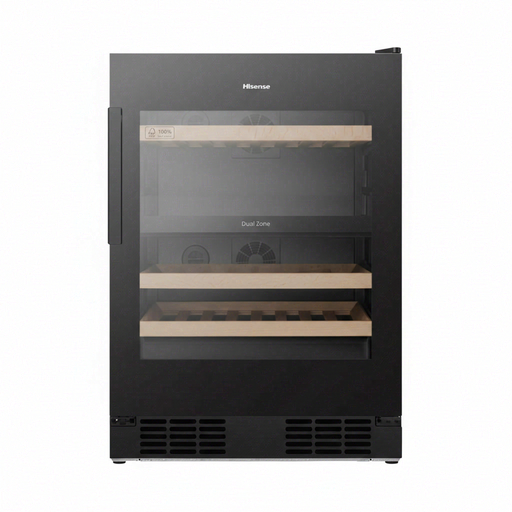
Why this model is a great fit: This model is aimed at users who store both red and white wine and value modern technology. The 46-bottle capacity is ideal for a growing collection, and the app control offers convenience and control for tech-savvy owners.
The two independently controlled zones (5–20°C) ensure stable temperature management. At 37 dB(A), its operation is quiet enough for living areas. The door, featuring anti-UV and Low-E glass, effectively protects the wine from light and temperature fluctuations.
Precise dual-zone cooling for red and white wine. Remote control and monitoring via the ConnectLife app. Quiet operation and UV-protective glass.
We have compiled an up-to-date list of products that fully meet these strict selection criteria and local safety regulations.
1. How loud is a dual-zone wine cooler and where can I place it? The noise level depends on the cooling technology. Compressor models are more powerful but can be louder. Pay attention to the manufacturer's decibel (dB) rating. A quiet wine cooler with a rating below 40 dB, like the Hisense RW3N122GSLF at 37 dB, can be placed in an open-plan kitchen or dining room without issue. Freestanding models require a few centimetres of clearance on the sides and back for adequate ventilation.
2. What is the difference between a wine cooler and a wine cabinet? The terms are often used interchangeably. Technically, a wine cooler is primarily used to bring wine to its ideal serving temperature, whereas a wine cabinet or wine cellar is designed for long-term ageing under cellar-like conditions (constant temperature, humidity, darkness). A dual-zone wine cooler for red and white wine is a type of wine cooler designed for serving.
3. What are the operating costs for a 46-bottle wine cooler? The operating costs depend on the appliance's energy efficiency class, the set temperature, and the ambient temperature. The energy efficiency class provides an indication of the annual electricity consumption in kilowatt-hours (kWh). Models in class F, such as the aforementioned Hisense cooler, are common in this appliance category under the current classification system. You can find the exact consumption values on the energy label of the respective product.