
Lieferung heute & morgen

Qualitätsgarantie

Willkommens-Angebote freischalten: KOSTENLOSE Lieferung | Bis zu 80 % RABATT | Kostenlose 30-Tage-JoyPlus-Testphase
App herunterladen
A dual-action car polisher can help you achieve consistent results when detailing vehicle paintwork, plastic or glass. However, not every machine is suitable for every task. If you focus only on speed, wattage or a large list of accessories, you can easily overlook important details such as throw, power supply and pad attachment.
A high speed alone says little about how suitable a machine is in practice. Wax and sealants usually require a lower speed than working on heavily weathered surfaces. That is why fine speed control, a controlled start-up and movement that remains as consistent as possible are so important.
With a rotary polisher, the backing plate spins on a fixed axis. A dual-action polisher, also known as a random orbital polisher, combines rotation with an eccentric movement. This can limit heat build-up in one area and is often easier for beginners to control. For targeted work, however, a rotary polisher can be used more precisely.
A cordless polishing machine gives you freedom of movement, but its runtime depends on pressure, speed, pad size and the condition of the paintwork. A single battery may not be enough for larger vehicles. Look out for:
A machine with two batteries is not automatically more economical. What matters is whether suitable replacement batteries will be available later and how long the charger takes to recharge them.
A set containing numerous car polishing sponges may appear comprehensive, but it can also be confusing. Different colours are not standardised. Always check the actual description of the pad’s hardness, material and intended use.
Hard polishing pads are generally used for greater material removal, while soft pads are intended for finishing, waxing or sealing. For sensitive paintwork, it is best to start with a soft pad and a mild polish. An aggressive pad can leave additional marks if used incorrectly.
The eccentric throw determines how the backing plate moves. A shorter throw can offer greater control for detail work. A longer throw can cover a larger area when used correctly, but requires more care around edges and sensitive areas.
Also check:
A small backing plate is suitable for mirror housings, bumpers, wheel areas and tight contours. A larger backing plate can be more practical for bonnets or roofs.
Electronic control with several speed settings makes it easier to adapt the machine to the polish, pad and surface. A soft-start function reduces the risk of polish being flung out when the machine starts. LCD displays can show speed and battery status more clearly, but they are no substitute for an easily accessible speed control.
Before polishing a car, the paintwork should be washed, dried and checked for bonded contaminants. Otherwise, coarse dirt can act like an abrasive. Removing paint scratches is also not possible for every type of damage: superficial marks may be reduced visually, while deep scratches reaching the primer often require a different repair.
Sandpaper for random orbital sanders is not automatically suitable for a polishing backing plate. The diameter, hole pattern, hook-and-loop system and grit must match the machine and the preparation work in question. When sanding, safety glasses, respiratory protection and suitable dust extraction are advisable.
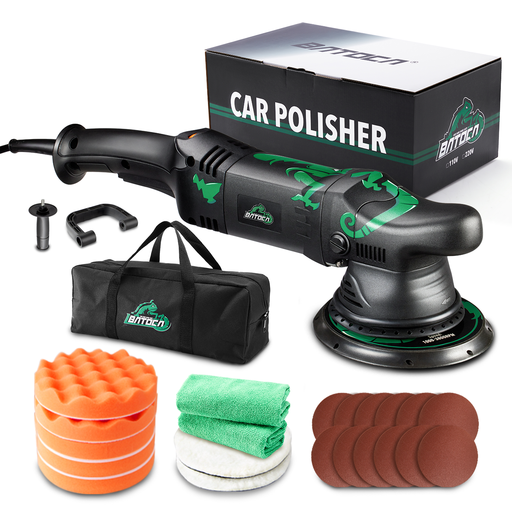
Why this product suits this profile: The corded machine offers six speed settings between 2500 and 5500 rpm, together with a 125-mm backing plate. This removes the need to plan charging breaks during longer jobs.
Variable speed control means you are not restricted to a single high speed. The cable removes dependence on one battery charge.
1100-W motor according to the product details, six settings, side handle and D-handle.
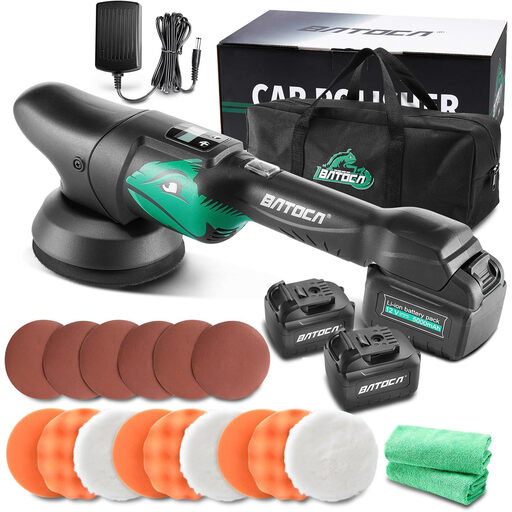
Why this product suits this profile: This cordless car polisher combines an 8-mm eccentric throw with an LCD display, six settings and two 5-Ah batteries. It is ideal for users who want to read operating data directly on the machine.
Two batteries reduce lengthy interruptions. The LCD display shows the speed and battery status instead of relying solely on general runtime figures.
Two 5-Ah batteries, LCD display, 8-mm throw and approximately 60 minutes of runtime per battery according to the product details.
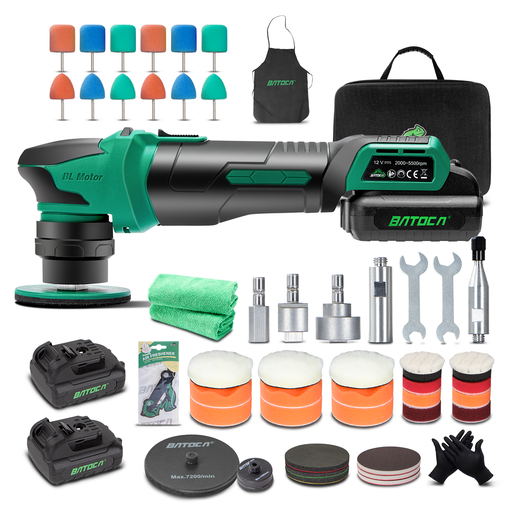
Why this product suits this profile: This compact car-care polisher is designed for tight areas such as mirrors, bumpers, wheels and edges. It offers rotary and dual-action modes, together with 25-mm and 75-mm attachments.
Its compact design complements a full-size polisher, rather than requiring an oversized machine for every surface. You can choose the system to suit detail work or larger, uniform areas.
Brushless motor according to the product details, 2 × 2.5-Ah batteries, four speed settings and 3- or 12-mm dual-action operation.
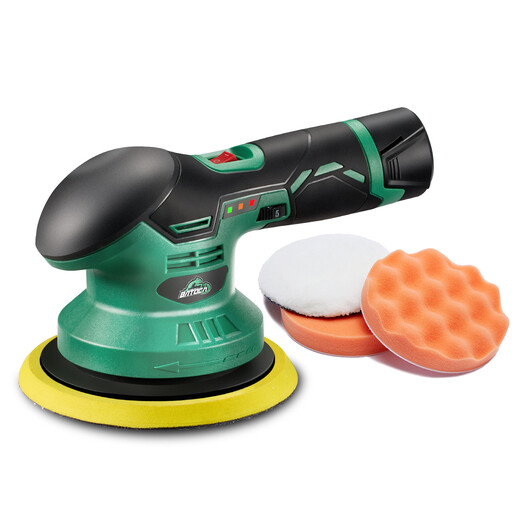
Why this product suits this profile: This cordless 12-V polisher, with a 5-mm random orbit and 125-mm attachment, is designed for users who want to work on their vehicle without a power cable.
According to the product details, the six-stage control covers 2500 to 5000 rpm. A three-colour battery indicator shows the charge level.
2.0-Ah battery, fast charger, brushless motor according to the product details and 5-mm random orbit.
For a controlled finish, polishing pads should match both the machine and the polish. The 8-piece polishing sponge set available from Joybuy includes various foam pads, a wool pad and an M10 adapter. Before use, check the attachment, diameter and permitted speed.
For genuine sanding work, suitable discs are the better choice. According to the product details, the WORKPRO 125-mm sandpaper discs have eight holes and grits from 60 to 600. Only use coarse grits for suitable preparation work, then gradually move to finer grits.
We have put together a complete, regularly updated list of products that fully meet these strict selection criteria and the safety regulations applicable in the EU.
A dual-action polisher can be easier for beginners to control than a rotary polisher. Start at a low speed, with a soft pad and light pressure. Test the combination first on an inconspicuous area.
Runtime depends on battery capacity, speed, pad size and working pressure. With a model supplied with two batteries, you can swap one while the other is charging. Manufacturer or product runtime figures should therefore be treated as guidance for specific operating conditions.
Not every scratch can be removed by polishing. Depending on its depth and the condition of the paintwork, only damage in the upper clear-coat layer may be reduced. Once the primer or metal is visible, a car-care polisher will generally not be sufficient.