
Lieferung heute & morgen

Qualitätsgarantie

Willkommens-Angebote freischalten: KOSTENLOSE Lieferung | Bis zu 80 % RABATT | Kostenlose 30-Tage-JoyPlus-Testphase
App herunterladen
A recirculating cooker hood is especially practical if your kitchen has no extractor duct or structural changes aren’t possible. It draws air through a grease filter and an activated carbon filter, then returns it to the room. For reliable everyday performance, don’t focus solely on design and maximum extraction rate.
Figures such as 650 m³/h often refer to the highest setting, not necessarily the normal operating mode with an activated carbon filter fitted. In recirculation mode, additional filters and air resistance can affect airflow. So compare extraction rate, noise level and filter specification together.
An activated carbon filter traps odours, but it’s a consumable. Depending on how often you cook and the type of filter, you may need to replace it every two to four months. Washable aluminium grease filters also need regular cleaning to keep working effectively.
A 60 cm cooker hood is often suitable for standard-sized hobs. For wider cooking areas, a 90 cm cooker hood may be a better choice because it covers more of the hob. You should also consider the installation height, the hood’s depth and the clearance from wall cabinets.
An extractor and recirculating cooker hood is a model that supports both modes, depending on how it’s installed. In extraction mode, air is channelled outside through a duct. This requires a suitable wall vent, an outlet and the right structural provisions.
Recirculation mode, on the other hand, requires a compatible carbon filter. It’s suitable for rented homes, internal kitchens and rooms without an extractor duct. If you’re using the hood at the same time as an open-flued appliance that draws air from the room, make sure there’s an adequate supply of fresh air. Always follow the installation instructions and local requirements.
Extraction rate is measured in m³/h. A compact model with a lower extraction rate may be enough if you only cook occasionally. If you often fry, grill or cook in an open-plan kitchen, compare models with several speed settings and a higher stated extraction rate.
A quiet cooker hood won’t necessarily be quiet on every setting. Check the maximum stated noise level in dB. For comparison, the product specifications for the models featured here list figures of 58 to 69 dB. How loud a hood seems in practice also depends on installation, room acoustics and airflow.
On many models, the multi-layer aluminium grease filter can be removed and cleaned. Claims such as “dishwasher-safe” refer to the manufacturer’s instructions, so check the care guidance. Activated carbon filters are generally separate from grease filters and may need to be replaced separately, depending on the model.
A cooker hood with LED lighting illuminates the hob directly. Touch controls, gesture control or app connectivity can make a hood more convenient to use, but they shouldn’t take priority over suitable dimensions and filter costs. Also check that replacement filters will remain available in the long term.
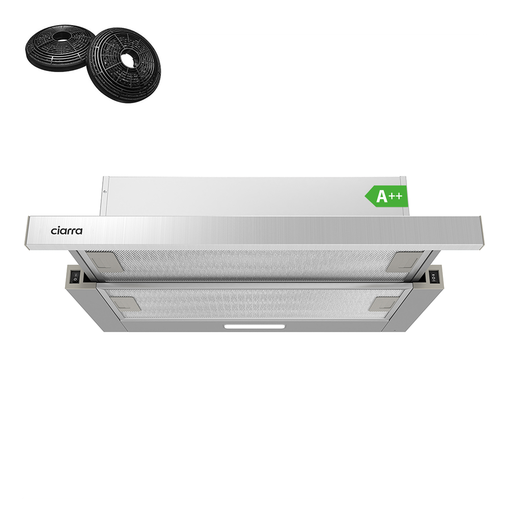
Why it suits this type of kitchen: Its pull-out design takes up little space, making it suitable for smaller kitchens or installation beneath a wall cabinet. The stated specifications include an extraction rate of 370 m³/h, two speed settings and a maximum noise level of 61 dB.
The description clearly specifies both operating modes, the included extraction duct and compatible carbon filters. This makes it easier to check that the installation type will work for your kitchen before you buy.
Pull-out design, washable aluminium filters, LED lighting and A++ energy efficiency rating.
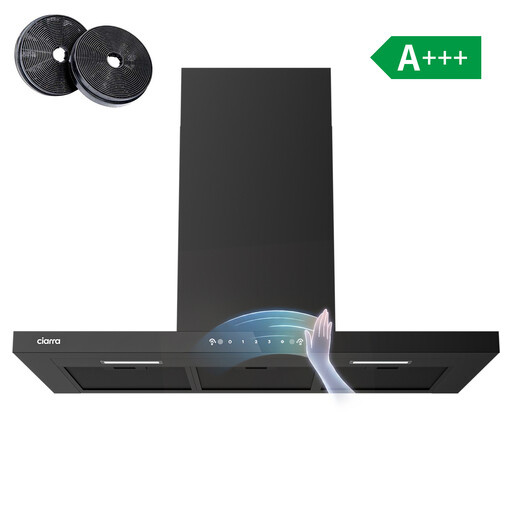
Why it suits this type of kitchen: The 90 cm design covers wider hobs. According to the product specifications, it offers an extraction rate of 650 m³/h, a maximum noise level of 59 dB, touch and wave controls, and two LED brightness settings.
The specifications cover both recirculation and extraction modes, three washable aluminium filters and the compatible carbon filter type. This makes it easier to plan for ongoing costs.
90 cm wide, 650 m³/h, A+++ energy efficiency rating and a 24-month warranty, according to the product specifications.
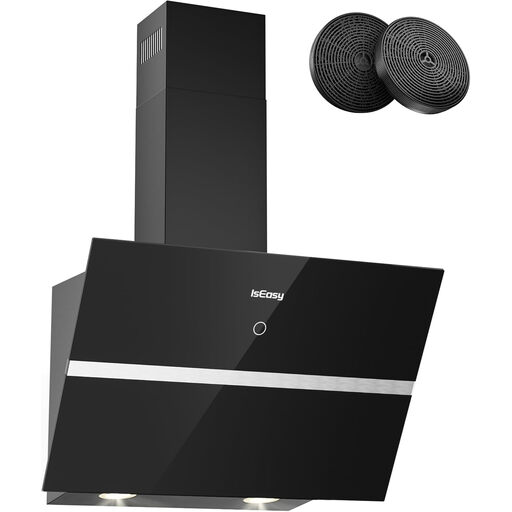
Why it suits this type of kitchen: Four speed settings, an extraction rate of 578 m³/h and a delay timer that runs for 1 to 9 minutes make it a good fit for households that cook regularly at different intensities.
The product description lists two carbon filters, a washable five-layer aluminium filter and specific replacement intervals for the activated carbon filters.
58 dB, touch controls, memory function, LED lighting and A++ energy efficiency rating, according to the product specifications.
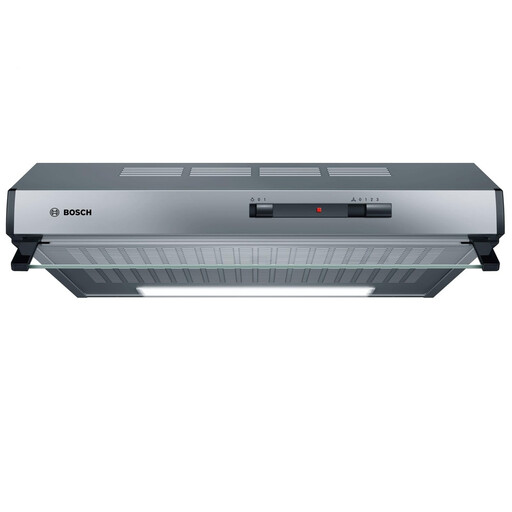
Why it suits this type of kitchen: This 60 cm model can be installed beneath a cabinet or on the wall. It has three speed settings and a slider switch.
The product specifications note that the recirculation kit is sold separately, so you can factor in this additional cost before you buy.
250 m³/h, LED lighting, dishwasher-safe grease filter and support for both extraction and recirculation modes.
We’ve put together a complete, regularly updated list of products that meet these strict selection criteria and fully comply with the safety requirements in force in the EU.
It depends on the model, filter type and how often you cook. For several of the appliances listed, two to four months is given as a guideline. Always follow the manufacturer’s specific advice.
Neither mode is the right choice for every kitchen. Extraction sends moisture and odours outside, but requires a suitable outlet. Recirculation is more flexible to install and suits many homes without an extractor duct, but the activated carbon filters need to be replaced regularly.
Running costs include electricity, replacement filters and, where needed, cleaning products. Compare the stated annual energy consumption, energy efficiency rating and prices of compatible carbon filters. Your actual costs will depend on how long you use the hood and which speed setting you choose.