For known, typical quartz-containing mineral construction dust, BG BAU recommends choosing a construction dust extractor with at least dust class M; a large container alone does not prove that a machine is suitable. If you have more sanding or drilling to do, also consider the tool connection, airflow and filter cleaning system. If the materials in an older property have not been identified, establish whether they contain hazardous substances first, rather than judging suitability based on the extractor’s dust class alone.
Who is this buying decision relevant to?
Renovators dealing with residual mineral dust
You want to clean floors and work surfaces after working with materials that have been identified and are not suspected of containing asbestos. Check the dust class rather than relying on container capacity alone: BG BAU describes construction dust extractors with at least dust class M for typical quartz-containing mineral construction dust.
DIYers with more sanding to do
You also need the extractor while sanding, milling or drilling. The tool connection, airflow and filter cleaning system should suit the extractor and the tool you’re using. BG BAU also recommends construction dust extractors for extracting dust from hand-held power tools.
Renovators working on older properties with unidentified materials
You’re not sure about the building’s history or the composition of old plaster, filler, tile adhesive or flooring. The German Federal Institute for Occupational Safety and Health lists these materials as potential sources of asbestos. Get expert advice to assess any suspicions before choosing an extractor.
What should you look for when buying?
For known mineral construction dust, check the dust class of the complete appliance before considering container size and convenience features. For typical quartz-containing mineral construction dust, BG BAU recommends construction dust extractors with at least dust class M. This does not replace checking the specific type of dust and the necessary protective measures.
| Buying criterion |
What to look for when buying |
Who should pay particular attention? |
| Dust class and material |
Check the building’s history and the material being worked on; confirm the dust class and the intended use of the complete appliance. If asbestos is suspected, do not use any of the extractors covered here. |
If I’m not sure what the dust contains, I want to find out whether I can vacuum it up myself and what level of suitability is required before cleaning. Around 28% of consumers put checking materials and safety first. |
| Tool connection |
Check that the cuff, hose connection, airflow requirements and automatic start control are compatible with the power tool you’re using. |
If I’m still sanding or drilling, I want the extraction to connect directly to the tool and work effectively while I’m using it. Around 22% of consumers prioritise the tool connection. |
| Filter cleaning system |
Check the specific filter cleaning system on the model, the filter type and which disposal bag is suitable. |
If I’m collecting fine dust repeatedly or in large quantities, I want to know which filter cleaning system will suit the way I work. Around 22% of consumers prioritise filter cleaning. |
| Portability and reach |
Compare gross and net capacity, weight with or without accessories, hose length and floor-cleaning accessories. |
If I need to move the extractor between rooms, weight and reach matter just as much to me as usable capacity. Around 17% of consumers prioritise ease of handling. |
| Equipment and ongoing costs |
Check what’s included, the disposal bag, replacement filters and any accessories required for the specific model. Follow the instructions when using the extractor for wet cleaning. |
If I’m choosing an appliance for a complete job, I want to plan for suitable equipment and consumables. Around 11% of consumers put the total cost first. |
Avoid common buying mistakes
-
Treating unidentified dust in an older property like ordinary renovation dirt
According to the German Federal Institute for Occupational Safety and Health, asbestos can be found in materials including plaster, filler, tile adhesive and flooring. Buying an extractor won’t identify what the material contains.
First, get expert advice on the building’s history and the materials involved. If asbestos is suspected or confirmed, do not use any of the extractors covered here to collect it.
The project may then require an expert materials survey and, if necessary, a separate asbestos removal contract.
-
Looking only at the capacity in litres or the ‘industrial vacuum’ label
Container capacity and dust class answer different questions. For typical quartz-containing mineral construction dust, BG BAU recommends construction dust extractors with at least dust class M. However, suitability still depends on the material and how the extractor will be used.
Start by checking the type of dust, the dust class and the intended use. Then compare usable capacity and ease of handling.
-
Assuming similar model versions are identical
The Festool CTM MIDI I 578301 has manual filter cleaning, while the CTM MIDI I AC 578552 version features AUTOCLEAN. Similar model names don’t mean the equipment and filter cleaning systems are the same.
Check the full model and order number, dust class, filter cleaning system and what’s included.
-
Planning to vacuum up liquids or remove dust with minimal dust release without checking the accessories
For the Festool CTM MIDI I 578301, the manufacturer specifies that a special wet filter is required for wet vacuuming. Disposal bags and filters must also be suitable for the specific model and application.
Before buying, check the operating mode you need and consult the documentation for the specific model to find the right filters, disposal bags and floor nozzles.
Depending on the model, you may need an additional wet filter, suitable disposal bags or floor-cleaning accessories.
Relevant brands and example models
Bosch Professional
The GAS 35 M AFC Professional, order number 06019C3100, is a wet and dry vacuum cleaner with dust class M and automatic filter cleaning.
- Bosch specifies a gross capacity of 35 l, a net capacity of 23 l, a 5 m anti-static hose and a tool cuff.
- Bosch’s claim that AFC maintains suction performance is manufacturer information, not an independent comparative test. Versions with a different dust class or order number should not be assumed to be the same without checking their identity.
Kärcher
The NT 30/1 Tact Te M ACD, order number 1.148-235.0, is a dust class M safety vacuum cleaner with Tact filter cleaning.
- Kärcher specifies a 30 l container, a tool socket with automatic start/stop for power tools and an electrically conductive hose.
- The stated weight is 14.2 kg without accessories. M ACD, Basic M and L are different versions and should not be assumed to be the same without confirming their identity.
Festool
The CTM MIDI I CLEANTEC 578301 is a compact dust class M vacuum cleaner. Festool describes it as suitable for shorter tool jobs and final cleaning.
- The manufacturer specifies manual filter cleaning and a maximum container or filter bag capacity of 15/12.5 l.
- According to Festool, wet vacuuming requires a special wet filter. The AUTOCLEAN version, CTM MIDI I AC 578552, is a different model.
Starmix
According to Starmix, the iPulse M-1635 Safe Plus is a dust class M safety vacuum cleaner with demand-controlled filter cleaning.
- The manufacturer describes filter cleaning controlled by differential pressure measurement, along with visual and audible airflow warnings.
- Manufacturer claims about uninterrupted work or time savings are not independent performance measurements. Safe, Safe Plus and the L, M and H versions should be considered separately.
Metabo
The ASR 35 M ACP, order number 602058000, is a multi-purpose vacuum cleaner with AutoCleanPlus and a 35 l container.
- Metabo specifies a 4 m anti-static hose, a PE disposal bag and a floor nozzle. The manufacturer’s international website lists the same order number as dust class M.
- The stated appliance weight is 16 kg. Bear this in mind if you’ll be moving the vacuum cleaner regularly.
Joybuy products for tool use and cleaning
The following Joybuy options are wet and dry vacuum cleaners whose product details mention a tool connection or tool adapter. For mineral construction dust, check the dust class and whether the complete appliance is suitable for the specific job. Do not use these appliances if asbestos is suspected.
 No image available
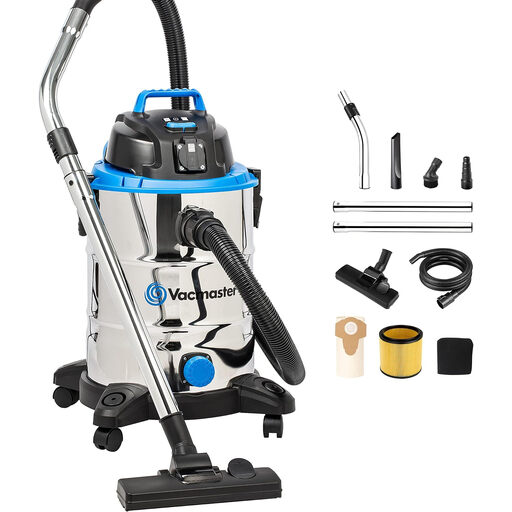
Vacmaster VQ1530SFDC, 1500 W, 30 l, wet and dry vacuum cleaner with blower
Designed for wet and dry cleaning, as well as use with a power tool connected. Check that the tool connection and airflow are suitable for your tool.
The product description warns against using the vacuum cleaner for hazardous materials. For mineral or quartz-containing construction dust, check the dust class, suitability and protective measures for the specific job. Do not use if asbestos is suspected.
View at Joybuy
 No image available
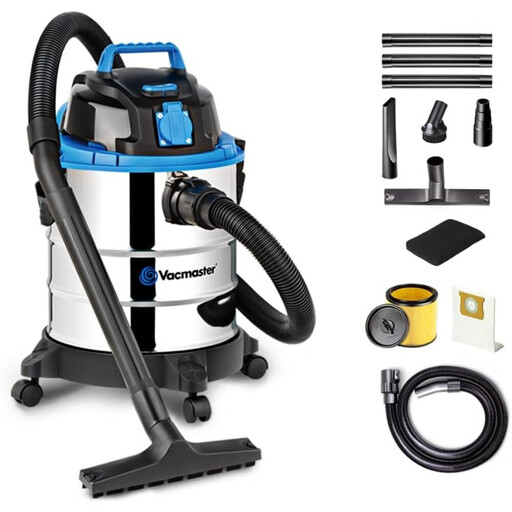
Vacmaster VQ1220SC, 1250 W, 20 l, wet and dry vacuum cleaner with blower
Described as suitable for wet and dry cleaning; a power tool adapter is listed as an accessory. Check that it fits your tool and is included in the specific package.
The product description warns against using the vacuum cleaner for hazardous materials. For mineral or quartz-containing construction dust, check the dust class, suitability and protective measures for the specific job. Do not use if asbestos is suspected.
View at Joybuy
Frequently asked questions
Do I always need to buy a dust class M vacuum cleaner for DIY renovation work?
This does not mean that a dust class M vacuum cleaner is compulsory for all DIY work at home. Section 1(4) of the German Hazardous Substances Ordinance generally exempts private households unless expressly stated otherwise. For typical quartz-containing mineral construction dust, BG BAU recommends construction dust extractors with at least dust class M. The appliance must be suitable for the specific material and job.
What changes if a company carries out the work?
The relevant hazardous substances requirements and the risk assessment for the commercial work must then be taken into account. TRGS 559, issued in April 2020 and corrected on 5 June 2020, sets out requirements for work involving quartz-containing dust. Any alternative solution within its scope must provide at least the same level of safety and health protection. A dust class M vacuum cleaner alone is not a complete safety plan.
Is a dust class H vacuum cleaner a safe choice for unidentified dust in an older property?
No. A higher appliance class does not identify the material or determine how it can safely be handled. The German Federal Institute for Occupational Safety and Health advises treating materials as potentially containing asbestos if construction began before 31 October 1993 or the start date is unknown. If asbestos is suspected or confirmed, do not use any of the extractors covered here; get expert advice to identify the material.
What do dust classes L, M and H mean for renovation dust?
For dry, hazardous, non-combustible dust, the classification table from the Institute for Occupational Safety and Health of the German Social Accident Insurance (DGUV) gives different maximum permeability levels: less than 1% for L, less than 0.1% for M and less than 0.005% for H. These classes are not a blanket classification for every substance. For typical quartz-containing mineral construction dust, BG BAU describes construction dust extractors with at least dust class M; other hazardous substances and protective measures must be assessed separately.
Can I use the same appliance to collect water afterwards?
Only if the instructions and equipment for the specific model allow it. For the Festool CTM MIDI I 578301, the manufacturer requires a special wet filter. Being described as a wet and dry vacuum cleaner does not mean that every dry-dust configuration is suitable for liquids without modification.


