
Lieferung heute & morgen

Qualitätsgarantie

Willkommens-Angebote freischalten: KOSTENLOSE Lieferung | Bis zu 80 % RABATT | Kostenlose 30-Tage-JoyPlus-Testphase
App herunterladen
An e-bike with fat tires certainly stands out. But beyond their striking design, these models offer practical advantages that make them an excellent choice for daily urban life and light off-road excursions. The wide tires provide cushioning and stability on various surfaces, from cobblestones to forest paths. At the same time, the diverse technical specifications, such as battery capacity, motor power, and frame geometry, can make choosing the right one a challenge.
This article serves as your guide. It breaks down the essential features of an e-fat bike and presents a selection of models to provide you with an informed basis for your decision.
A note from your Joybuy Product Recommendation Officer.
The decision to buy an e-bike should be based on an analysis of your personal requirements. The following three criteria are of central importance.
Range is a crucial factor. It is primarily determined by the battery capacity, measured in watt-hours (Wh). A higher Wh number generally means a potentially longer range. Also, pay attention to the system's voltage, often specified as 48V e-bike. Compared to a 36-volt system, a 48-volt system can deliver more power more efficiently at the same current (amperage), which can have a positive effect on acceleration and hill-climbing performance. However, a long-range e-bike doesn't just depend on battery size; it's also influenced by factors like rider weight, route profile, selected assistance level, and outside temperature.
The term e-bike with fat tires is a broad one. Typical fat bike tires, with a width of 4 inches or more, offer maximum traction and comfort on loose surfaces like sand or snow. For mixed use in the city and on light trails, a so-called city fat bike with slightly narrower, yet still voluminous tires (approx. 2.5 to 3 inches) can be an excellent balance. These offer lower rolling resistance on asphalt but still provide enough cushioning and grip for unpaved paths. Such an all-terrain e-bike combines versatility with riding comfort.
The motor's position (mid-drive or hub motor) affects the handling. Mid-drive motors provide a low, central center of gravity and a natural riding feel, while hub motors are often found in more compact or budget-friendly models. The frame shape is also critical. A mini e-bike with a folding mechanism is ideal for commuters with limited storage space, while a classic step-through frame enhances everyday comfort.
Based on the criteria above, we have curated a selection of models that cater to different user profiles.
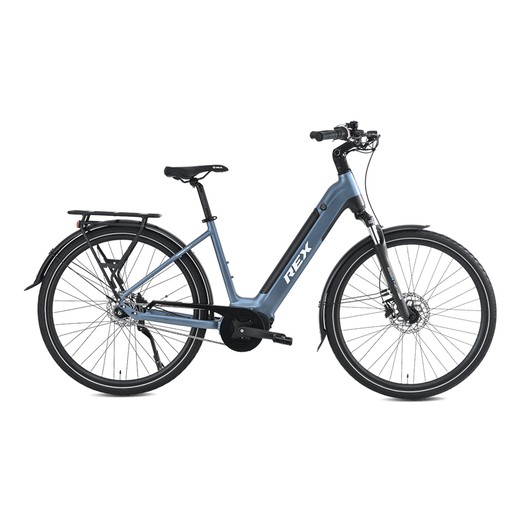
What makes it stand out: The Rex Commuter+ is positioned as a classic commuter bike with robust components. The Ananda M60 mid-drive motor delivers 70 Nm of torque, making it easier to tackle inclines. The combination of a Wave frame for easy mounting and dismounting and hydraulic disc brakes from Shimano makes it a reliable companion for daily use.
Pros:
Who it's for: This model is designed for riders looking for a comfortable and powerful e-bike for the city and light tours. It is particularly suitable for commuters who value an upright riding posture, proven components, and a strong drive system.

What makes it stand out: The ENGWE T14 is an ultra-compact mini e-bike designed for maximum portability. With its 14-inch tires and simple folding mechanism, it can be effortlessly taken on public transport or stored in the office. The 48V 10Ah battery powers the 250W motor and offers a range designed for short trips.
Pros:
Who it's for: Ideal for urban commuters who need a flexible solution for short to medium distances and have limited storage space. It's a practical addition for anyone looking to optimize their mobility in the city.
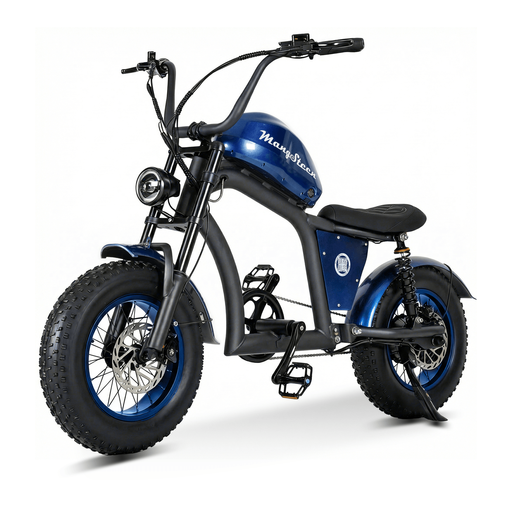
What makes it stand out: The Mangosteen FT02 Mini combines the concept of a mini e-bike with the features of a true all-terrain e-bike. The 16 x 4.0-inch wide tires and suspension system allow for rides on a wide variety of surfaces. Particularly noteworthy is the powerful 48V 22.5Ah battery, which, according to the manufacturer, enables a range of up to 100 km, offering an exceptionally long range in its class.
Pros:
Who it's for: This model is aimed at style-conscious riders looking for a versatile e-bike for the city and off-road. It is the right choice for anyone who appreciates a distinctive look, very high battery performance, and the ability to ride off the beaten path.
If the models presented don't exactly match your needs, or if you'd like to compare other color variants and features, you can find a wider selection in our category.
? Discover more blue electric bikes and similar models here
The wide tires of a city fat bike act as a natural suspension. They absorb shocks from cobblestones, potholes, or curbs, thus increasing riding comfort. They also offer a larger contact patch, which enhances stability, for example, when crossing tram tracks. The downside can be slightly higher rolling resistance on smooth asphalt.
The range stated by the manufacturer is a theoretical value determined under ideal conditions. In practice, the actual range is influenced by several factors: the total weight (rider + luggage), the route profile (inclines), the selected motor assistance level, tire pressure, outside temperature, and starting behavior.
Yes. E-bikes classified as Pedelecs (Pedal Electric Cycle) are legally considered bicycles in Germany and many other regions. The requirements are: the motor has a maximum rated continuous power of 250 watts, the pedal assist cuts off at a speed of 25 km/h, and the motor only serves to assist while pedaling (a start-up assist up to 6 km/h is permitted). Models that meet these criteria do not require insurance, a license plate, or a driver's license.