What should you look for when reading in daylight?
The key question is whether your essays are mainly reflowable text or fixed-layout PDF pages. Where your files come from and whether they have copy protection can also affect your choice of device.
| What matters to you |
What to check before buying |
Who it matters most to |
| Comfortable reading of flowing text |
Screen size and dimensions; adjustable typeface and font size |
If I mainly read essays as reflowable text outdoors, a portable device matters more to me than colour or a large PDF view. Around 33% of consumers prioritise comfortable reading of reflowable text. |
| Fixed-layout PDFs |
Open a typical page with a table, footnotes and illustrations; check zoom and landscape mode |
If my essays are PDFs with tables or small labels, I want to take in the page without repeatedly zooming and scrolling. Around 33% of consumers prioritise the readability of fixed-layout PDFs. |
| Colour and annotations |
Check fine labels in one of your own graphics; check the annotation features and accessories you need |
If the colours in an illustration convey information, or I want to make notes directly on the device, how my files are displayed and the available features matter. Around 17% of consumers prioritise colour graphics or annotations. |
| Library and file access |
Check the source, format, DRM, library system, device model and software version |
If I borrow essays or already have my own files, the specific transfer method needs to work with the device and its copy protection. Around 17% of consumers prioritise access to files and library e-books. |
E-readers and E-Paper devices at Joybuy
The selection includes a colour e-reader and a larger E-Paper note-taking device for reading and handwritten notes.
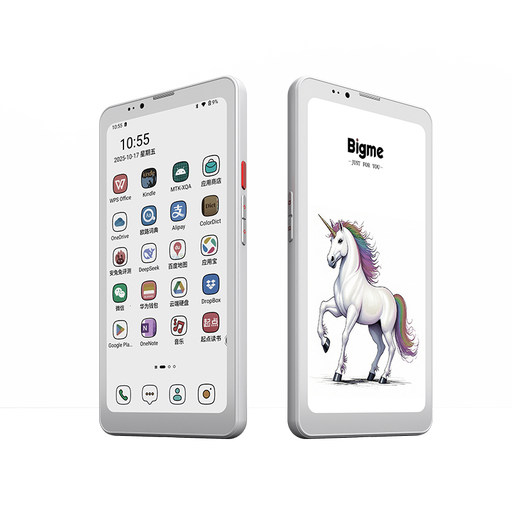 Image unavailable
Bigme HiBreak Pro Color Display, 6.13 inches
Worth considering for colour illustrations in bright daylight; the product description says the E-Paper screen is suitable for use in direct sunlight.
6.13-inch E-Ink colour display; the description lists Kaleido 3, with 300 ppi for black-and-white content and 150 ppi for colour content.
View at Joybuy
 Image unavailable
iFLYTEK AINOTE 2, 10.65 inches
Could be a good option for longer texts and handwritten notes; the product description says you can read and write in typical outdoor lighting.
10.65-inch E-Ink tablet with handwritten notes and handwriting-to-text functionality, according to the product name and description. The screen has no front light.
View at Joybuy
Frequently asked questions
Does an e-reader need a front light for reading in bright daylight?
No, a front light isn’t essential in bright daylight. The BOOX Go-10.3-(Gen-II) range includes a version without a front light and the Lumi version with an adjustable front light. If you also read in low light, check the specific model.
Can I adjust and annotate an academic PDF essay in the same way as an EPUB?
Not necessarily. Kobo’s PDF help pages describe zoom and landscape mode, but also note limitations on changing font size, selecting text and highlighting. Other devices may offer different features, so test your file and the annotations you actually need.
Does the German Onleihe work on every EPUB-compatible reader?
No. The Onleihe compatibility guide from divibib, updated in June 2026, excludes Kindle e-readers from protected Onleihe e-books. For certain tolino models, it lists direct access from software version 5.15.253009, and for PocketBook from version 6.3. Also check which Onleihe system your library uses.
How can I check whether my own essays will work on the device?
Check the file format and copy protection for the specific model and the transfer method you plan to use. For borrowed or protected files, a general PDF or EPUB listing isn’t enough; check the requirements with your library and the device’s software version.
Is a colour display useful for academic illustrations?
It’s useful when colours distinguish information in your graphics. The tolino vision color specifications list 300 ppi for black-and-white content and 150 ppi for colour content, so check fine labels on one of your own illustrations.


