For dense, fixed-layout PDF reports, a larger E Ink display is a sensible starting point if footnotes and seeing the page as a whole matter more than compact size. E Ink describes its technology as using ambient light, but what matters is whether you can read your own pages comfortably outdoors. If colour plans, handwritten annotations or easy portability are your priorities, weigh up those needs accordingly and test the file workflow with one of your own PDFs.
Which reader is right for you?
Readers of detailed excavation reports
If you read fixed-layout PDF pages with footnotes, scans or plans outdoors, check the full-page view, zoom and navigation using a typical page. Kobo Help documents PDF zoom on Kobo readers; when you zoom in, you can only see part of the page at a time.
Researchers who make handwritten notes
If you make notes in the margins alongside your findings, the stylus, file permissions, and import and export options need to fit your workflow. Kobo Help sets out the conditions for annotating and exporting unprotected PDFs.
Readers of colour plans
If colours in maps or legends are important, check fine labels and similar shades directly in your report. Manufacturers' claims about colour reproduction do not tell you how every plan will look on a particular display.
What should you look for when buying?
Start by opening a typical report page in bright daylight and checking whether you can read the whole page at once. Then compare colour, note-taking features and file access using the specific files you work with.
| Consideration |
What to check before buying |
Who is it important to? |
| Readability of fixed-layout PDF pages |
Test a full page with footnotes, as well as zoom and navigation. |
If I need to take in footnotes and the page as a whole at the same time, the right page view is crucial. Around 29% of consumers put the readability of dense PDF pages first. |
| Reading in daylight |
Compare a bright page and a low-contrast page where you plan to read. |
If I read reports outdoors, I want to make out fine lines and text without distracting reflections. Around 23% of consumers put display visibility in bright daylight first. |
| Handwritten notes |
Try importing a PDF of your own, adding a note in the margin and exporting it again. |
If I want to mark up findings directly in a report and use them afterwards, the file and workflow need to work together. Around 18% of consumers prioritise handwritten annotations and sharing them. |
| Colour plans |
Check a plan, including its legend and small labels, on the colour display. |
If colour differences are the only way to interpret coloured findings, I need to be able to see those differences in my own document. Around 12% of consumers put colour-coded plans first. |
| Portability and your own files |
Match the display size and weight to the PDFs and EPUB files you use; check how files are transferred. |
If I carry my reader around often and want to open my own files, its size and a suitable file-transfer method matter. Around 18% of consumers prioritise portability and access to their files. |
Common misconceptions
-
“PDF-compatible” does not automatically mean report pages are comfortable to read
With fixed-layout PDFs, you cannot adjust the text size freely as you can with reflowable books. When you zoom in, you can only see part of the page at a time.
Test a typical page with footnotes and a challenging plan in both full-page view and zoom.
Frequent zooming and panning can take extra time while you read.
-
A stylus included in the box does not guarantee unrestricted PDF annotation
Copy protection, annotation restrictions and the import method can all affect whether you can write directly on a PDF and use your notes afterwards.
Check permissions, import and export using a file you actually work with.
An unsuitable transfer method can mean extra work moving files back and forth.
-
Colour or a larger display cannot make up for a poor-quality scan
A display can show the information already in a document, but it cannot restore details missing from the original. Colour alone does not tell you whether fine labels and similar shades will be distinguishable in your own plan.
Check the original file and compare the areas that matter on the devices you are considering.
Key brands to consider
Kobo
The Elipsa 2E is a large-format black-and-white option for report PDFs and handwritten notes.
- Kobo Help documents PDF zoom, as well as annotation and export for eligible, unprotected PDFs.
- Protected PDFs or files that restrict annotations cannot be marked up in the same way. PDF text cannot be resized like text in a reflowable book.
PocketBook
The InkPad One is a large-format black-and-white option for your own documents and handwritten notes.
- The manufacturer's German-language specification sheet lists a 10.3-inch display and an active stylus included in the box.
- These details do not show how readable a particular plan scan will be or whether every PDF supports the export you need.
Kindle
The Kindle Scribe, 2024 model, is a black-and-white option with a large display and a stylus.
- When choosing, consider whether the documented PDF import method fits your workflow.
- Check in advance that direct writing works with the intended import method and the specific files you use.
BOOX
The Note Air5 C is a colour E Ink option for reports with maps, legends and notes.
- The manufacturer lists a 10.3-inch Kaleido 3 colour display, Android 15 and stylus support.
- Check fine labels and shades in your own PDF; the manufacturer's specifications do not show how every detail in a report will look.
reMarkable
The Paper Pro combines a larger colour display with PDF reading and handwritten annotations.
- The manufacturer lists an 11.8-inch colour display and a reading light; PDF and EPUB import are documented.
- For web and USB transfers, the manufacturer specifies a file size limit of 100 MB. The display size and file workflow should suit both how you carry it and the files you use.
tolino
The epos 3 is a more portable option for reflowable text and less complex report PDFs.
- tolino documents an 8-inch display and support for viewing EPUB and PDF files.
- PDF support alone does not guarantee a comfortable full-page view of small footnotes or a stylus for margin notes.
E Ink devices at Joybuy
This Joybuy selection includes E Ink devices for reading in daylight, handwritten work and colour displays.
 No image available
iFLYTEK AINOTE 2, 10.65-inch E Ink tablet with protective case
Worth considering for E Ink reading and handwritten work; test the note-taking and file workflow with one of your own reports.
10.65 inches; E Ink; protective case specified in the product name.
View at Joybuy
 No image available
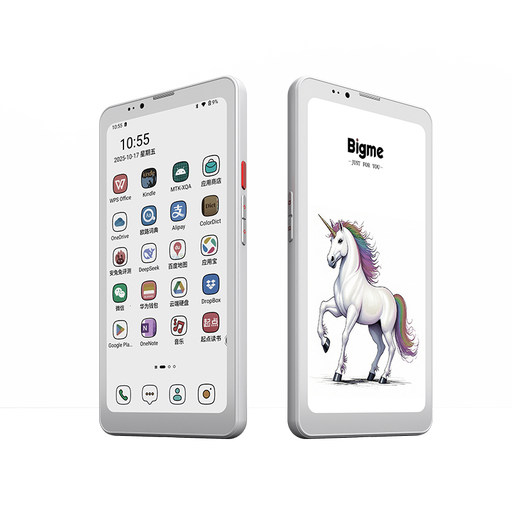
Bigme HiBreak Pro Color Display, 6.13 inches
The colour display may be useful for colour-coded plans; check whether the 6.13-inch screen shows your labels clearly enough.
E Ink reader with colour display; Android 14; 8GB+256GB.
View at Joybuy
 No image available
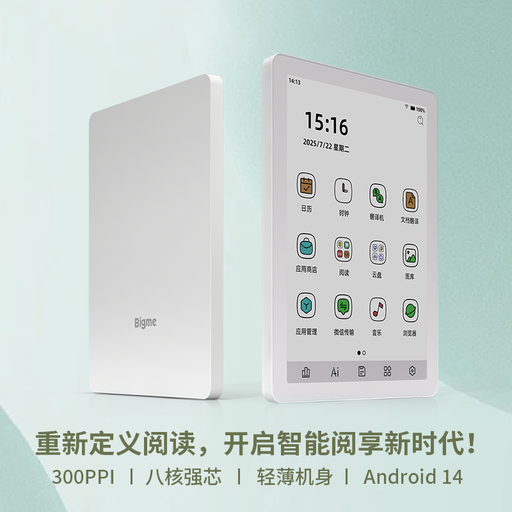
Bigme E-Book Reader B6, 6 inches, white
This compact size is worth considering for reading on the go and reflowable text; check that a typical fixed-layout PDF page is still easy to read.
E Ink; 36-level front light; Android 14; 4+64GB.
View at Joybuy
Frequently asked questions
Can I search for text in a scanned report and easily enlarge the font?
Not necessarily: a scanned image needs optical character recognition (OCR) before its text can be searched. You cannot adjust the font in a fixed-layout PDF as you can in a reflowable book. Check whether your report contains searchable text; if not, try zooming in.
How do I get my own report PDFs onto the reader and my notes back off it?
It depends on the device and the file. Kobo Help describes transferring unprotected PDFs from a computer and exporting annotated, unprotected PDFs. Other devices may have different import methods and transfer options. Test importing and exporting with one of your own files.
What are your rights when buying an e-reader online in Germany?
Consumers generally have a statutory right to cancel distance-selling contracts; section 355 of the German Civil Code (BGB) specifies a 14-day period. The Federal Ministry of Justice and Consumer Protection and the Federal Office of Justice also list exceptions under section 312g of the BGB. The Verbraucherzentrale distinguishes statutory consumer rights from a voluntary guarantee.
Can you put a worn-out e-reader in household rubbish in Germany?
No. The German Environment Agency says that waste electrical equipment must be collected separately. Depending on the circumstances, you may be able to use a local collection point or return it to a retailer. Removable batteries should be disposed of separately where possible.


