
Lieferung heute & morgen

Qualitätsgarantie

Willkommens-Angebote freischalten: KOSTENLOSE Lieferung | Bis zu 80 % RABATT | Kostenlose 30-Tage-JoyPlus-Testphase
App herunterladen
An e-scooter for adults needs to perform reliably in everyday life: on the way to work, when switching to bus and train, or on a longer leisure ride. However, product descriptions often focus on high ranges, powerful motors and top speeds. For choosing a model in Germany, other questions are just as important: Is the model approved for public roads? Does the weight suit daily transport? How do range, tyres and suspension perform in real-world conditions?
Figures like "up to 55 km" or "up to 100 km" usually refer to specific conditions. Load, inclines, temperature, tyre pressure, riding mode and surface all affect the actual distance you can achieve. If you're looking for an e-scooter for commuting, you should plan a reserve and not choose solely based on the highest range figure.
A powerful electric scooter may be suitable for private land or certain leisure routes, but it isn't necessarily allowed on public roads. For Germany, buyers should look for a valid General Operating Permit (ABE) and the possibility of the required insurance. A mention of a technical certification such as EN 17128 does not automatically replace a German road approval.
A foldable e-scooter with 10- or 11-inch tyres and suspension can offer more comfort on uneven paths. However, it is usually heavier and bulkier than a compact model with 8.5-inch tyres. Before buying, consider stairs, the boot, storage space and transport on public transport.
An e-scooter with road approval must meet the requirements that apply in Germany. These include, among other things, a suitable design, lighting, brakes and a permitted maximum speed of 20 km/h. For an e-scooter with ABE, you should check the details of the operating permit, the insurance sticker and the permitted area of use in the product documentation.
Even a model with a higher technically possible speed cannot automatically be used accordingly in public traffic. What matters is which version is actually approved and registrable.
Battery capacity is often given in Wh (watt-hours) . A higher value can enable a greater range reserve under comparable conditions, but it often increases weight and charging time. For daily journeys, it's also relevant whether the battery is removable and whether a charging option is available at work or at home.
The range figure should be understood as a guide value. In cold temperatures, headwinds or frequent inclines, the range can be significantly lower.
An e-scooter with suspension can better absorb bumps from kerbs, cobblestones or poor cycle paths. Pneumatic tyres can offer rolling comfort, but require regular checks and can be damaged. Solid rubber or honeycomb tyres are lower maintenance and more puncture-resistant, but may transmit shocks more strongly to the handlebars.
For safety, the brakes, lighting and standing area are particularly important. If you frequently ride on downhill stretches, you should look for a reliable braking system with easily accessible controls.
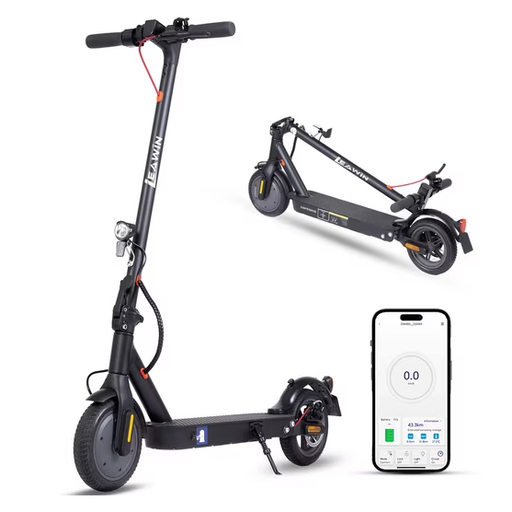
Why this product fits the profile: This model combines a stated weight of 12.5 kg with foldability, a top speed of 20 km/h and a range of up to 25–40 km. The product description mentions a German ABE and a maximum load of 120 kg.
The specifications separate the permitted speed from the misleadingly worded model name. ABE, lighting and brake equipment are explicitly listed.
350 W motor, 8.5-inch honeycomb tyres, E-ABS and disc brake; app connectivity and IP54 are also specified.
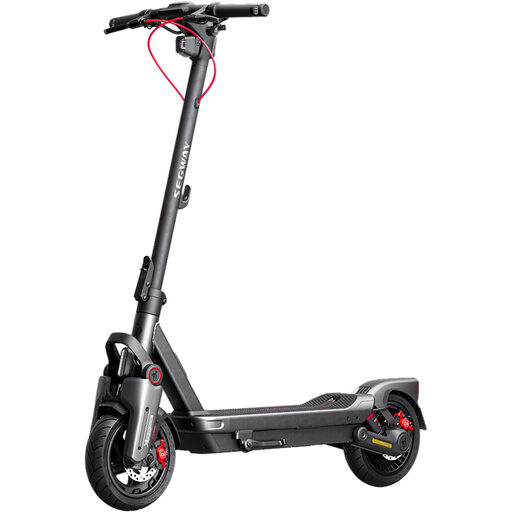
Why this product fits the profile: For long commutes, the focus is on a 597 Wh battery, up to 80 km in Eco mode, 11-inch tyres and hydraulic suspension. The stated maximum rider weight is 130 kg.
The product data lists separate values for Eco mode and top speed. This makes it easier to plan your daily route more realistically.
597 Wh battery, FlashCharge with a stated charging time of 3.5 hours, hydraulic suspension, disc brakes and IPX6.
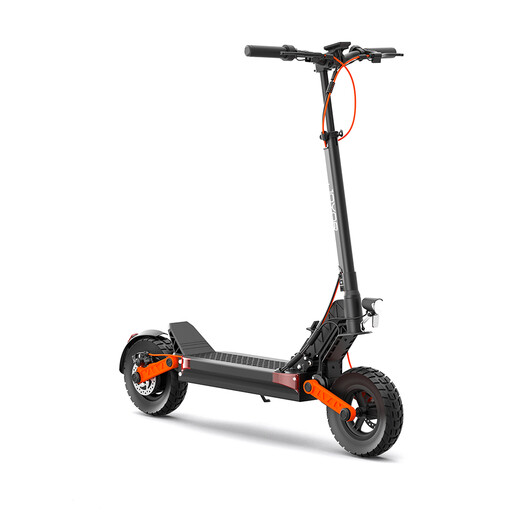
Why this product fits the profile: The combination of a 48 V battery, a stated range of up to 90 km and 10-inch off-road tyres is aimed at heavy users who also plan to ride on paved side roads or changing surfaces.
The tyre type and mechanical disc brakes are specifically stated. Before using on public roads, local approval must be checked separately.
26 Ah battery, foldable frame, 10-inch off-road tyres, front and rear mechanical disc brakes and NFC security features according to product specifications.
We have put together a complete, regularly updated list of products that fully meet these strict selection criteria and the safety regulations in force in the EU.
An approved e-scooter may generally reach a maximum of 20 km/h on public roads. Models with higher technical specifications may be subject to special usage restrictions and are not automatically approved for roads, cycle paths or other public areas.
The lifespan depends on factors such as charging cycles, temperature, storage and charge level. You should use the charger provided by the manufacturer. For storage, dry conditions and following the instruction manual are important.
In addition to electricity consumption, costs for the insurance sticker, wear parts and maintenance arise depending on the model. Tyres, brakes and, where applicable, inner tubes need to be checked or replaced. For an e-scooter with ABE, the annual insurance requirement should also be taken into account.