Hosts planning how many to buy
If you’re serving several people, knowing the number of guests, how many rolls you need and how many come in a pack will help you shop for the amount you’re likely to need.


Fresh rolls are a good choice for Easter breakfast if you want them on the table without any oven time and would like to buy the exact number you need. Bake-at-home rolls are an option if you can fit the preparation in just before eating and choose a pack size to suit your guests. Whichever you choose, check the specific variety and its allergen information. With bake-at-home rolls, you’ll also need to allow for oven time and space on the baking tray.
If you’re serving several people, knowing the number of guests, how many rolls you need and how many come in a pack will help you shop for the amount you’re likely to need.
If you want to serve the rolls at a particular time, it’s especially important to choose between rolls that are ready to eat and bake-at-home rolls that need time in the oven.
If you have an allergy or intolerance, check the information for the specific rolls you’re buying. Read the packaging or ask for the latest allergen information when buying loose rolls.
First, work out how many rolls you need and when you want to serve them. Then you can decide which varieties to choose and which ingredients to check before buying.
| Criteria | What to check when buying | Who it matters to |
|---|---|---|
| Quantity needed | Work out how many guests you’re serving and how many rolls you want; check the pack size if buying packaged rolls. | If I’m having several guests, I want to plan for enough rolls without buying more than people are likely to eat. For around 36% of consumers, planning the quantity comes first. |
| Serving time | Choose between rolls that are ready to eat and bake-at-home rolls; if buying the latter, check the instructions and oven capacity. | If breakfast is at a set time, I need the rolls to be ready then without disrupting the kitchen routine. Around 29% of consumers put getting the serving time right first. |
| Ingredients and allergens | Read the latest information on the packaging or ask when buying loose rolls; check for warnings about possible cross-contact. | If I need to avoid certain ingredients, the information for each product determines what I can serve. This is a priority for around 21% of consumers. |
| Variety | Choose a staple variety and, if you like, add some alternatives; check the ingredients for each variety separately. | If my guests have different preferences, I want to offer a few extra varieties alongside a staple. For around 14% of consumers, choosing the varieties is the main consideration. |
Rolls can vary in size and recipe, so a pack with lots of rolls won’t necessarily be right for your breakfast.
Work out how many you need, then compare the pack size and type of roll together.
A name such as ‘multigrain’ doesn’t give you the full picture of the ingredients or possible traces. For example, EDEKA lists possible traces of milk, mustard, sesame and soya in one of its Toscana rolls.
Check the latest information for the specific product. If you’re buying loose rolls, ask about allergens before you buy.
Bake-at-home rolls need space on the baking tray and must be prepared according to the product instructions. EDEKA notes that the baking time for its Kaiser rolls depends on the type of oven.
Check in advance how many rolls will fit in your oven at once, and plan around the instructions on the pack.
A place to look for packaged bake-at-home rolls if you want to plan the number you need before Easter breakfast.
EDEKA provides product information on a range of wheat and bake-at-home rolls, which can help you compare ingredients and preparation instructions.
Its ‘Unser Brot’ own-brand bakery range is one option if you’d like to pick up rolls with the rest of your food shop.
ALDI Nord offers a selection of rolls from its in-store bakery counter, so you can choose individual varieties for breakfast.
A bakery option for choosing classic or hearty rolls individually.
A regional bakery offering speciality breads and rolls.
This selection includes two packs for Easter breakfast: Kaiser rolls if you want to plan the number you need, and a multigrain variety for a bit more choice. Remember to allow time to prepare both before serving.
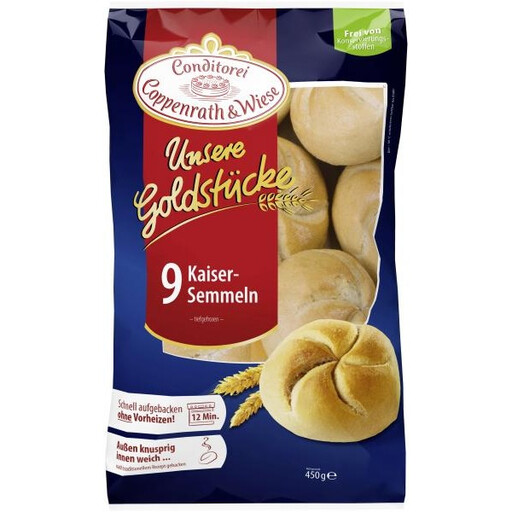 Image unavailable
The pack of nine Kaiser rolls makes it easy to plan how many you’ll need for your guests.
Follow the preparation instructions on the pack and check the latest ingredient and allergen information.
 Image unavailable
These multigrain rolls are an option if you’d like to add another variety to your Easter breakfast.
The pack contains 300 g. Check the pack for the number of rolls, as well as the preparation and allergen information, to make sure it’s right for your number of guests.
Start with the number of guests and how many rolls you’d like to serve. Then compare the pack size and size of similar rolls. If rolls are sold individually, you can choose exactly how many you need.
Bake-at-home rolls are a good choice if you can allow for oven time and space on the baking tray before breakfast. If you want to serve rolls without having to prepare them, freshly bought rolls are the simpler option.
Ask at the point of sale for the latest information about the specific variety. According to the Federal Ministry of Agriculture, Food and Regional Identity, the required allergen information must also be available for unpackaged food. Check the retailer’s advice about possible cross-contact too.
No. The variety name is no substitute for ingredient or allergen information. Check the latest labelling on packaged rolls and ask about loose rolls before choosing one for someone with an allergy.