Organisers keeping an eye on fat content
You’d like to add individually wrapped cereal bars to your Easter egg hunt and compare the fat content per 100 g, rather than relying on terms such as “light” or “zero”.


When choosing cereal bars for an Easter egg hunt, the fat content per 100 g is a more useful comparison than a “light” or “zero” label, provided you compare like with like. REWE and ALDI SÜD both list 9,4 g of fat per 100 g for CORNY free Schoko and CORNY Schoko light respectively; Schwartau Professional lists 10,6 g for CORNY Haferkraft Zero Kakao, while EDEKA lists 13,9 g for GUT&GÜNSTIG Schoko. These figures alone don’t show whether a bar can legitimately be described as “reduced fat”. Portion size and the allergens listed on the pack you buy also matter when planning how to hand them out.
You’d like to add individually wrapped cereal bars to your Easter egg hunt and compare the fat content per 100 g, rather than relying on terms such as “light” or “zero”.
If several children or families are taking part, check the ingredients and allergen information for every variety you buy before handing out the bars.
You need individually portioned bars that are easy to count and hand out. So, as well as the nutrition information, check the weight and number of bars in each pack.
Start by comparing the nutrition information per 100 g for similar cereal bars. Then consider the individual portions you want to hand out and whether the ingredients are suitable for everyone taking part.
| Criterion | What to check when buying | Who it matters to |
|---|---|---|
| Fat content | Fat per 100 g for similar cereal bars; if a product is labelled “reduced fat”, also check what it is being compared with. | If I want to choose bars with a lower fat content, I need a consistent basis for comparison. Around 37% of consumers would prioritise this criterion. |
| Ingredients and allergens | The ingredients list, highlighted allergens and, where relevant, may-contain warnings on the pack you buy. | If I’m handing bars out to a group, I need to check for ingredients that may not be suitable for everyone. Around 27% of consumers would prioritise this check. |
| Individual portions | The number and weight of the bars, and whether the packaging is suitable for hiding them. | For the hunt, I want to be able to count the portions and hide them safely. Around 18% of consumers would choose mainly on portion format. |
| Pack size and selection | Compare the pack contents and information for the specific variety available. | If I’m catering for several people, the pack I choose needs to suit how I plan to hand out the bars. This would be the main buying criterion for around 18% of consumers. |
These labels don’t necessarily refer to the same nutritional value. Schwartau Professional lists 0,4 g of sugar and 10,6 g of fat per 100 g for CORNY Haferkraft Zero Kakao; the sugar figure is no substitute for comparing fat content.
Check the fat content per 100 g. If a product claims to be reduced fat, also check what it is being compared with.
Cereal bars that look similar can have different ingredients and allergen information. EDEKA lists gluten-containing cereals, milk and peanuts among the ingredients in its GUT&GÜNSTIG Müsliriegel Schoko, as well as possible traces of other allergens.
Check the information on every pack you buy before hiding or handing out the bars. If you’re unsure whether a bar is suitable for someone taking part, check before the event.
A smaller bar may contain less fat per bar without having a lower fat content per 100 g. REWE sells CORNY free Schoko in a 6 × 20 g pack; EDEKA lists GUT&GÜNSTIG Schoko as 8 × 25 g.
Compare products using the figures per 100 g, then use the bar weight to plan your portion sizes.
The CORNY products considered here cover different cereal bar ranges and portion formats; the information applies to each specific variety listed.
EDEKA sells its Müsliriegel Schoko in a pack of 8 × 25 g, giving you a specific individual portion format to plan around.
The retailer stocks a range of fruit and cereal bars; for this selection, the information for each specific product is what matters.
These two CORNY varieties come in multi-bar packs, making them worth considering when planning how to hand out portions. When choosing by fat content and allergens, rely on the nutrition information and ingredients listed on each pack. “No Added Sugar” does not mean reduced fat.
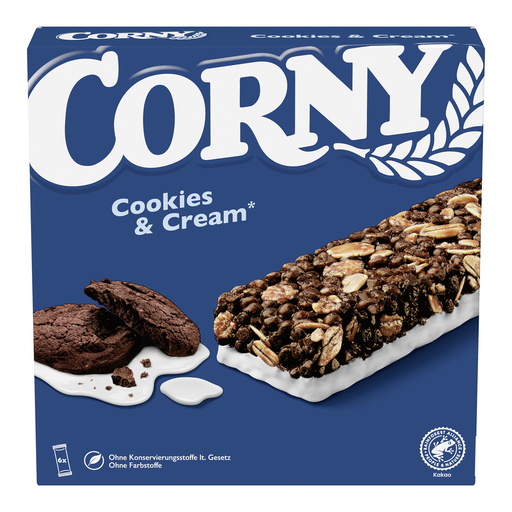 No image available
The product title states that the pack contains six 23 g bars, making it easy to plan how to hand them out. Compare the fat content per 100 g and check the ingredients and allergens on the pack you buy.
 No image available
The product title states that the pack contains six 20 g bars, which can be planned as individual portions for the hunt. Check the nutrition information and allergens on the specific pack; “No Added Sugar” in the name doesn’t indicate reduced fat.
Check which comparable product the reduced-fat claim is based on, and also look at the absolute fat content per 100 g. The German consumer advice centre recommends assessing nutrition claims alongside the nutrition information. A lower figure than that of another bar doesn’t, on its own, prove that the product makes a reduced-fat claim.
No. These terms alone don’t tell you the fat content. Schwartau Professional lists 0,4 g of sugar and 10,6 g of fat per 100 g for CORNY Haferkraft Zero Kakao. So compare the fat information separately and check what each claim refers to.
The ingredients list and allergen information on the bars you’re actually handing out are what matter. According to the Federal Ministry of Agriculture, Food and Regional Identity, the 14 most common causes of allergies and intolerances must be labelled. For each variety, also check for may-contain warnings in light of the needs of everyone taking part.
The Nutri-Score can help you compare products within a group, but it doesn’t replace the nutrition information or ingredients list. The German consumer advice centre considers comparisons most useful within the same product group or between products intended for the same purpose. For this Easter egg hunt, check fat per 100 g, portion size and allergens separately.