
Lieferung heute & morgen

Qualitätsgarantie

Willkommens-Angebote freischalten: KOSTENLOSE Lieferung | Bis zu 80 % RABATT | Kostenlose 30-Tage-JoyPlus-Testphase
App herunterladen
Choosing a new motorcycle helmet is a decision that directly impacts your safety and riding comfort. When searching for an ECE 22.06 modular helmet in particular, riders are faced with a plethora of options and marketing promises. However, not every advertised feature is useful in practice. This guide will help you avoid common purchasing pitfalls and identify the features that truly matter for touring riders, commuters, and those who wear glasses.
Before looking at specific models, it's important to understand the typical pitfalls that can lead to a poor purchase.
To make an informed decision, you should focus on three essential technical aspects. These define the safety, comfort, and everyday usability of a helmet.
The ECE R 22.06 standard is the current benchmark for motorcycle helmets in Europe and a non-negotiable criterion. Compared to the previous 22.05 standard, the testing procedure includes:
A helmet with this certification offers a demonstrably higher level of safety.
For touring riders and commuters, practical handling is crucial. A high-quality modular helmet with a dual visor combines comfort and safety.
The helmet shell is usually made of polycarbonate (ABS) or fibre composite materials (e.g., fibreglass, carbon). ABS helmets offer good value for money, while fibre composite helmets are often lighter for the same level of protection, which reduces neck strain on long tours. Regardless of the material, the correct fit is crucial. The helmet must sit firmly on your head without creating pressure points. Measure your head circumference at its widest point above the eyebrows to determine the right size.
Based on the criteria mentioned, we have identified some models that are suitable for specific user profiles.
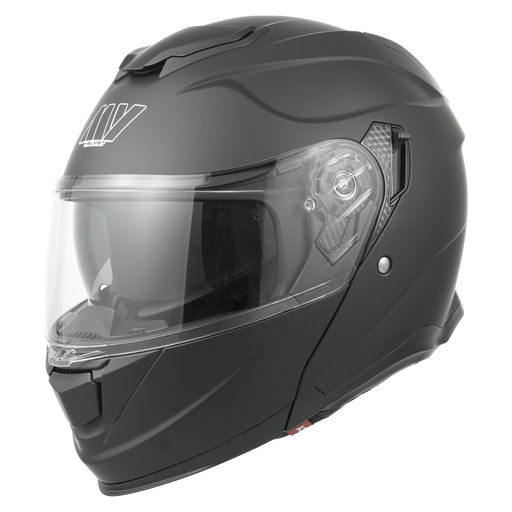
Why This Fits Their Persona: This model combines the most important features for the daily commute: certified safety, flexibility thanks to the flip-up mechanism, and comfort from the integrated sun visor. Ideal for city traffic and short overland journeys.
It meets the current ECE R 22.06 standard and has dedicated cutouts for easy retrofitting of a communication system, thus avoiding the "improper" Bluetooth-ready trap.
ABS outer shell with an EPS inner shell for shock absorption; removable and washable liner for easy hygiene.
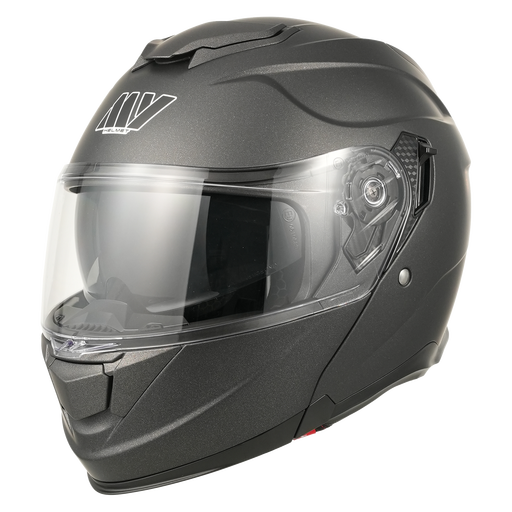
Why This Fits Their Persona: For long distances, comfort and adaptability are crucial. This touring helmet offers protection in changing light conditions with its dual visor, and the comfortable liner ensures a pleasant feel even after hours in the saddle.
The ECE 22.06 certification ensures that the helmet can withstand demanding rotational impact tests, a safety aspect that is particularly relevant on long tours at higher speeds.
The dual-visor system protects the eyes and, according to the manufacturer, blocks 99% of UV rays. The preparation for a Bluetooth headset simplifies the installation of navigation and communication devices.
Why This Fits Their Persona: The biggest advantage of a modular helmet for glasses wearers is the ability to put the helmet on and take it off without removing their glasses. This model's smooth mechanism makes the process quick and straightforward.
By focusing on a helmet with the modern ECE 22.06 standard, it ensures that the practical flip-up function does not come at the expense of structural integrity and safety—a common compromise in older or cheaper models.
The flip-up mechanism allows for easy fitting while wearing glasses. The inner lining is designed to accommodate the arms of the glasses without causing pressure points.
We have compiled a complete, real-time list of products that fully satisfy these strict selection criteria and UK safety regulations.
Measure your head circumference with a measuring tape at the widest point, about one centimetre above your eyebrows and ears. Compare this measurement with the manufacturer's size chart. The helmet should fit snugly and not rotate or wobble when you shake your head. Ideally, try the helmet on for a few minutes to ensure it doesn't create any pressure points.
An ECE 22.06 modular helmet must pass the same stringent impact tests as a full-face helmet of the same standard, both with the chin bar closed and open (provided it has P/J homologation). The critical factor for safety is the chin bar mechanism. On certified helmets, this is designed to remain closed during an impact, offering protection comparable to that of a full-face helmet.
This specification means that the helmet has integrated channels and cutouts in the inner lining and EPS shell. These are intended for mounting speakers (usually in the ear area) and a microphone. You must purchase the actual Bluetooth communication system separately. However, the preparation ensures that installation is possible without modifying the helmet and that comfort is not compromised.