
Lieferung heute & morgen

Qualitätsgarantie

Willkommens-Angebote freischalten: KOSTENLOSE Lieferung | Bis zu 80 % RABATT | Kostenlose 30-Tage-JoyPlus-Testphase
App herunterladen
A good sun spray is more than just a summer accessory—it's an essential part of your daily skincare routine to protect your skin from UV radiation. But the market is flooded with products whose promises often create more confusion than clarity. From "water-resistant" to "tan-enhancing," many terms are poorly defined and can lead to poor purchasing decisions that compromise both your wallet and your skin's health.
As your Joybuy Product Recommendation Officer, I'll help you identify the crucial features and avoid the common pitfalls of buying sun spray. The goal is to find a product that offers reliable protection while fitting seamlessly into your lifestyle.
Before we dive into the selection criteria, let's look at the most common marketing traps that can lead to inadequate protection.
To make an informed decision, you should understand three core technical parameters that determine a sun spray's effectiveness.
The Sun Protection Factor (SPF) indicates how much longer you can be exposed to the sun with sunscreen before getting a sunburn, compared to without it. An SPF 30 sun spray filters about 97% of UVB rays, while an SPF 50 sun spray filters approximately 98%. The difference in protection is smaller than the numbers suggest. Far more important than an extremely high SPF is applying the correct amount and reapplying regularly. For daily use in the UK, SPF 30 is often sufficient, but for prolonged and intense sun exposure, for fair skin types, or on holiday, SPF 50 is a safer choice.
Effective sun protection must shield against both types of harmful UV radiation:
You can identify a product with broad-spectrum protection by the UVA logo (the letters UVA inside a circle) on the packaging. This guarantees that the UVA protection is at least one-third of the stated SPF. Products from the Asian market, like those from KOS?, often use the additional PA classification (PA+ to PA++++), which provides a very detailed measure of UVA protection.
The texture of a spray not only affects how it feels on the skin but also its suitability for different needs.
Here are some product recommendations tailored to specific user profiles and their requirements.
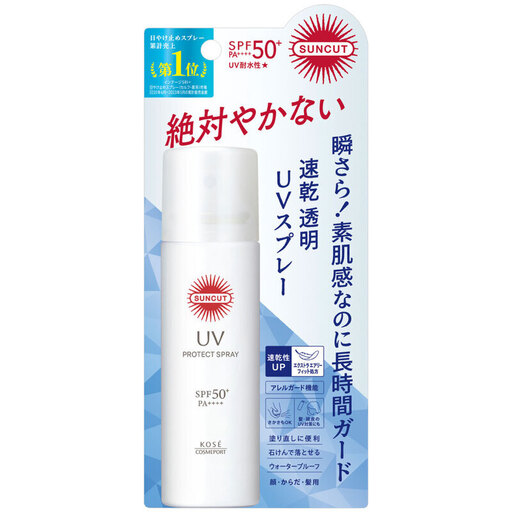
Why This Fits Their Persona: Ideal for those who need straightforward, high-performance protection for daily use. The transparent formula can even be applied over makeup without smudging, making it perfect for topping up protection throughout the day.
It bypasses the trap of uneven application from transparent sprays by using a fine mist that allows for easy, layered application to ensure full coverage.
Very high broad-spectrum protection (SPF 50+ and PA++++) in an ultra-light, non-sticky, and water-resistant formula.
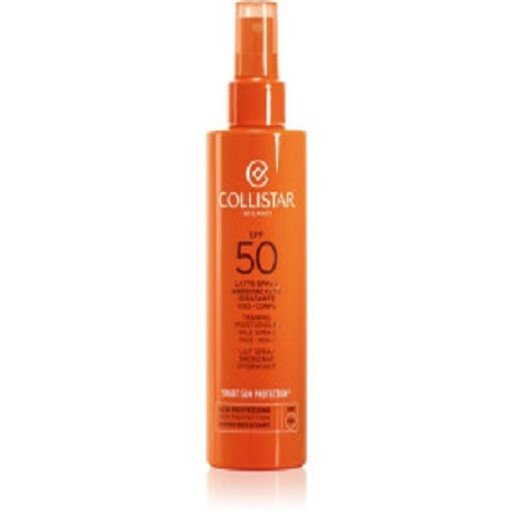
Why This Fits Their Persona: Perfect for those who want a deep tan without compromising on protection. The formula combines a high SPF 50 with moisturising properties and a complex designed to support the natural tanning process.
It debunks the "quick tan" myth by combining a high SPF 50 with a tan accelerator. This protects the skin while supporting the tanning process, rather than neglecting protection.
Combines high UVA/UVB protection with the Unipertan complex to intensify tanning and provides 24-hour moisture, according to the manufacturer.
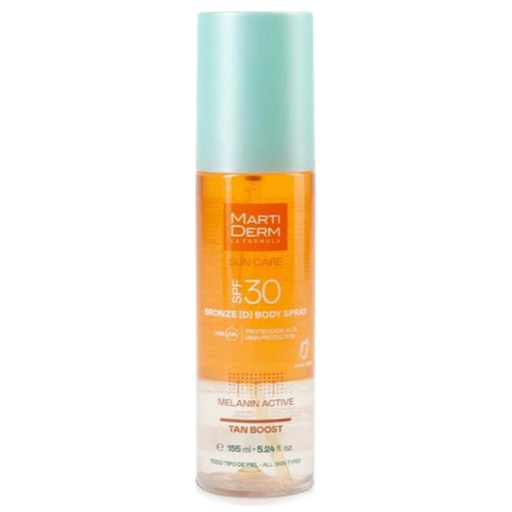
Why This Fits Their Persona: This spray is a great choice for beachgoers and water sports enthusiasts who care about protecting marine ecosystems. The formula, designated as reef-safe, is suitable for all skin types and offers solid protection for sunny days.
It addresses the growing concern about environmentally harmful ingredients in sunscreens by explicitly avoiding filters that are harmful to corals, thus enabling a conscious purchasing decision.
Reef-safe formula with broad-spectrum SPF 30 protection. The lightweight texture absorbs quickly and is suitable for all skin types.
We have compiled a complete, up-to-date list of products that fully meet these strict selection criteria and UK safety regulations.
1. How much sun spray do I need to use to achieve the stated SPF? The official recommendation for lotions is about 2 mg per square centimetre of skin, which amounts to about 30-40 ml for an adult's entire body. This is difficult to measure with a spray. A good rule of thumb is to spray a visible, glossy layer onto the skin and then rub it in thoroughly. Spray until the skin is well-covered and repeat the process as needed.
2. Can I still use sun spray from last year? Check the packaging for the Period After Opening (PAO) symbol, which looks like an open jar. It indicates how many months the product is good for after opening, usually 12M. If the product is older, or has changed in colour, smell, or consistency, you should discard it. The UV filters can lose their effectiveness.
3. Is a sun spray suitable for the face? Some sprays are formulated for both face and body. However, never spray the product directly onto your face to avoid inhalation or contact with your eyes. Spray a sufficient amount into your palms and then carefully apply it to your face, avoiding the eye area.