
Lieferung heute & morgen

Qualitätsgarantie

Willkommens-Angebote freischalten: KOSTENLOSE Lieferung | Bis zu 80 % RABATT | Kostenlose 30-Tage-JoyPlus-Testphase
App herunterladen
A reliable light source is an indispensable part of any Everyday Carry (EDC) setup. Whether you're finding a keyhole in the dark, dealing with a car breakdown after sunset, or working in poorly lit corners, a compact and powerful EDC flashlight provides safety and functionality. However, the market is flooded with models that vary widely in brightness, size, and features.
This article serves as an objective guide to help you understand the technical specifications and make an informed decision tailored to your specific needs. We will present a selection of models and explain the key criteria to consider when choosing the right EDC flashlight for daily use.
The right model depends on your individual use cases. Three key aspects should be considered: lighting modes, attachment options, and the power source.
Modern EDC flashlights often offer more than a single brightness level. Multiple modes significantly increase their versatility. Look for models with adjustable brightness levels (measured in lumens) to adapt the light intensity to any situation and optimize battery life. A low mode with just a few lumens is perfect for reading a map, while a high mode is used to illuminate larger areas.
A particularly useful feature is a flashlight with red light. Red light does not significantly disrupt the eyes' dark adaptation, making it ideal for night use, such as in astronomy, hunting, or to avoid blinding others in a tent or vehicle.
How a flashlight is carried and used is crucial for EDC purposes. A clip-on flashlight is especially practical in this regard. A sturdy, two-way clip allows you to attach it to a pocket, belt, cap brim, or backpack strap. This keeps the light always within reach and enables hands-free illumination.
Additionally, a flashlight with a magnet in its base increases flexibility. It can be attached to metallic surfaces like a car hood, a fuse box, or a steel beam, which is a significant advantage for tradespeople, technicians, and mechanics.
The power source determines the flashlight's operating costs and readiness. While models using standard batteries (e.g., AAA) are easy to power and well-suited for emergency kits, the rechargeable USB-C flashlight has become the standard for daily use.
An integrated battery with a USB-C charging port allows for easy recharging via a power bank, laptop, or wall adapter. This is not only cost-effective but also more environmentally friendly. Pay attention to the battery's capacity (measured in mAh) and the specified charging time to ensure maximum uptime.
Based on the criteria above, we have compiled a selection of models that stand out for their specific features, catering to different user profiles.
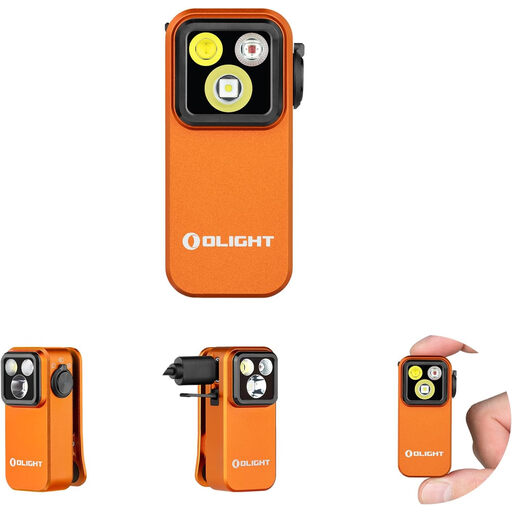
Why It Stands Out: The Olight Oclip Pro is a prime example of a multifunctional small, bright flashlight. It combines three light sources in one compact body: a floodlight for close-range illumination, a spotlight for distance, and a red light to preserve night vision.
Pros:
Who It's For: This model is aimed at EDC enthusiasts, tradespeople, and outdoor adventurers looking for a single, extremely versatile lighting solution for a wide range of scenarios—from close-up inspections to long-distance signalling.

Why It Stands Out: The iUltra redefines the keychain flashlight. Its minimalist design features magnetic activation—pull to turn on, dock to turn off—for quick, one-handed operation. The integrated USB-C plug makes charging cables obsolete.
Pros:
Who It's For: Ideal for users who need a discreet but always-available light source right on their keychain. Perfect for everyday tasks like finding items in a bag or lighting the path to the car.
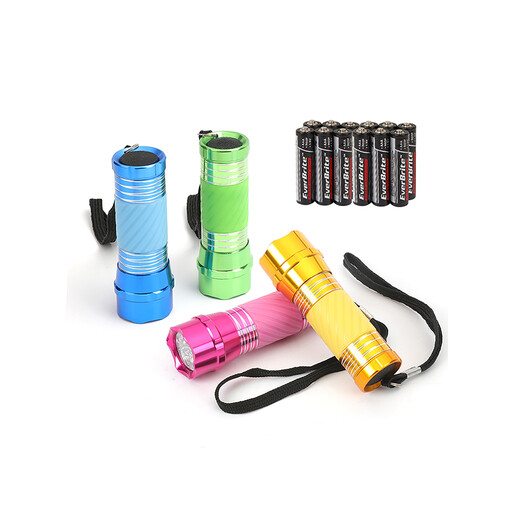
Why It Stands Out: This set from EverBrite focuses on simplicity, reliability, and excellent value for money. The 4-pack allows you to keep a light source in multiple strategic locations.
Pros:
Who It's For: For budget-conscious users and families looking for a simple and reliable lighting solution for various locations. Ideal as a backup light or for occasional use.
The models featured here cover a broad spectrum of use cases. However, if you haven't found the perfect product for your specific needs, many other specialized designs are available.
Explore our full range of compact lighting solutions, including specialized LED penlights, which are ideal for inspections and precision work.
Lumen (lm) is the physical unit for luminous flux, measuring the total quantity of visible light emitted by a source. A higher lumen count means greater brightness. For an EDC flashlight, 50–150 lumens are sufficient for general close-range tasks. Models with 300–500 lumens or more provide stronger illumination for greater distances or more demanding situations.
Yes, a flashlight with red light is very useful for many users. Red light has a longer wavelength that is less disruptive to the rods in the eye's retina, which are responsible for night vision. As a result, your eyes' natural dark adaptation is preserved. This is beneficial for astronomers, pilots, hunters, or campers who need to illuminate their surroundings at night without compromising their night vision.
The IP (Ingress Protection) rating indicates how well a device is protected against the intrusion of foreign objects (first digit) and water (second digit). For an EDC flashlight that is carried daily, water resistance is crucial. An IPX4 rating (protection against splashing water from all directions) is the minimum for use in the rain. IPX6 (protection against powerful water jets) or IPX8 (protection against continuous immersion in water) offer even greater reliability under harsh conditions.