
Lieferung heute & morgen

Qualitätsgarantie

Willkommens-Angebote freischalten: KOSTENLOSE Lieferung | Bis zu 80 % RABATT | Kostenlose 30-Tage-JoyPlus-Testphase
App herunterladen
There is a wide choice of educational games for children: brainteasers, puzzles, magnetic games, construction sets and classic board games all promise entertainment alongside educational value. In practice, however, not every game suits a child’s age, attention span or intended setting. If you focus only on colourful packaging or the number of pieces, you can quickly end up with a product that sits unused after a short time.
128 building blocks or 120 magnetic elements may sound impressive. What matters, though, is whether there are clear instructions, suitable challenges and enough space to play. Young children can become overwhelmed by too many individual pieces. With magnetic toys, you should also pay particularly close attention to warnings about small parts and strong magnets.
A game for ages 3 and up is not automatically suitable for every three-year-old. Fine motor skills, language comprehension and frustration tolerance develop at different rates. A 24-piece puzzle may be suitable for beginners, while a complex logic game with several levels is more likely to appeal to older children. The manufacturer’s age recommendation should therefore be considered alongside the child’s stage of development.
Terms such as educational toy, Montessori toy or STEM toy initially describe an approach, not a uniform level of quality. More useful are clear details about the material, piece size, number of players, playing time, number of challenges and storage. Statements about educational benefits should be understood as product descriptions and should not suggest guaranteed developmental effects.
Educational toys for ages 3 and up generally work well when they feature clearly recognisable colours, simple matching tasks and manageable movements. A magnetic number maze or an age-appropriate puzzle for children can be used independently or together with an adult.
From around age 6, compact brain games for children, dice puzzles and multi-stage challenges become suitable options. From age 8, more complex board games for children involving time limits, strategy or deductive questions may be appropriate. Before buying, check:
For wooden toys, details about the material, smooth surfaces and the quality of the finish are important points of reference. Plastic parts should not have sharp edges. Products containing magnets require particular care: Strong magnets must not be swallowed. Damaged parts from which magnets could fall out should no longer be kept in a child’s room.
The warning ‘not suitable for children under 3 years’ often refers to small parts that could be swallowed. It does not replace adult supervision. Even with a game for ages 3 and up, close supervision may be advisable if there are many individual pieces.
Large construction toys need a level playing surface and reliable storage. For train journeys, restaurant visits or holidays, compact travel games for children with an integrated box are more practical. With puzzles, the dimensions and number of pieces should match the space available. A frame or puzzle mat makes it easier to get started and prevents the pieces from sliding around.
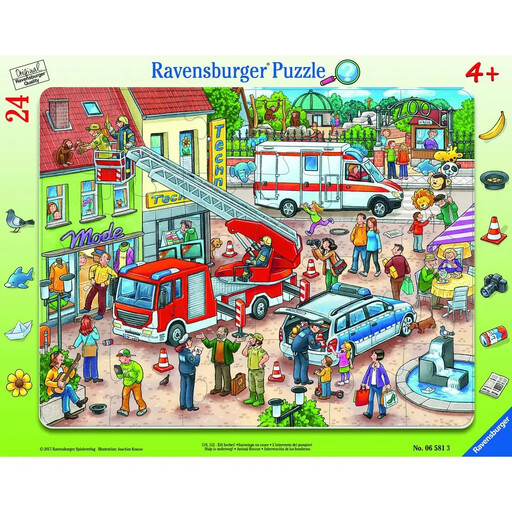
Why this product suits the profile: This frame puzzle is designed for children aged 4 and over. With 24 pieces, it offers a manageable introduction to puzzling.
The number of pieces and the frame are clearly stated. This makes it easier to assess the difficulty level before buying than with a purely general description of an educational toy.
24 puzzle pieces, frame base, an additional search game and no batteries required.
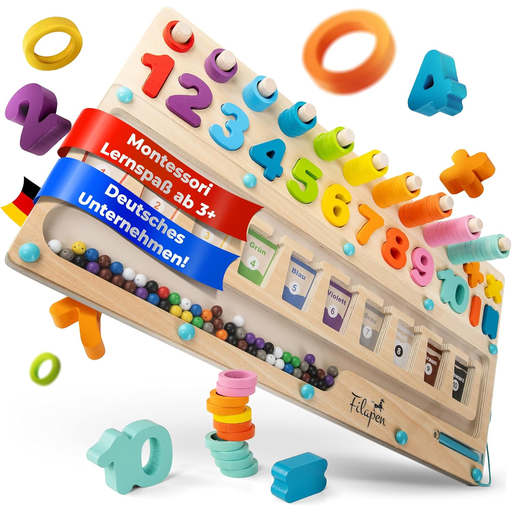
Why this product suits the profile: This wooden toy combines a magnetic maze, colour sorting and numbers from 1 to 10 in one product. The product details specify solid wood, dimensions of 23 × 43.5 × 4 cm and use from age 3.
Specific play tasks and material details make the product’s scope clear. The small-parts warning also highlights the need for supervision.
Wooden board, magnetic pen, colour matching and number peg tasks; no batteries required.
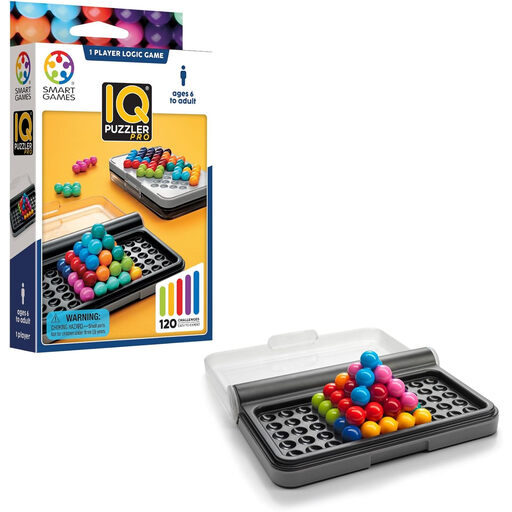
Why this product suits the profile: This compact solo game is suitable for children aged 6 and over and is ideal for taking on the go. It includes 120 challenges in 2D and 3D formats.
The number of challenges, recommended age, number of players and compact format are all clearly stated. This also makes it suitable as a travel game for children.
120 challenges, three game modes, 13 pieces and no batteries required.
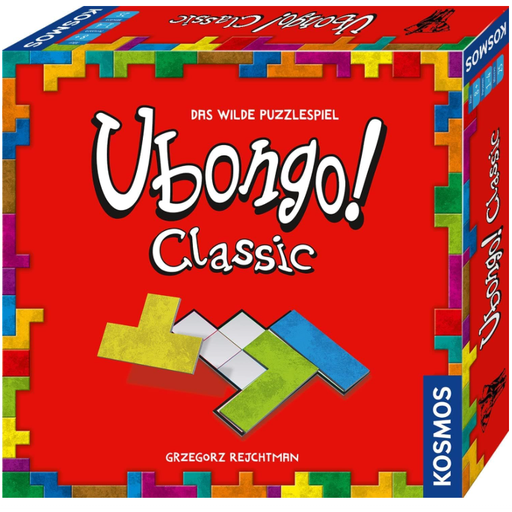
Why this product suits the profile: This board and puzzle game is designed for 1 to 4 players aged 8 and over. Two difficulty levels provide different challenges for the whole family.
The number of players, age recommendation and number of challenges are stated clearly. Buyers can therefore better judge whether the time pressure and competitive element suit their family.
648 challenges, two difficulty levels and simultaneous play for up to four people.
We have put together a complete, regularly updated list of products that fully meet these strict selection criteria and the safety regulations applicable in the EU.
Many products are designed for children aged 3 or 4 and over. However, small parts, understanding of the rules and the level of supervision required are also important factors. For younger children, manageable matching and puzzle games are suitable; complex logic and board games are often intended for ages 6 or 8 and over.
Lifespan depends on the material, storage and frequency of use. Cardboard and puzzle pieces should be stored in a dry place. Wooden and plastic parts should be checked regularly for cracks or loose components. With magnetic toys, checking for damage is particularly important.
Yes. Magnetic mazes, puzzles, construction sets and many board games work without a power supply. This makes them suitable for travelling and spontaneous play sessions. Electronic games such as Simon Classic, on the other hand, require batteries, but offer light and sound sequences as an integral part of the gameplay.