
Lieferung heute & morgen

Qualitätsgarantie

Willkommens-Angebote freischalten: KOSTENLOSE Lieferung | Bis zu 80 % RABATT | Kostenlose 30-Tage-JoyPlus-Testphase
App herunterladen
Educational learning toys for children should do more than simply keep them occupied. They should suit the abilities, interests and safety requirements of the relevant age group. However, choosing the right product is not always straightforward for parents, grandparents and other family members. Many products use terms such as “Montessori”, “early learning” or “sensory learning” without clearly explaining which features they actually offer.
Three common buying traps occur particularly often:
A considered choice should therefore begin not with the design, but with the child’s age, the construction, the materials and how practical the toy will be in everyday life.
For baby toys for children aged 6 months and over, grasping, touching, sliding and observing are the main activities. Suitable options for this age group include a motor skills toy made from a few large parts, a play gym or a simple sound toy.
With toys for children aged 1 year and over, sorting, stacking and simple matching tasks can be introduced. However, a sorting game with large shapes or a stacking game should still be checked regularly for loose parts, cracks and sharp edges.
Products containing small building blocks, marbles or strong magnets generally belong in the toys for children aged 3 years and over category or above. What matters is not just the advertised age group, but the complete warning information on the packaging and product page.
Look for:
According to the product information, several of the plastic products mentioned here are made from ABS plastic and described as BPA-free. This information comes from the respective manufacturer or retailer and should be checked against the labelling on the product. The same applies to CE and EN71 markings: they are useful points of reference, but they do not replace checking for visible damage and ensuring age-appropriate use.
A baby activity table is practical if your child enjoys trying out different elements while sitting or standing. For a smaller home, compact motor-skills cubes or a portable sensory toy are often easier to accommodate.
Electronic products often require batteries, which are not always included. You should also check the volume control, on/off switch and how easy the surfaces are to clean. With construction toys and magnetic building blocks, the size of the parts, the magnet warning and tidy storage are all important.
For shared playtime, board games for children with short, simple rules are also a good choice. They encourage children to follow straightforward sequences and take turns without requiring a long playing time.
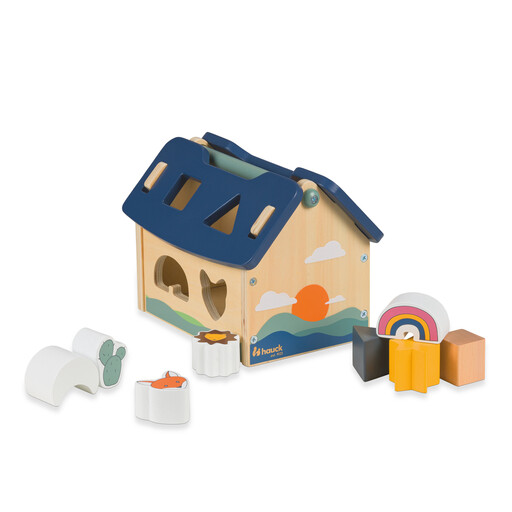
Why this product suits this profile: This wooden toy is designed for children aged 12 months and over. It combines shape and colour sorting with compact storage in the playhouse.
The play concept is clearly defined and does not require batteries or rely on light or sound effects. However, the warning about small parts must still be observed.
FSC-certified wood according to the product description, eight building blocks, a removable roof and a carry handle.
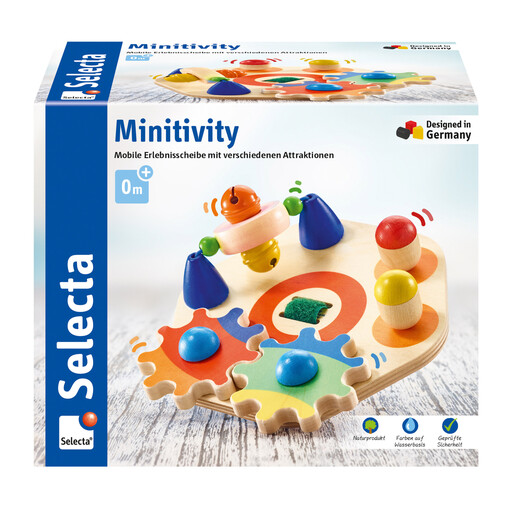
Why this product suits this profile: This compact motor-skills toy made from natural wood can be attached to a cot, playpen or pushchair, making it ideal for short play sessions during the day.
Instead of numerous electronic features, it offers three clearly recognisable play stations: gears, moving elements and bells.
Three play stations, 14 cm in size, natural wood and made in Germany according to the supplier.
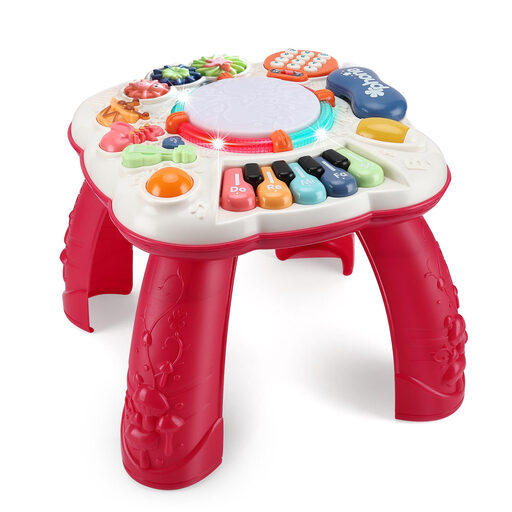
Why this product suits this profile: According to the product information, the 2-in-1 design can initially be used as a floor play panel and later fitted with legs to become a baby activity table.
The volume is adjustable according to the description, and a quiet mode is available. Before buying, check the battery type and the product’s stability in its intended location.
Six play areas, removable legs, ABS material according to the supplier, plus music and button functions.
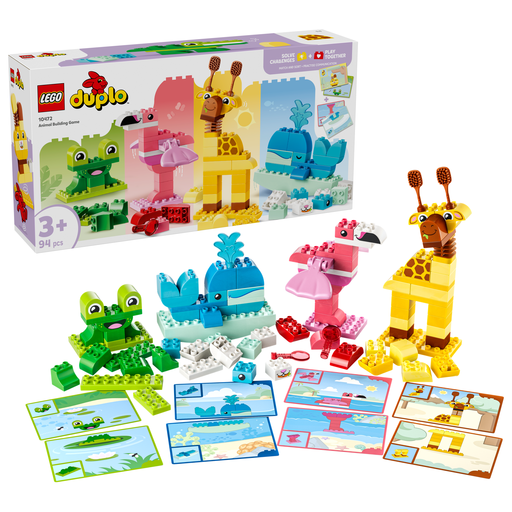
Why this product suits this profile: For children aged 3 and over, this set combines building, combining and shared play with 94 pieces and template cards.
The instruction cards provide a starting point, while the interchangeable animal combinations go beyond producing just one fixed result.
94 pieces, eight possible animal figures according to the description, and opportunities for comparing and combining creations together.
We have put together a complete, regularly updated list of products that fully meet these strict selection criteria and the safety regulations applicable in the EU.
For children aged 12 months and over, large sorting shapes, simple stacking games, motor-skills cubes and sturdy wooden toys are all suitable options. It is important to choose a few easy-to-grasp parts and use the toy under supervision. The specific warnings for the individual product take precedence over general age recommendations.
How long a toy remains useful depends more on the open-ended play concept than on the number of features. Construction toys, magnetic building blocks for ages 3 and over, and combinable building blocks can change over time as children experiment with new shapes and challenges. With electronic baby toys, adjustable volume is useful; the batteries and functions should also be checked regularly.
The price depends on factors including the material, number of pieces, brand and range of functions. A simple sorting game may be sufficient for beginners, while a comprehensive construction toy or activity table requires more space and budget. So do not compare only the purchase price; also consider what is included, the availability of replacement parts, cleaning requirements and the expected useful life.