
Lieferung heute & morgen

Qualitätsgarantie

Willkommens-Angebote freischalten: KOSTENLOSE Lieferung | Bis zu 80 % RABATT | Kostenlose 30-Tage-JoyPlus-Testphase
App herunterladen
By the Joybuy Product Recommendation Officer, July 21, 2026
The selection of toys for three-year-olds is vast. Parents and grandparents often face the challenge of finding a product that not only entertains but also specifically supports their child's development. A good educational toy fosters skills without overwhelming the child and, ideally, remains a companion for several years. This article provides guidance and presents a selection of educational toys tailored to the needs of children aged three and up.
Before you make a decision, a few criteria can help you identify the right toy for your child's developmental stage and interests.
A suitable educational toy should build on a child's current abilities while providing new stimuli. For preschoolers, toys that train specific skills are particularly relevant. For example, fine motor skills toys prepare children for preschool writing skills by practicing gripping, inserting, or guiding pens. Other toys focus on the first steps of learning letters and numbers by combining visual and tactile stimuli. Ensure the toy is versatile and covers different learning areas.
Safety comes first. In Germany and the EU, toys must bear the CE mark, which confirms that the product meets applicable safety requirements. Educationally valuable wooden toys are especially popular. They are robust, durable, and offer a pleasant tactile experience. Regardless of the material, you should look for non-toxic finishes and sturdy components, especially since children at this age still frequently explore their environment with their mouths.
Some of the most thoughtfully designed toys are based on clear educational concepts. Montessori toys for ages 3+ are designed so that children can learn independently and correct their own mistakes. Such toys promote concentration and independent problem-solving. A toy that "grows" with the child and offers various difficulty levels or play variations will remain interesting for longer and represents a sustainable purchase.
Based on the criteria above, we have compiled a selection of products that address various areas of development.
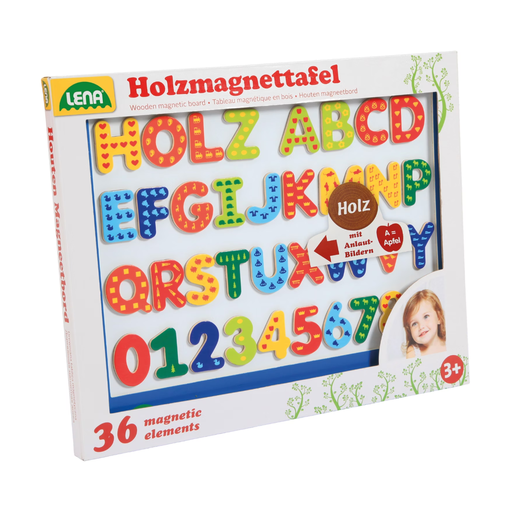
Why it stands out: This set combines a generously sized magnetic board with a complete set of letters and numbers. The letters feature initial sound pictures (e.g., A for Apple), which eases the introduction to the world of letters and creates a direct visual connection.
Benefits:
Who it's for: This set is ideal for children showing their first interest in letters and numbers. It serves as an excellent central learning tool in a child's room or playroom and supports preparation for preschool.
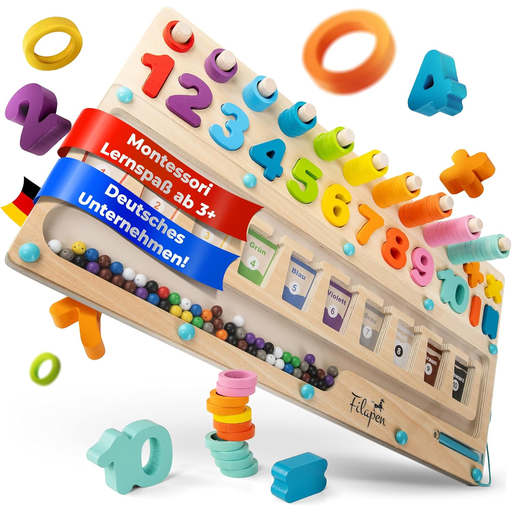
Why it stands out: This multifunctional wooden toy combines a magnetic maze for developing fine motor skills with tasks for colour and number recognition. The design follows Montessori principles and encourages independent discovery.
Benefits:
Who it's for: A perfect gift for children ages 3 and up who enjoy tactile and challenging tasks. It is specially designed for the targeted development of fine motor skills and early mathematical understanding.

Why it stands out: This comprehensive workbook offers a variety of activities for pre-writing and cognitive development on 48 wipe-clean pages. Its reusability makes it a sustainable companion for home and on the go.
Benefits:
Who it's for: Ideal for families looking for a structured, screen-free learning opportunity for home or on the go. It is excellent for school preparation and can also provide valuable support for children with special educational needs.
Haven't found the right toy for your child yet? There is a wide variety of educational learning sets that promote different skills and are tailored to various interests.
Discover our selection of Educational Learning Sets
1. What makes an educational toy "educationally valuable"? An educationally valuable toy challenges a child according to their age without being too easy or too difficult. It encourages active engagement, specifically promotes skills like logic, creativity, or fine motor skills, and is ideally open to different ways of playing. Materials like wood are often preferred as they are durable and stimulate sensory perception.
2. When are Montessori toys for ages 3+ appropriate? Toys based on Montessori principles are appropriate as soon as a child shows interest in independent and focused activities. Since these toys are often self-explanatory and self-correcting, they are excellent for three-year-olds to build concentration, independence, and practical skills.