
Lieferung heute & morgen

Qualitätsgarantie

Willkommens-Angebote freischalten: KOSTENLOSE Lieferung | Bis zu 80 % RABATT | Kostenlose 30-Tage-JoyPlus-Testphase
App herunterladen
Creative educational toys for children aged 3 and over should encourage independent play, be age-appropriate and get real use in everyday life. But with colourful product pictures, promises of STEM development and large sets to choose from, finding the right toy isn’t always easy. That’s why parents, grandparents and other family members need clear criteria to guide them: materials, safety information, piece size, ease of use and how the toy will be used.
A set with 145 pieces sounds impressive, but it won’t automatically suit every child. Lots of individual pieces can overwhelm younger children or be difficult to sort after playtime. For beginners, a more manageable set of 50 to 58 pieces may be a better choice. What matters is whether the shapes suit the child’s stage of development and the kinds of play they enjoy.
Magnetic building blocks for children need to connect securely to be practical. At the same time, the magnets must remain permanently enclosed within the pieces. Buyers should look for information confirming that the magnets are welded or fully sealed inside, and check the pieces regularly for cracks or loose components. Swallowed magnets can cause serious injuries. Products containing small parts should be kept away from children under three.
An LCD writing tablet for children isn’t a tablet computer with apps, storage or learning programmes. It’s designed for drawing, writing and occasional note-taking. Its advantage is that it’s easy to use without paper or pens. Before buying, parents should check whether it has an erase function, how large the drawing area is and whether it has a lock to prevent accidental erasing.
The ‘suitable from 3 years’ label is an important starting point, but it doesn’t replace the family’s own judgement. Small magnetic building blocks and balls can pose a choking risk. Even with age-appropriate products, adult supervision is advisable at first. After playtime, check for pieces that are damaged, cracked or loose.
Also look for clear safety warnings and information about relevant European requirements, such as EN 71 for toy safety. A claim such as ‘non-toxic’ shouldn’t be considered in isolation. It’s more helpful to look for specific material details, such as ABS plastic, information about how the product is made and details of the responsible person in the EU.
For magnetic building blocks, smooth, rounded edges and a robust connection between the two halves of each magnet are useful features. According to the product details, several of the models featured here are made from ABS plastic. The XINQIYUAN sets are also described as using ultrasonic welding to seal the magnets permanently inside. Check these details against the safety information provided for each product.
Lightweight products with a storage bag are handy for travelling, restaurant visits or waiting around. An LCD drawing tablet weighing around 0.18 to 0.21 kilograms is usually easier to carry than a large construction set. For building together at home, on the other hand, a set with 81, 117 or more pieces could be a better fit. Compact screens are fine for quick drawings, while 12 or 15 inches gives you more room for pictures and learning notes made together.

Why this product suits this profile: With 7.5 cm pieces and a storage bag, this set offers a manageable introduction to magnetic construction toys for children aged 3 and over.
The number of pieces is manageable. The product details state that it contains small parts and magnets, so the recommended supervision is particularly important.
58 pieces, a 7.5 cm format and a storage bag; the supplier says it has reinforced magnets and rounded ABS plastic edges.
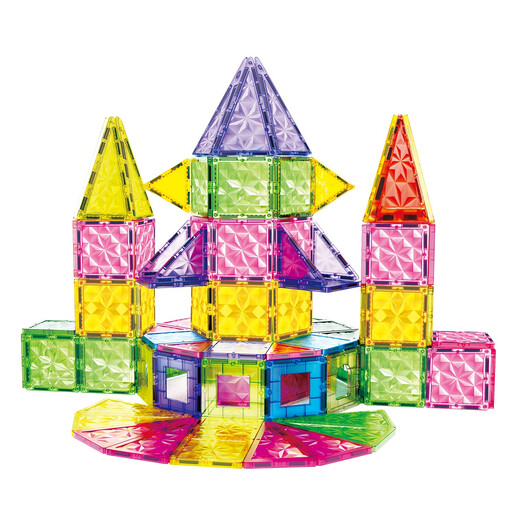
Why this product suits this profile: The wider choice of shapes is designed for children who already have experience with magnetic building blocks and want to create more elaborate structures.
The product details specify fully enclosed magnets, smooth edges and regular checks for damage.
117 pieces, a storage solution and, according to the product description, compatibility with standard 7.5 cm magnetic tiles.

Why this product suits this profile: The larger drawing area makes it a good choice for families who want a reusable drawing tablet for home, travel or learning notes.
According to the product details, the tablet needs no pens or paper and can be cleared at the touch of a button. It shouldn’t be mistaken for a digital tablet, though.
12-inch drawing area, weighs around 0.2 kilograms and features a one-button erase function, according to the product details.

Why this product suits this profile: Its lightweight design makes it a handy little educational toy to take on the go, as well as a birthday gift for nursery-age children.
At around 0.178 kilograms, its compact design is made for shorter drawing sessions, not extensive digital features.
According to the product details, it’s made from ABS plastic and has rounded edges, a reusable surface and a one-button erase function.
We’ve put together a complete, regularly updated list of products that meet these strict selection criteria and fully comply with the safety regulations in force in the EU.
Simple magnetic building blocks, large construction bricks or an LCD drawing tablet may be suitable. What matters is the specific age guidance, the size of the pieces and whether the child can follow safe-use rules. Adult supervision is advisable when magnets and small parts are involved.
How long it lasts depends on its construction and how it’s handled. An LCD drawing tablet that doesn’t use paper or pens can last for a long time if used properly. Before buying, check the casing material, the design of the edges, the erase mechanism and the cleaning instructions.
Magnetic building blocks can make a suitable gift if they’re right for the child’s age group and the magnets are securely enclosed. Children under three must be kept away because of the risk of swallowing the pieces. Don’t continue using the set if any pieces are damaged.