
Lieferung heute & morgen

Qualitätsgarantie

Willkommens-Angebote freischalten: KOSTENLOSE Lieferung | Bis zu 80 % RABATT | Kostenlose 30-Tage-JoyPlus-Testphase
App herunterladen
Educational toys for babies and toddlers should keep little ones engaged, be suitable for their age and support a range of skills. At the same time, the choice can feel overwhelming: glowing buttons, music and numerous features may look appealing, but they reveal little on their own about how practical a toy is for everyday use. For parents, grandparents and other relatives, it is therefore important to look for verifiable information – such as the recommended age, material quality, volume control and cleaning requirements.
A toy with lots of buttons and melodies can be engaging. However, if all the functions are activated with a single button or are poorly explained, the learning benefit remains limited. It is more useful to choose clearly distinguishable play areas that allow children to press, turn, sort or drum independently.
A product described as being for “babies and toddlers” will not necessarily suit every stage of development. A Montessori toy from 6 months should be designed differently from a children’s musical instrument for a three-year-old. Always check the specific age recommendation and consider whether the child can already sit, grasp, stand or sort objects purposefully.
Terms such as “non-toxic”, “BPA-free” or “CE-certified” should not be considered in isolation. Look for clear product labelling, manufacturer and importer details, as well as warning notices. For the plastic products mentioned here, compliance with CE and EN71 requirements according to the manufacturer’s information is stated. Even so, the products should be used in accordance with the instructions and under supervision when used by young children.
For babies from around six months, easily accessible elements are important. A toy designed for tummy time should stand or lie securely and should not contain small parts that can come loose easily. An activity table for babies with removable legs may be suitable for different playing positions, provided the child can sit or stand safely and the product cannot tip over.
From the age of one, children can start using peg puzzles, turning elements and sorting activities. An activity cube for toddlers is practical when several types of activity are needed in a compact space. For children aged three and over, larger musical toys with a microphone or several drum surfaces may be appealing.
For plastic toys, rounded edges, a smooth surface and a stable base are important points to check. Wooden toys should be neatly finished and free from sharp areas. The hauck wooden puzzle is described as being made from FSC-certified wood with a rounded design; direct adult supervision is also specified.
You should also look for:
Musical baby toys should offer volume control or a quiet mode. This is particularly useful in flats, when travelling and during quiet periods. Also check whether batteries are included. Several electronic products in this selection require batteries, which are not included.
For fabric toys, cleaning is crucial. According to the product information, the Sterntaler “Dino Rexi” musical soft toy has a removable mechanism and can then be washed. Mechanical musical boxes, on the other hand, do not require batteries, but only play one set melody.
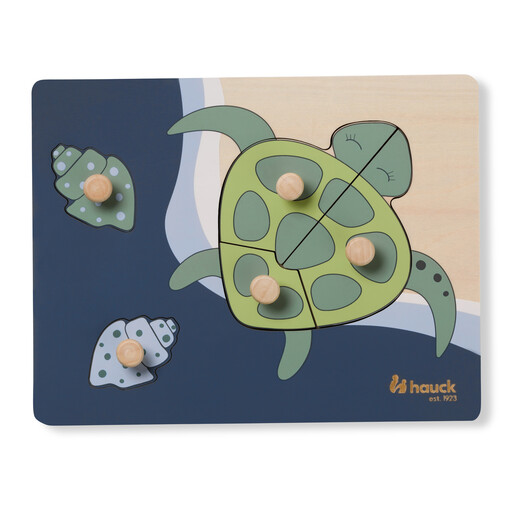
Why this product suits this profile: This wooden puzzle is designed for children aged 12 months and over, focusing on one manageable activity without batteries or noise.
The clear age recommendation, rounded design and adult supervision help prevent unsuitable purchases caused by overly demanding or confusing features.
FSC-certified wood according to the product description, wooden handles and a puzzle board with animal shapes.
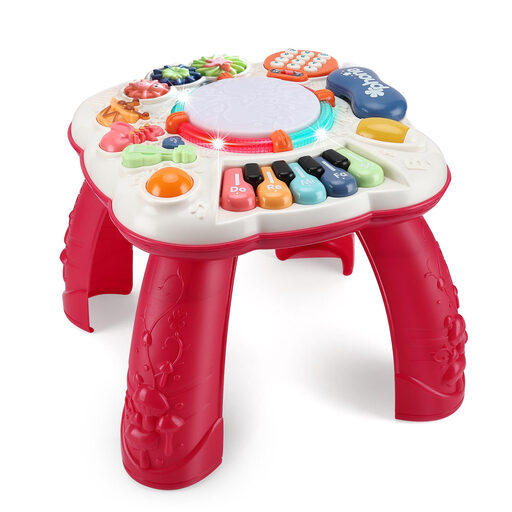
Why this product suits this profile: The 2-in-1 design can initially be used as a floor play panel and later with legs as an activity table.
Removable legs and the stated volume control address the common problems of using a toy too early and creating a constantly high level of noise.
Six play areas, a non-slip design according to the description and a quiet mode for use at home.

Why this product suits this profile: The compact cube is ideal for travelling, waiting times and smaller living spaces when several types of activity are needed.
The age recommendation, compact design and carry handle help avoid choosing a toy that is too large or introducing it too early.
Eight play modes with a piano, guitar, telephone function, gears and music in a space measuring approximately 23 × 23 × 24 cm.
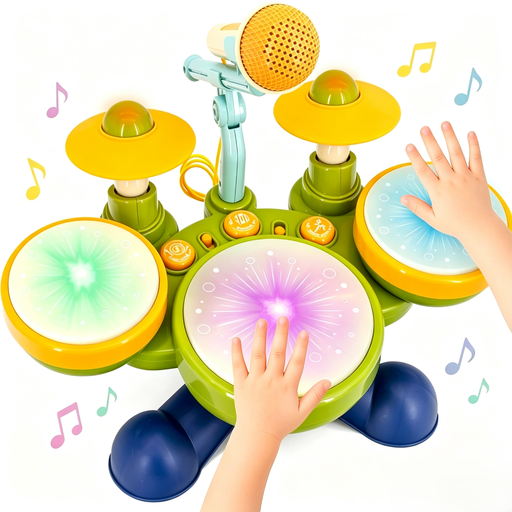
Why this product suits this profile: For children aged one to three who want to drum, sing and try out different play modes.
The volume control helps reduce the risk of consistently high volume, while the removable stand also allows for floor play.
Three light-up drums, two height-adjustable cymbals, a microphone and a stable four-point base according to the manufacturer’s information.
We have put together a complete, regularly updated list of products that fully meet these strict selection criteria and the safety regulations applicable in the EU.
A sensory toy delivers the greatest benefit when used together. Name colours and shapes, wait for the child’s response and let them discover cause and effect for themselves. With a baby drum, adults can demonstrate a simple rhythm without expecting a particular result.
When choosing a gift, you should also consider the space it requires, battery consumption and noise level. A small wooden puzzle is better suited to quiet play, while an activity table or children’s musical instrument requires more room to move around. The age recommendation remains the most important starting point, even when buying a birthday or Christmas present.
From six months, grasping, pressing and sorting elements may be suitable, provided the child can sit safely or play on their tummy. Large, firmly attached parts, rounded edges and a stable base are important criteria. Electronic functions should have easily accessible volume control.
How long a toy remains useful depends less on the number of features than on the child’s development. Adjustable or convertible products may remain suitable for longer. An activity cube or a table with both floor and standing functions offers different playing positions; a simple puzzle remains interesting when its difficulty matches the child’s stage of development.
Electronic educational toys usually involve the cost of batteries. Before buying, check which battery types are required and whether they are included. Mechanical musical boxes do not need batteries. With musical products, it is also worth checking the volume, quiet mode and whether the toy can be switched off when needed.