
Lieferung heute & morgen

Qualitätsgarantie

Willkommens-Angebote freischalten: KOSTENLOSE Lieferung | Bis zu 80 % RABATT | Kostenlose 30-Tage-JoyPlus-Testphase
App herunterladen
Educational toys for babies and toddlers should keep them engaged, spark their curiosity and encourage them to explore independently. At the same time, parents are faced with a huge choice of Montessori toys, motor-skills toys, sensory toys and electronic activity centres. However, not every product is right for your child’s stage of development, your home or your family’s safety needs.
Many products boast a wide range of play modes. But small parts, complex tasks or loud sound effects may not be suitable for a baby. What matters is not the number of features, but whether your child can grasp and understand them, and use them safely without becoming overwhelmed.
Check the manufacturer’s age recommendation and look out for warnings. An activity cube labelled for ages 1–3 is not automatically suitable for younger babies. A construction set for children aged 3 and over should also be kept out of infants’ reach.
Terms such as Montessori, sensory learning and STEM often describe a type of play, but they are not standardised quality marks. A wooden puzzle for children aged 1 and over can help develop shape recognition and hand-eye coordination. A baby activity table can also offer buttons, colours and sounds. Its actual benefits depend on whether its features are clearly designed and right for your child.
Rounded edges and BPA-free materials are useful things to know, but they do not replace checking the whole product. With magnetic building blocks, parents should pay particular attention to securely enclosed magnets, small parts and the specific age recommendation. If swallowed, magnets can cause serious injuries. Any damaged parts should therefore be removed from the play area straight away.
Small balls, marbles, loose magnets and accessories that can come off easily can be hazardous for children under 3. A wooden puzzle for children aged 1 and over should have easy-to-grip knobs, a sturdy base and shapes that are large enough. When buying educational toys for children aged 1 and over, it is also worth checking the product dimensions: toys that are too large or heavy are often used less in everyday life.
For plastic toys, smooth, rounded edges, sturdy joints and clear information about the materials are important. For wooden toys, details such as FSC-certified wood can indicate where the material comes from. However, this alone does not tell you everything about the finished product’s safety-related features.
The CE marking is a legally required conformity marking for many toys on the European market. It is not an independent award or a general quality mark. You should also check for warnings, manufacturer details and the name of the responsible party in the EU. The EN 71 series of standards covers toy safety requirements; check the relevant supplier information to confirm a product’s specific compliance.
For children’s musical instruments and electronic play centres, a volume control and an easy-to-reach off switch are useful. Several of the products featured do not include batteries. So check whether the battery type and compartment are suitable for your needs.
Cleaning is another everyday consideration: surfaces with lots of grooves can take longer to clean. Magnetic parts should generally be cleaned dry or with a suitable cloth, in line with the manufacturer’s instructions.
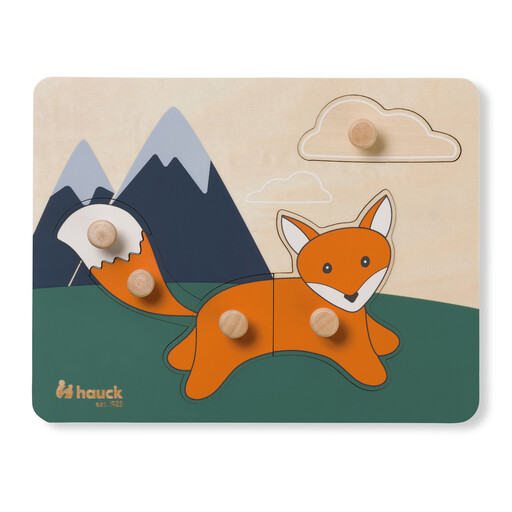
Why this product suits this family: This compact wooden puzzle offers a simple introduction to matching shapes and practising grip. It needs no batteries and is ideal for short play sessions.
The recommended age of 12 months and over, large wooden knobs and clearly limited number of pieces make it easier to assess than an overloaded multi-function toy.
FSC-certified wood according to the product information, rounded edges, measures 22 × 17 × 2 cm and requires no batteries.
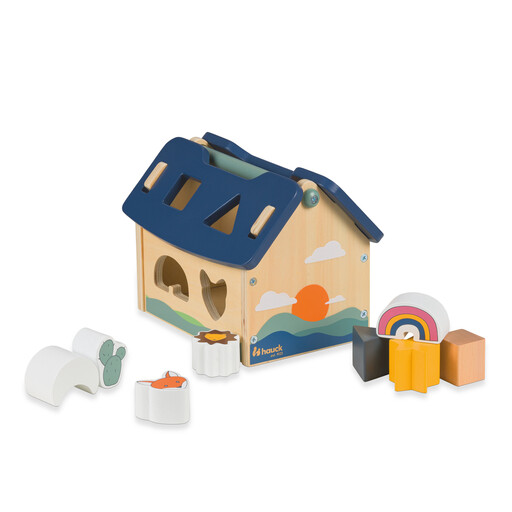
Why this product suits this family: This shape-sorting house combines storage, shape recognition and gripping activities in a clearly designed toy for children aged 12 months and over.
The eight shape pieces and removable roof are clearly listed, so it is easy to see exactly what the toy offers.
Wooden construction, carry handle, built-in storage and a recommended age of 12 months and over according to the product information.
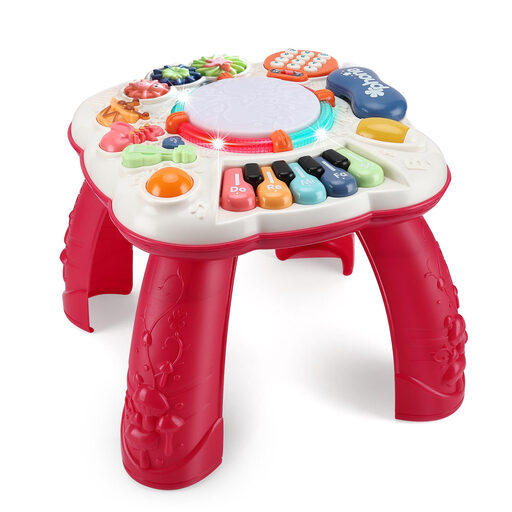
Why this product suits this family: The baby activity table can first be used as a floor play panel, then with its legs attached. It is a good option for families who need different ways to play.
The six play areas and removable legs are clearly listed. A volume control and quiet mode make it easier to use at home.
Suitable for ages 6–36 months, with six interactive areas, battery-powered operation and the option to convert it into a flat play panel, according to the product description.
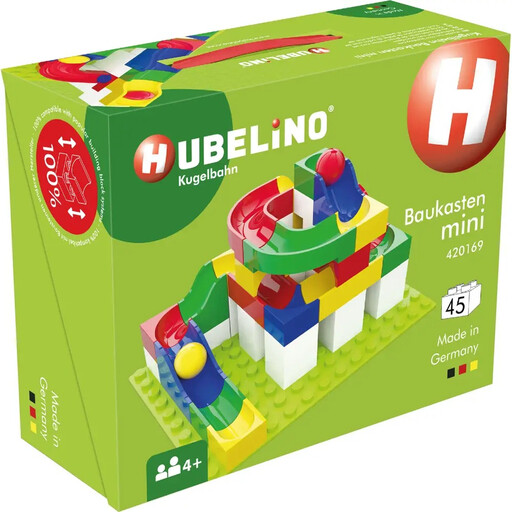
Why this product suits this family: This construction set for children aged 4 and over is designed for families who enjoy building together, experimenting and adding to their creations.
The product information specifically mentions small parts and marbles, as well as the age limit. So it is clear that this set is not intended for babies or younger toddlers.
45 pieces, storage case, compatible with other Hubelino products and no batteries required, according to the supplier information.
We’ve put together a complete, regularly updated list of products that meet these strict selection criteria and the safety requirements in force in the EU.
From 12 months, children can use large, easy-to-grip shapes, simple posting toys, wooden puzzles with knobs and sturdy sorting toys. Make sure the age recommendation is suitable, that there are no small parts that can come off easily, and that an adult supervises your child directly.
Lifespan depends on the materials, construction and how the toy is used. Wooden toys with few moving parts can last a long time if looked after properly. Electronic products also depend on the condition of the battery compartment, switches and sound modules. Check toys regularly for cracks, loose parts, sharp edges or exposed magnets.
Yes, unless they are powered by a mains adapter or rechargeable battery. Many products are supplied without batteries. If your child often uses sensory toys, check the volume, battery condition and off switch regularly. For a battery-free alternative, try wooden puzzles, sorting toys or classic building blocks.