
Lieferung heute & morgen

Qualitätsgarantie

Willkommens-Angebote freischalten: KOSTENLOSE Lieferung | Bis zu 80 % RABATT | Kostenlose 30-Tage-JoyPlus-Testphase
App herunterladen
Educational toys should do more than keep children occupied. They should suit the child’s age, abilities and everyday life. However, choosing the right products can be challenging for parents, grandparents and other family members. Many products are marketed with terms such as “Montessori”, “sensory-motor” or “early development”, without clearly explaining their specific features.
Three common buying misconceptions are particularly likely to result in unsuitable purchases:
A learning toy from 1 year should suit the child’s current hand strength and coordination. Large handles, easily accessible openings and manageable tasks make it easier to get started. For a wooden puzzle from 12 months, for example, easy-to-grip knobs and a small number of clearly recognisable shapes are useful.
The age recommendation does not replace checking the warnings. If a product contains small parts, it may only be suitable under direct supervision despite a general recommendation from 12 months. Packaging, plastic film, cables and battery compartments should also be kept out of reach of babies and toddlers.
Look for clear, verifiable information about the materials and workmanship. Rounded edges, smooth surfaces without sharp edges and sturdy connections help to reduce common risks of injury and swallowing. For wooden toys, details such as FSC-certified wood can provide more information about the material’s origin.
The CE marking is a manufacturer’s declaration that the product complies with relevant EU requirements. It is not an independent seal of quality. The EN71 marking may also refer to the European series of toy safety standards. Nevertheless, check the specific item, instructions and warnings. For foam products, non-slip undersides, concealed zips and washable covers are also practical features.
A musical toy for babies should have volume control and an off or quiet function. These features make it easier to use in flats, during car journeys or at shared rest times. However, volume control is no substitute for keeping a suitable distance and limiting the duration of use.
Also check whether batteries are included, how large the toy is and whether it stands securely. A baby activity table with removable legs can be more practical where space is limited, as it can also be used as a flat floor toy.
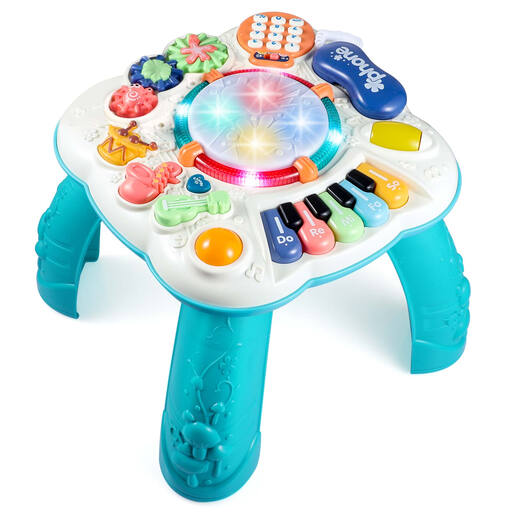
Why this product suits this profile: This table combines several play options and can initially be used without its legs as a flat floor toy. The stated age range is 6 to 36 months.
The product description lists rounded edges, BPA-free ABS and adjustable volume. Batteries are not included and need to be purchased separately.
Six play areas, removable legs and a compact size of approximately 30 × 30 × 31 cm according to the product information.
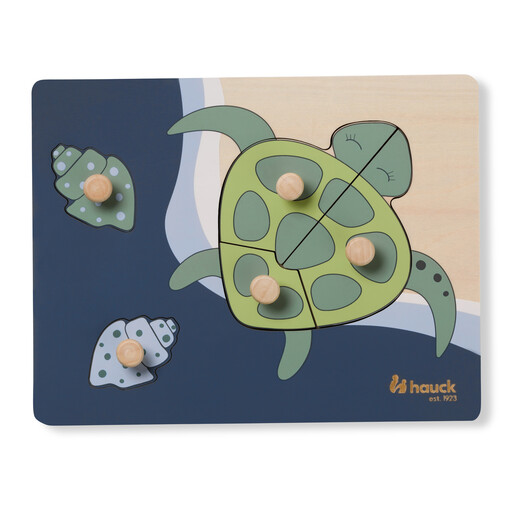
Why this product suits this profile: This wooden puzzle is designed for children from 12 months and focuses on a simple activity featuring animal shapes, wooden knobs and a precisely fitted baseboard.
The activity is clearly defined and does not overwhelm children with a multitude of electronic functions. The product description highlights rounded edges and direct adult supervision.
FSC-certified wood according to the product information, wooden knobs and dimensions of approximately 22 × 17 cm.
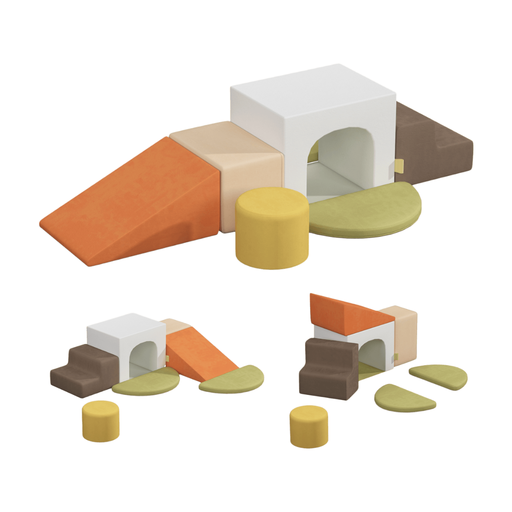
Why this product suits this profile: These soft blocks are suitable for indoor play areas where children can climb, crawl, build and create their own obstacle courses.
Washable covers make regular cleaning easier. The product information lists concealed zips, hook-and-loop fastenings and a non-slip underside.
Seven foam elements, EN71-1, EN71-2 and EN71-3 according to the product information, plus a cover that can be machine-washed.
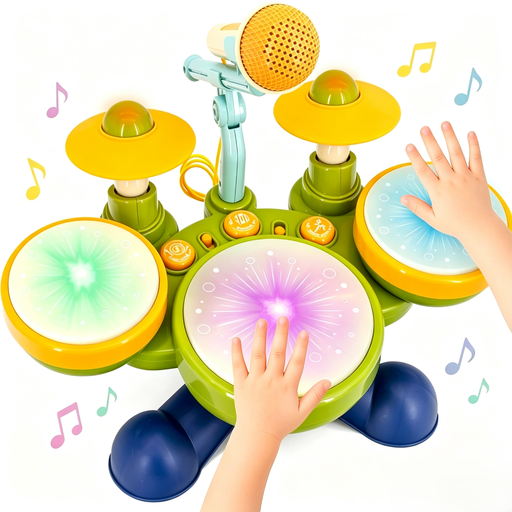
Why this product suits this profile: This set is suitable for families looking for an interactive musical toy for a baby or toddler, while still wanting to adjust the volume.
The volume can be adjusted according to the product description. A removable stand also allows it to be used as a flat floor toy.
Three illuminated drum surfaces, two height-adjustable cymbals, a microphone and battery operation according to the product information.
We have put together a complete, regularly updated list of products that fully meet these strict selection criteria and the safety regulations applicable in the EU.
For babies aged around 6 to 18 months, sensory toys for babies, simple objects to grasp and a mobile crawling toy for babies may be appealing. A rolling toy should only be used on a clear, safe surface and never near stairs or cables.
From 12 months, consider a shape-sorting toy from 1 year, a shape sorter or a wooden puzzle. For outdoor play, a sand toy set or water track can be suitable. Sand and water toys should be cleaned after use. Also check for conflicting information: if a set contains small parts while also carrying a warning for children under three, the warning takes priority.
For movement-based indoor play, foam building blocks for children can support children who want to crawl, stack or climb. From the toddler years onwards, role play, a children’s drum with microphone or, later, a simple children’s bath toy set can also be introduced. Not every product needs to be available all the time: keeping a small selection and rotating it regularly can make things more manageable.
From 6 months, products that are easy to grip, sturdy and simple to clean are a sensible choice. These include basic sensory elements, flat activity toys or movable objects. The specific age recommendation, the absence of accessible small parts and supervised use are all crucial.
There is no universal recommended duration. Choose a low volume, keep a sufficient distance and include breaks. Volume control or a quiet function makes the toy easier to use in everyday life. If the child shows signs of discomfort or overstimulation, stop the play session.
Regularly check screws, seams, zips, stands and battery compartments. Clean products according to the manufacturer’s instructions and store sand and bath toys dry. Damaged or loose parts should be removed from the play area immediately. Choosing toys that suit the child’s age and using them in varied ways will also help them remain relevant for longer.