
Lieferung heute & morgen

Qualitätsgarantie

Willkommens-Angebote freischalten: KOSTENLOSE Lieferung | Bis zu 80 % RABATT | Kostenlose 30-Tage-JoyPlus-Testphase
App herunterladen
Educational toys for babies and toddlers should do more than look appealing: they should suit your child’s stage of development. Parents, grandparents and nurseries have plenty to choose from, including toys for developing motor skills, Montessori toys, sensory toys, musical learning toys and construction toys for children aged 3 and over. They can vary considerably in their age recommendations, materials and supervision requirements.
Lights, music, buttons and sounds can capture a child’s attention. However, more stimulation doesn’t necessarily make play more enjoyable for every child. What matters is whether the features encourage purposeful actions such as pressing, grasping, sorting, turning or building. A simple shape sorter may therefore be more useful in everyday play than a product with lots of confusing modes.
An activity cube for children aged 1 to 3 isn’t intended for a six-month-old baby. Magnetic building blocks with small parts and strong magnets are generally designed for children aged 3 and over. An age recommendation isn’t just packaging advice; it’s an important part of your buying decision.
Claims such as ‘non-toxic’, ‘BPA-free’ or ‘safe’ should always be backed up by product information. Look for rounded edges, sturdy construction, securely enclosed components and clear warnings. For electronic toys, the battery compartment, volume control and cleaning instructions are also important.
For babies from around 6 months, choose easy-to-reach, graspable features, such as rattles, soft balls or a flat activity toy for tummy time. A baby musical table with detachable legs can later be used as a table, but it should only be set up once your child can stand securely.
From around 1 year, toys with turning, fitting and sorting elements can be appealing. An activity cube or classic Montessori toy offers several hands-on activities in a compact space. For children aged 3 and over, magnetic building blocks and other construction toys can encourage creativity and spatial thinking. Small parts and magnets mean appropriate supervision is essential.
For plastic toys, ABS plastic, smooth surfaces and neatly rounded edges are important features to look for. With wooden toys, check that they’re splinter-free and that the materials are clearly described. For example, the Hauck shape sorter is described as being made from FSC-certified wood.
Check toys regularly for cracks, loose parts and damaged casings. Take particular care with magnetic toys: if magnets become visible or parts come loose, stop using the product. Swallowing magnets can cause serious injuries. If you suspect this has happened, seek medical help immediately.
Musical learning toys often need batteries, which may not be included. Check the battery type and compartment, as well as whether there’s a volume control. Adjustable volume is useful for drum sets and musical tables, but it doesn’t replace sensible use. Electronic products shouldn’t be immersed in water.
Many plastic toys and magnetic building blocks can simply be wiped with a soft cloth. Some products specifically advise against using a dishwasher, hot sterilisation or liquid cleaners. Read these instructions before using the toy for the first time.
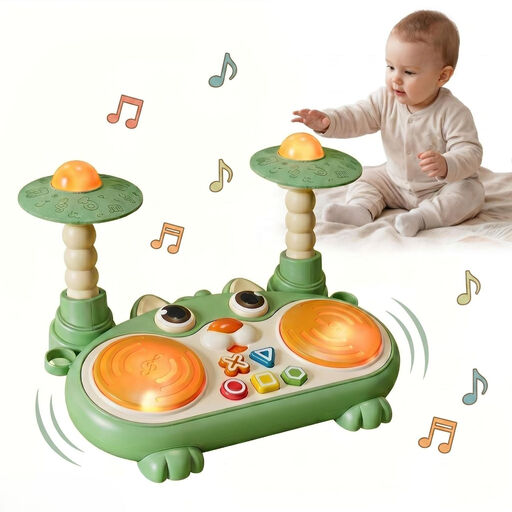
Why it suits this profile: This compact toy combines drum pads, lights, animal sounds, and shape and colour sorting for children aged 6 to 36 months.
Its features are clearly defined and go beyond lights alone: five shape pieces, drum pads and sounds offer a variety of ways to play.
ABS plastic, rounded edges and a non-slip base; batteries are not included.
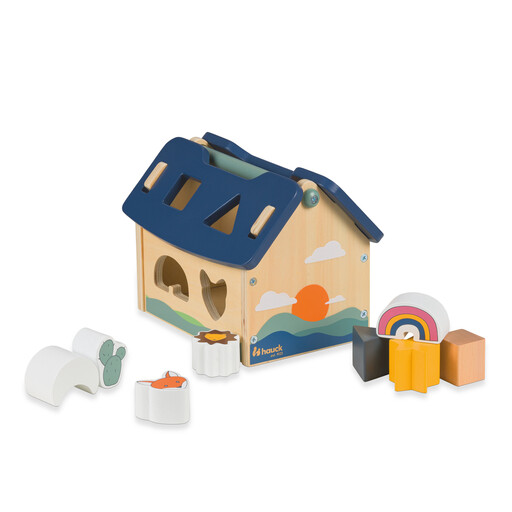
Why it suits this profile: Designed for children aged 12 months and over, this wooden toy is a good choice for families looking for a simple, traditional shape sorter with a manageable number of features.
Instead of electronic stimulation, it focuses on matching, stacking and taking pieces out. This keeps the ways to play clear and easy to follow.
Made from FSC-certified wood according to the product description, with eight blocks and a hinged roof for storage.
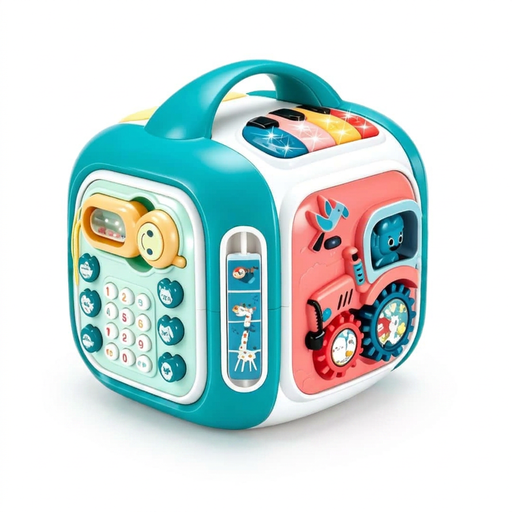
Why it suits this profile: Ideal for travel, waiting times or compact play areas, this cube combines eight activity zones in a space measuring approximately 23 × 23 × 24 cm.
The mechanical and musical activities are separate: gears, a telephone, piano, guitar and other features can each be selected for focused play.
Carry handle, BPA-free ABS plastic according to the product information, and rounded edges; suitable for children aged 1 to 3.

Why it suits this profile: Designed for children aged 3 and over who want to build houses, animals or other creations using magnetic pieces.
The product information clearly highlights the small parts and strong magnets. This makes the age restriction clearer than general claims about building sets.
76 pieces, 3.75 cm squares and enclosed magnets according to the product description; no batteries needed.
We’ve put together a complete, regularly updated list of products that meet these strict selection criteria and fully comply with the safety regulations in force in the EU.
For babies from 6 months, choose toys with features they can easily reach and grasp. These include rattles, textured balls, simple sorting buttons or a flat sensory toy for tummy time. Check the specific age recommendation, watch out for small parts that could be swallowed and choose a surface that’s easy to clean.
Lifespan depends on the materials, how often a toy is used and how well it’s cared for. Plastic cubes and wooden toys can last a long time if checked regularly. Electronic products also depend on the batteries and whether their switches continue to work properly. Damaged parts, cracks or loose magnets are all reasons to stop using a toy, whatever its age.
Battery-operated toys have ongoing costs because the batteries need replacing. How long they last depends on how often the toy is played with, the volume setting and the type of batteries used. Before buying, check whether batteries are included and whether the product has a volume control or quiet mode.