
Lieferung heute & morgen

Qualitätsgarantie

Willkommens-Angebote freischalten: KOSTENLOSE Lieferung | Bis zu 80 % RABATT | Kostenlose 30-Tage-JoyPlus-Testphase
App herunterladen
Educational toys for children should keep them engaged while providing age-appropriate play opportunities. However, choosing the right product is not always easy for parents, grandparents and other relatives: product descriptions promote Montessori concepts, sensory development, early learning progress and especially durable materials. What really matters, though, are specific details such as the recommended age, small parts, materials, power supply and cleaning requirements.
Many features sound convincing at first. However, an activity centre with music, lights, shapes and wheels can be overwhelming if the child is not yet able to grasp objects purposefully or understand cause and effect. Conversely, a simple motor-skills toy can quickly become boring for older children.
You should therefore check:
Small components, magnets, button cells and battery compartments require particular attention. A toy may be suitable for a three-year-old, but in a household with a younger sibling it should only be used under supervision.
Important information includes warnings such as choking hazard due to small parts, details about supervision and warnings about strong magnets. CE marking and EN71 information are useful points of reference, but they do not replace checking the specific product and its safety warnings.
Electronic baby toys require batteries, whereas a puzzle or wooden toy works without power. Children’s musical toys should also have volume control if they are used regularly indoors. For magnetic toys, visual checks and dry cleaning are part of ongoing maintenance.
For toys from 1 year, larger, easy-to-grip elements and simple slotting, stacking or pressing functions are generally suitable. According to the product information, a Hauck shape sorter is intended for children aged 12 months and over and contains eight shape blocks. For puzzles for toddlers, the number of pieces should be manageable. According to the product information, the Ravensburger “My First Puzzle” is suitable from the age of two and includes four pictures with increasing levels of difficulty.
For toys from 3 years, more complex constructions are an option. However, magnetic building blocks often contain small elements and strong magnets. Supervision, regular checks and safe storage are particularly important here.
Look out for:
The Hauck shape sorter is listed as being made from FSC-certified wood. Several plastic products in the selection are described as using BPA-free materials and having rounded edges. Such information should always be checked against the specific product page and the safety warnings listed there.
A good play concept can be enjoyed again and again. Construction toys, magnetic building blocks and simple sorting games offer open-ended play opportunities. A pull-back dinosaur car requires no batteries and can be used indoors or outdoors. Electronic educational toys, on the other hand, offer lights and sound effects, but should have easy-to-understand controls and, ideally, volume control.
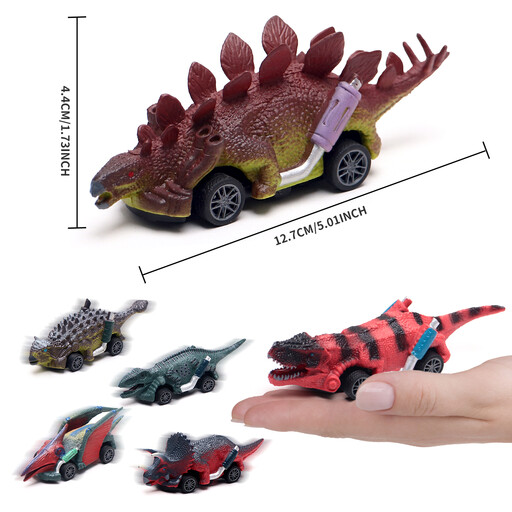
Why this product matches the profile: This set combines toy cars and dinosaurs with a battery-free pull-back motor. According to the product information, it is suitable for children aged 2 to 6 and is designed for simple races indoors and outdoors.
It requires neither batteries nor a charger. The product information mentions rounded edges and also highlights small parts and suitability from 36 months.
Six different dinosaur vehicles, dimensions of approximately 13 × 4 × 3,5 cm and a mechanical play concept that needs no power supply.
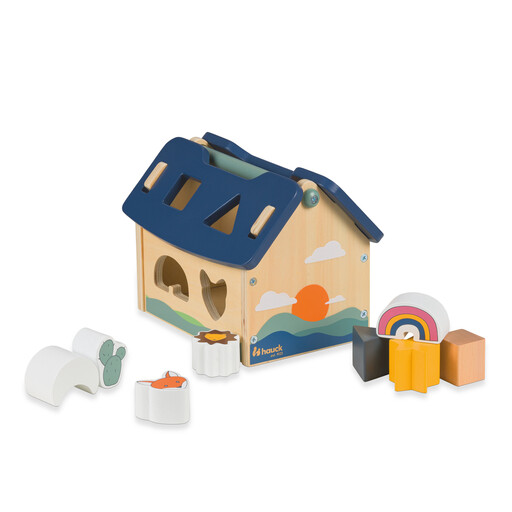
Why this product matches the profile: This wooden toy combines shape sorting and stacking. According to the product description, it is intended for children from 12 months and features a house with a carry handle and storage space.
Rather than relying on numerous electronic effects, this toy focuses on a clearly defined, repeatable sorting and stacking concept.
FSC-certified wood according to the product information, eight shape blocks and storage space in the playhouse.
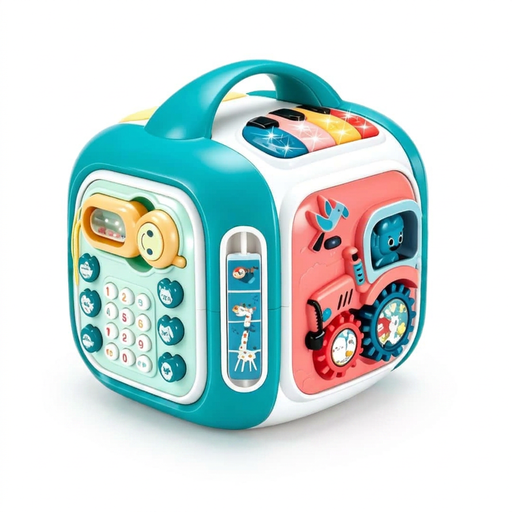
Why this product matches the profile: The cube is listed as suitable for children aged 1 to 3 and combines a piano, guitar, telephone, gears and other activity surfaces in a portable format.
Its compact design can replace several individual activity toys. Before buying, check the batteries, volume and how the functions will actually be used.
Eight play modes, a carry handle and a stated size of 23 × 23 × 24 cm; according to the product information, it is made from ABS, is BPA-free and has rounded edges.
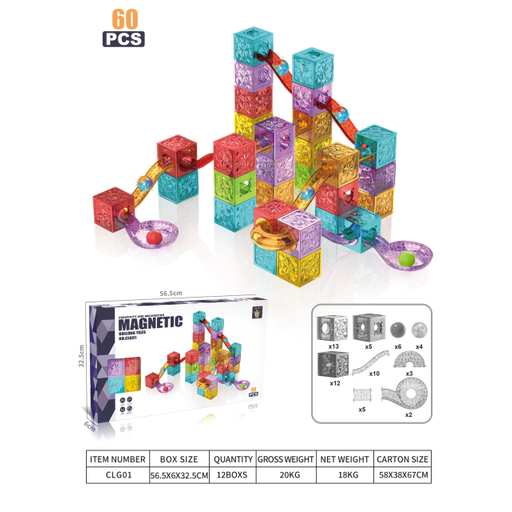
Why this product matches the profile: According to the product information, this set is designed for children from 3 years and contains 60 magnetic components with an edge length of 5,5 cm for two- and three-dimensional constructions.
The product information states that the magnets are permanently sealed. Nevertheless, small parts and strong magnets mean that supervision is required, as is checking for cracks or damage.
60 pieces, a storage bag and, according to the supplier, compatibility with other magnetic building sets of the same size.
We have put together a complete, regularly updated list of products that fully meet these strict selection criteria and the safety regulations applicable in the EU.
For children from 1 year, easy-to-grip sorting, stacking and slotting toys, along with simple activity toys, are generally suitable. Check the recommended age, the size of all parts and whether the child can use the play concept without any small parts that could be swallowed. An adult should stay with the child at first.
How long a toy remains useful depends less on the number of functions than on the play concept and the child’s stage of development. Open-ended construction toys, puzzles with increasing levels of difficulty and role-play toys can often be used across several stages of development. Electronic baby toys depend more heavily on batteries, volume and the child’s individual preferences.
Children’s musical toys and activity centres may require batteries. For this reason, look for information such as “batteries included” or “batteries not included”, the battery type and an automatic shut-off function. Battery-free alternatives such as wooden sorters, puzzles and pull-back cars avoid these additional costs.