
Lieferung heute & morgen

Qualitätsgarantie

Willkommens-Angebote freischalten: KOSTENLOSE Lieferung | Bis zu 80 % RABATT | Kostenlose 30-Tage-JoyPlus-Testphase
App herunterladen
Educational toys for children should be fun while also encouraging them to engage in a suitable activity. In practice, however, choosing the right product is not always easy: age recommendations, material information and function descriptions vary from one product to another. Parents, grandparents and other relatives should therefore look beyond the number of play modes or eye-catching packaging.
A toy with a piano, lights, telephone, music and gears may appear versatile at first glance. What matters, however, is whether the functions suit the child’s age and motor skills. For babies, large, easy-to-reach controls may be more suitable than complex construction sets with small parts. An activity table for toddlers should also stand firmly and be easy to clean.
The statement “from 3 years” is not merely a general indication; it may be linked to specific risks. Small components can pose a choking hazard. With magnetic building blocks, there is the additional risk that swallowed magnets can cause serious injuries. Such products must be kept out of the hands of children under three and should be checked regularly for damaged casings or loose parts.
Terms such as Montessori, STEM or sensory initially describe the focus of a product. On their own, they reveal nothing about the material, size, volume control or build quality. More useful information includes specific details such as ABS plastic, the number of pieces, individual part sizes, battery type, care instructions and safety warnings.
For baby toys from 6 months, large, securely connected elements and simple cause-and-effect functions are suitable. These include pressing, turning, tapping and sliding. A toy for children aged between one and three may combine several of these actions, but should still avoid loose small parts.
From the age of three, construction toys, creative building toys and first STEM toys may become interesting. Here, it is not only the number of pieces that matters, but also the size of the individual building blocks and the opportunity to create your own models.
Plastic toys often include details such as ABS or BPA-free. These details should match the information provided on the product page and packaging. Rounded edges, enclosed casings and a sturdy construction are practical features for everyday use. CE marking is mandatory in the EU; where EN71 is mentioned, it should be clear what the reference relates to.
Extra care is required with magnetic building blocks: the magnets must be securely enclosed within the component. Damaged parts should be removed immediately. Cards, electronic devices and magnetically sensitive medical devices should be kept away from strong magnets.
Electronic musical educational toys usually require batteries. Check whether these are included and whether the battery compartment can be closed securely. A volume control or quiet mode can be useful in a home, but it is no substitute for appropriate use and adult supervision.
Many products may only be cleaned with a dry or slightly damp cloth. A toy that must not come into contact with water should not be used in the bathroom or during mealtimes.

Why this product suits this profile: Measuring approximately 23 × 23 × 24 cm, this compact cube combines eight play areas and, according to the product information, is suitable for children aged one to three. A piano, guitar, telephone, gears and other elements offer different ways to play in a small space.
The functions are built directly into the cube, so no extensive assembly is required. According to the product description, the edges are made from rounded ABS plastic; the age recommendation should still be followed.
Compact dimensions, a carry handle and several manual and musical play modes.
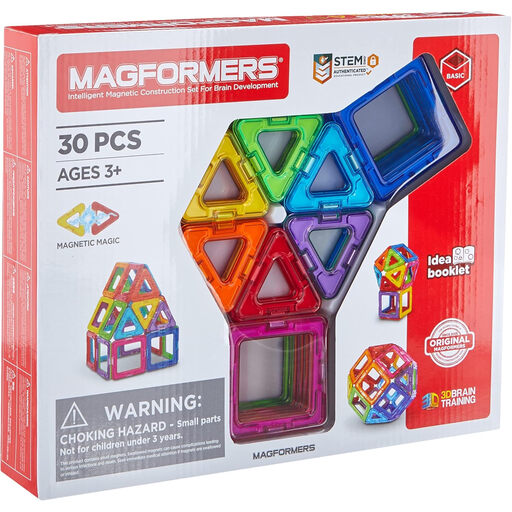
Why this product suits this profile: The set contains 30 plastic pieces with integrated neodymium magnets and is intended for children aged three and over. It is designed for families who want to combine geometric shapes with three-dimensional building, without batteries.
The product information specifies the type of magnets, the number of pieces and the warning about small parts and strong magnets. This makes it easier to assess age suitability and the level of supervision required before buying.
30 pieces, no batteries required, and repeatable construction of 2D shapes and 3D structures.
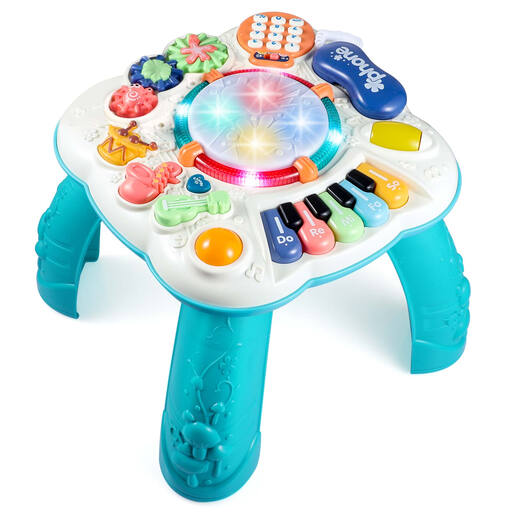
Why this product suits this profile: The table combines six play zones, including piano keys, a drum, a telephone and gears. According to the description, the detachable legs allow it to be used as a floor play board or as a standing activity table.
The product information states that the volume can be adjusted. Before use, check the batteries, stability and that all parts are present.
Two ways to use it, six play areas and an integrated volume control.

Why this product suits this profile: According to the product information, the 22 large DUPLO elements are intended for children aged two and over. The pieces can be used to build various construction vehicles, making this a suitable birthday or Christmas gift for toddlers.
The large building blocks are easier to grip than traditional small parts. Even so, follow the specific warning on the packaging and check the components regularly for damage.
22 large elements, several vehicle variations and no batteries required.
We have compiled a complete, regularly updated list of products that fully meet these strict selection criteria and the safety regulations applicable in the EU.
From six months, large, easy-to-grip elements and simple sensory stimuli may be suitable. An activity centre with tapping, turning or pressing functions can be appropriate, provided this is covered by the age recommendation. Small parts and strong magnets should be avoided.
The lifespan depends on the material, build quality, level of interest and care. Products with open-ended play possibilities, such as building blocks or rebuildable construction toys, can be used over a longer period. Electronic products also depend on batteries and moving components. Regular checks for cracks, loose parts and damaged battery compartments are advisable.
Battery-operated toys may incur additional costs when the batteries need replacing. Check the required battery type and whether batteries are included. Magnetic or traditional building blocks do not incur energy costs during normal use; what matters here is keeping the sets complete and storing them somewhere dry and suitable.