
Lieferung heute & morgen

Qualitätsgarantie

Willkommens-Angebote freischalten: KOSTENLOSE Lieferung | Bis zu 80 % RABATT | Kostenlose 30-Tage-JoyPlus-Testphase
App herunterladen
Educational toys should do more than simply keep children occupied. They should encourage age-appropriate activities involving motor skills, language, creativity or scientific topics. However, choosing the right product is not always easy for parents and grandparents: many products promote their Montessori connection, wide range of functions or supposedly especially safe materials.
What matters is not the number of buttons, colours or components, but whether the toy suits the child’s age, home environment and actual play habits.
A baby activity cube with piano keys, gears and a telephone function can offer plenty of variety. However, if the controls are difficult to reach or the sounds cannot be adjusted, the toy can quickly become impractical for everyday use. When choosing musical educational toys, check whether the volume can be adjusted and, where applicable, whether there is a quiet mode.
The term Montessori toy does not automatically describe a particular material quality or educational suitability. It is more useful to look at the specific activity: can the child turn, slot, sort, build or understand cause and effect? For younger children, simple, easy-to-reach functions are often more suitable than an overloaded feature set.
Construction toys, building blocks for children and model-making kits for children often contain small parts. These can pose a choking risk for children under three. An age recommendation of six or nine years and over is therefore not merely a marketing detail and should be taken into account when choosing a product.
A baby activity table with removable legs can be used during different developmental stages: initially as a flat play surface, and later as a table for standing play. This is practical, but it does not replace an individual assessment. Children develop at different rates; a toy should neither be overwhelming nor consist solely of passive lights and sound effects.
For babies and toddlers, suitable options include:
For schoolchildren, educational toys for children aged 6 and over, children’s experiment kits, STEM toys or more challenging construction and model sets may be suitable.
For plastic toys, details such as ABS, BPA-free and rounded edges can provide useful guidance. They should be considered alongside the manufacturer and importer information, the recommended age range and the safety instructions. CE marking indicates that the manufacturer has taken the relevant EU requirements into account; however, it is not an independent quality seal.
For the following baby products, the product details state that they feature ABS plastic, BPA-free materials, rounded edges, and CE and EN71 compliance. These details come from the respective product descriptions and should be checked again on the product page before buying.
Children’s musical instruments and electronic educational products often require batteries, which are not included. You should therefore check:
Adult supervision is expressly recommended or required for the Kosmos Student Lab and Clementoni Slime Laboratory. Chemical components, small parts and accessories should be kept out of the reach of younger children after play.

Why this product suits this profile: The compact cube combines eight play areas in a 23 × 23 × 24 cm space and can be carried by its handle. It is suitable for families looking for several activity features without taking up much room.
The product description specifies no loose parts, BPA-free ABS and rounded edges. The different functions can be accessed directly on the cube.
Suitable for ages 1–3; with piano, guitar, telephone, gears and musical functions.
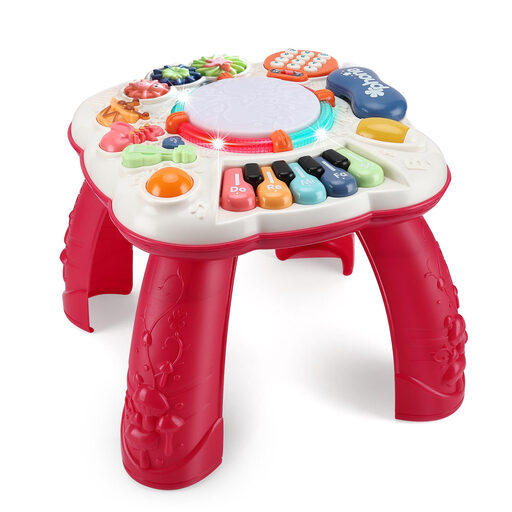
Why this product suits this profile: The model is designed to be used as a floor play panel and as a table with removable legs. An adjustable volume control and quiet mode are particularly useful in homes where rooms are shared.
The design accommodates different play positions. According to the product details, the volume can be adjusted or muted.
Six play zones; suitable from 6 months according to the product details; batteries are not included.
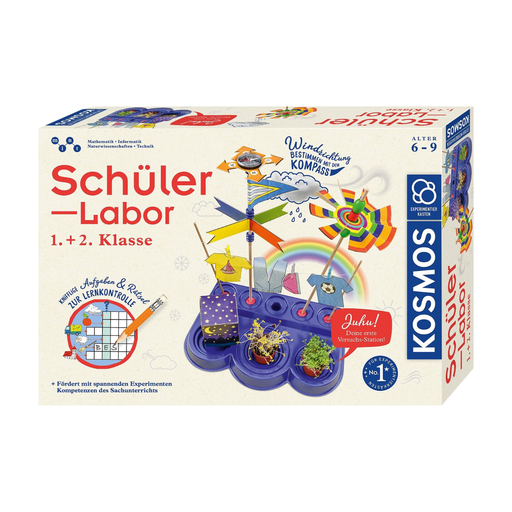
Why this product suits this profile: According to the product details, this experiment kit is aimed at children aged 6 to 9 and includes more than 50 experiments covering light, shadows, air, water and sensory perception.
The topics and instructions are described clearly. This makes it possible to check before buying whether they are suitable for the child’s age and the desired area of learning.
More than 50 described experiments; step-by-step instructions; use under adult supervision.
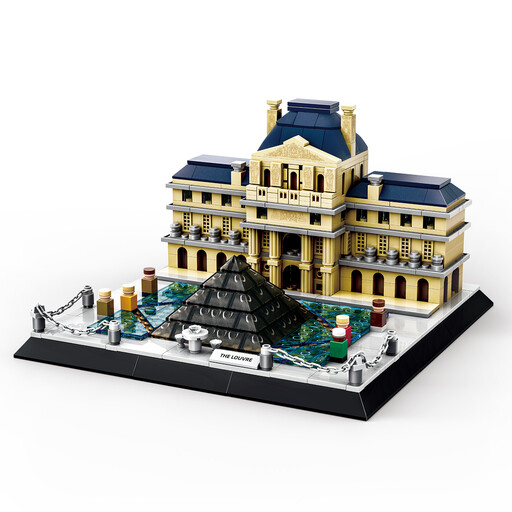
Why this product suits this profile: This architectural model appeals to families and those interested in architecture and history, as well as hobby builders. It can be assembled as a shared project or used as a model-making kit for children aged six and over with guidance.
The number of pieces, packaging size and recommended age are specified. As the set contains small parts, it is not suitable for children under three.
803 ABS components; architectural design; build together and then display as a decorative model.
We have put together a complete, regularly updated list of products that fully meet these strict selection criteria and the safety regulations applicable in the EU.
Depending on their interests, a children’s drum kit with microphone, a slime laboratory for ages 8 and over or a COBI model of the Messerschmitt Me 262 for ages 9 and over may also be suitable. Military model fans can also choose from WANGE sets featuring aircraft carriers, destroyers, cruisers and vehicles. For all options, check the number of pieces, recommended age, space requirements and supervision requirements before buying.
For one-year-olds, large, securely fixed elements that can be pressed, turned, slid or grasped are a sensible choice. A baby activity cube or baby activity table should be stable and contain no small parts that could be swallowed. The manufacturer’s specific age recommendation remains the key factor.
The lifespan depends on the materials, workmanship, use and storage conditions. For electronic products, the battery compartment, speaker and switches are particularly important. Construction sets can be used for longer if all parts remain together and are stored in a dry, organised manner.
Experiment kits should only be used in accordance with the stated age range and under the specified adult supervision. Warnings about chemicals, small parts and protective measures should be checked before buying and before every experiment. An experiment kit is not a toy to be used unsupervised.