
Lieferung heute & morgen

Qualitätsgarantie

Willkommens-Angebote freischalten: KOSTENLOSE Lieferung | Bis zu 80 % RABATT | Kostenlose 30-Tage-JoyPlus-Testphase
App herunterladen
Educational toys for children should do more than provide short-term entertainment. That is why parents, grandparents and carers look at learning content, safety, materials and suitability for the child’s age. However, many product descriptions make broad claims about “development” or “Montessori quality” without clearly explaining how the toy actually works.
As a Joybuy Product Recommendation Officer, I therefore filter out the key details: What can the child actually do? Is the toy suitable for their age? What level of supervision is required? And will the purchase involve additional costs for batteries, consumables or extensions?
A toy may be described as suitable for a wide age range, but that does not mean it will be equally suitable for every child. A baby toy with lights and sound effects is designed for different abilities from an experiment kit for children aged 8 and over. The important considerations are not just the numbers on the packaging, but also:
The term Montessori toy is not automatically a protected quality mark for every product. The specific function is more meaningful: sorting, inserting, turning, matching, building or trying things out independently. A product with lots of buttons is not necessarily more educationally beneficial than a simple wooden puzzle.
Electronic educational toys may require batteries. Experiment kits need consumables, while construction systems with extensions can lead to additional expenses. The level of supervision required should also form part of the buying decision: a chemistry set involving heating or a toy with small parts that could be swallowed is not intended for unsupervised play.
Use the recommended age range and warning notices as a guide. The CE marking indicates that the manufacturer has declared or taken into account the relevant EU requirements. However, it is not an independent quality mark and does not replace checks by an adult.
You should also check:
More features do not automatically mean greater educational value. With motor skills toys, easy-to-reach turning, inserting and sliding elements are important. Sensory toys should use visual, tactile or auditory stimulation in a controlled way. For musical toys for children, volume control, stability and simple operation are practical criteria.
A toy intended for use on the go should be compact and robust. Larger construction systems or play mats may be suitable for a child’s bedroom. For baby toys, smooth surfaces that are easy to clean are helpful. With creative toys, check whether they contain paints, powders or slime accessories, and how they can be cleaned.
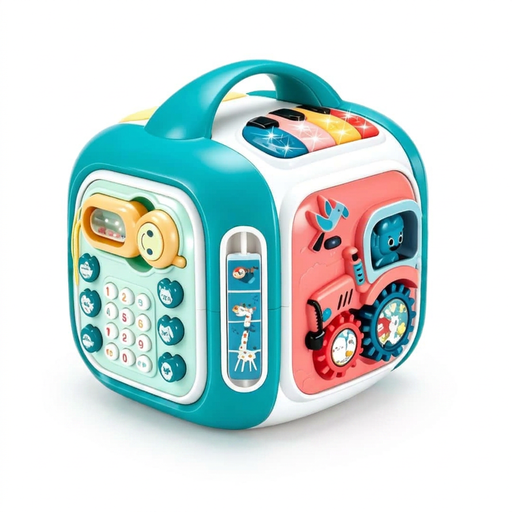
Why this product suits this profile: The cube combines several play options for children aged 1 to 3 and, according to the product details, requires no batteries. This makes it a good choice for families looking for a versatile toy that does not take up too much space.
The functions are clearly specified: turning, pressing, telephone play, plus piano and guitar elements. The age recommendation and information about the materials and rounded edges should still be checked before buying.
8 play modes, carry handle, ABS plastic and stated dimensions of 23 × 23 × 24 cm.
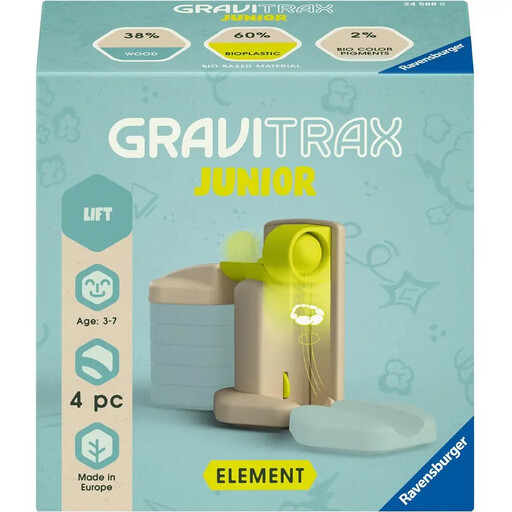
Why this product suits this profile: This extendable system is designed for children aged 3 and over and combines building with simple cause-and-effect experiences. It is an option for households where toys are intended to be used in a range of different configurations.
Compatibility with GraviTrax Junior starter sets is specified. Before buying, check whether you already have a starter set, as this element alone does not make up a complete system.
Lift element, marble and ramp; according to the product details, made from wood bioplastic and requiring no batteries.
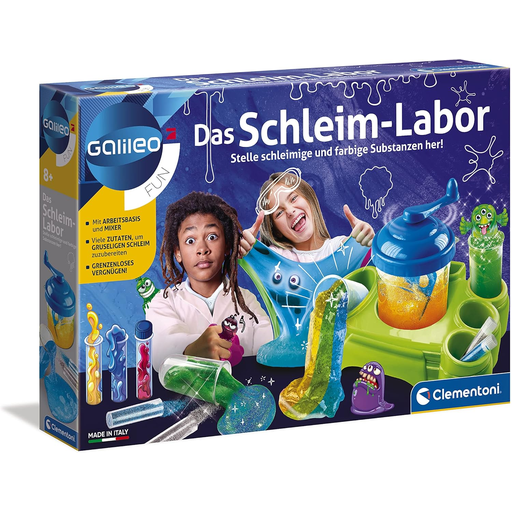
Why this product suits this profile: This experiment kit is intended for children aged 8 and over and offers structured activities focused on colours, textures and mixing processes. Adults should supervise the experiments directly.
The instructions, mixing station and laboratory utensils are listed as included components. The warning about small parts and the requirement for direct supervision remain essential.
Work station, hand mixer and accessories for making colourful slime varieties; no batteries required.
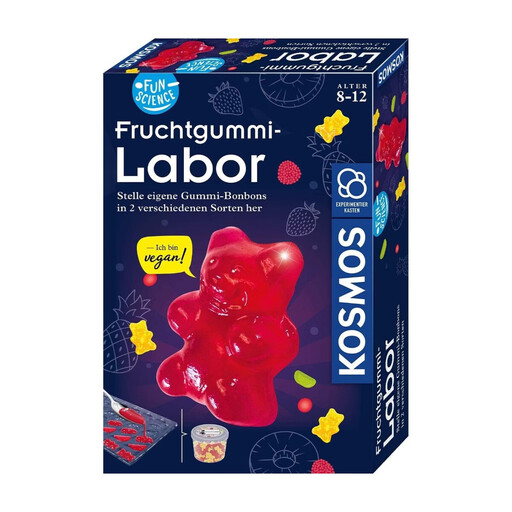
Why this product suits this profile: This set for children aged 8 and over combines creative play with a simple introduction to gelling agents and states of matter. It is suitable for cooking activities shared with an adult.
The product details list the required components, including moulds, measuring cups and mixes. Adult supervision is still necessary when heating and pouring.
Vegan gummy mixes in strawberry and pineapple flavours, moulds and four glasses that can be decorated.
We have put together a complete, regularly updated list of products that fully meet these strict selection criteria and the safety regulations applicable in the EU.
“Educationally valuable” is not a standard protected product term. In practical terms, useful toys offer a clear activity, such as sorting, building, experimenting, making music or creating things. A suitable level of difficulty is important, as is the opportunity for the child to take an active role independently.
Lifespan depends on the materials, construction, use and care. Check moving parts regularly for cracks, loose components or sharp edges. With electronic toys, the battery compartment and cables or contacts are additional points subject to wear. Wooden and construction toys can remain usable for a long time when stored in a dry place, provided they do not become damaged.
That depends on the set. Some experiment kits include mixes and accessories for specific experiments; refill materials may be needed later. Batteries are usually not included with battery-powered educational toys. Before buying, it is worth checking the contents, power supply and any possible extensions.