
Lieferung heute & morgen

Qualitätsgarantie

Willkommens-Angebote freischalten: KOSTENLOSE Lieferung | Bis zu 80 % RABATT | Kostenlose 30-Tage-JoyPlus-Testphase
App herunterladen
Educational toys for children should offer more than a short-term distraction. Parents, grandparents and other family members often look for products that suit a child’s development, are safely made and remain interesting beyond the first few days of play. However, when terms such as Montessori toys, STEM toys or “early learning” are used, the true quality is not always immediately clear.
A toy for children aged 3 and over is not automatically suitable for a two-year-old. Magnetic building blocks, small figures and connecting pieces can pose a particular risk if parts are swallowed. The manufacturer’s age recommendation and the specific warnings on the product page are the key points to consider.
For babies and toddlers, larger pieces that are firmly connected are generally more practical. A baby activity cube or activity table with rounded edges can offer a range of ways to play without leaving lots of loose small parts around the child’s room.
Lights, melodies and numerous buttons look appealing in product images. What matters is whether the functions suit the child’s age and interests. With musical educational toys, parents should also look for volume control, an off switch and a securely closed battery compartment.
With creative and construction toys, the important question is whether children can develop their own solutions. A set with open-ended play possibilities may remain useful for longer than a product that only allows one prescribed activity.
Terms such as “non-toxic”, “safe” or “environmentally friendly” should not be considered in isolation. Check whether the manufacturer provides information about the material, recommended age, warnings and a responsible person in the EU. The CE marking is a manufacturer’s declaration that certain EU requirements have been met; it does not replace careful supervision by adults.
Extra care is required with magnetic building blocks: damaged pieces must no longer be used. If magnets are swallowed, they can cause serious injuries. If this is suspected, seek medical help immediately.
For toys for children aged 1 and over, large turning, pressing and connecting elements are suitable, for example. A product for children aged 6 to 36 months should stand securely or have a suitable floor-play design. From the age of 2, children can use larger building blocks, enjoy simple role play and explore mouldable materials.
From the age of 3, children can often manage more complex construction tasks. Magnetic building blocks for children aged 3 and over help them recognise surfaces, angles and spatial relationships by connecting shapes. Development varies from child to child: educational toys do not replace adult guidance and cannot guarantee a particular learning outcome.
Look for:
For products with batteries, a secure closure and dry storage are among the basic checks to make. With modelling clay and creative materials, any potential allergens should be taken into account. For example, the Play-Doh Photo Fun Set contains wheat and, according to the product information, is intended for children aged 2 and over.
Compact products are useful for small homes or travel. The 8-in-1 Baby Activity Cube measures 23 × 23 × 24 cm and combines a piano, guitar, telephone, gears and a music function, among other features. With products like these, it is worth checking the volume and whether several of the functions will genuinely be used regularly.
With magnetic sets, the size of the pieces, the range of shapes and the storage solution are just as important as the number of pieces. A bag or box makes sorting easier and helps reduce the number of lost pieces.

Why this product suits this profile: This compact cube brings together eight play areas and is intended for children aged 1 to 3. This means one product can cover several classic activities.
The functions are arranged in one sturdy unit. According to the product information, the edges are made from rounded ABS plastic; adults should nevertheless check the toy regularly.
23 × 23 × 24 cm, carry handle and several turning, pressing and musical elements for everyday play.

Why this product suits this profile: This set is designed for children aged 3 and over and contains 76 transparent pieces with an edge length of 3.75 cm. It is ideal for families who want to combine spatial construction with open-ended building.
The product information states that the edges are smoothly finished and the magnets are securely enclosed. If there are cracks or visible magnets, the set should no longer be used.
76 pieces, transparent surface, reportedly compatible with other standard magnetic tiles and usable without batteries.

Why this product suits this profile: The large building blocks are intended for children aged 2 and over and can be combined to create different construction vehicles. This makes the set suitable for shared play and repeated rebuilding.
The larger pieces are easier to grip than the small parts intended for older children. However, the product description does mention small parts, so the age limit and supervision remain important.
22 building blocks, three described vehicle combinations and manual play without batteries.
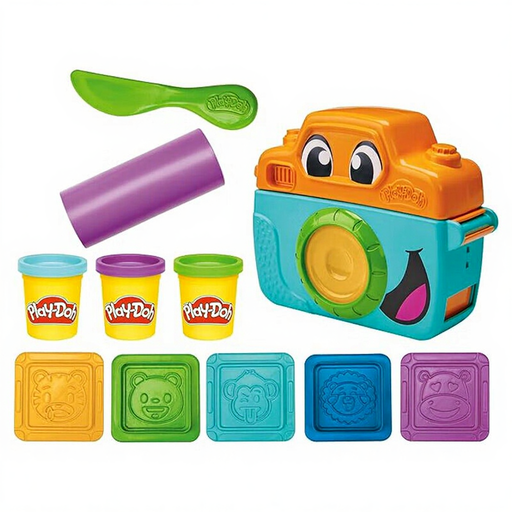
Why this product suits this profile: This set is designed for children aged 2 and over and combines shapes, stamps and free-form creativity. It is a great creative toy for shared craft sessions and a suitable birthday present for children.
The purpose of the toy is clearly described and does not depend on electronic effects. The five animal stamps and modelling tools included allow for several creative variations.
Wheat-based Play-Doh, five animal-face stamps and tools; according to the product information, suitable for children aged 2 and over.
We have put together a complete, regularly updated list of products that fully meet these strict selection criteria and the safety regulations applicable in the EU.
From around 6 months, babies can use large, easy-to-grip elements with simple cause-and-effect responses. These include soft materials, rattles, activity tables and musical educational toys with adjustable volume. Loose small parts and products with an unsecured battery compartment should be kept out of a baby’s reach.
The magnetic building blocks mentioned in this guide are mostly intended for children aged 3 and over. Strong magnets and small parts can be dangerous if swallowed. Adults should check the building blocks for cracks, loose connections and exposed magnets before every use.
How long a toy remains useful depends on the child’s age, interests and way of playing. Open-ended systems such as creative toys, LEGO DUPLO and magnetic building blocks can be rebuilt and adapted to new skills. With electronic products, parents should check whether the functions can be switched off, the batteries replaced and the sounds adjusted to an appropriate volume.