
Lieferung heute & morgen

Qualitätsgarantie

Willkommens-Angebote freischalten: KOSTENLOSE Lieferung | Bis zu 80 % RABATT | Kostenlose 30-Tage-JoyPlus-Testphase
App herunterladen
Educational toys for children should offer more than a brief distraction. Parents, grandparents and other family members often look for a product that suits the child’s age, interests and available space. At the same time, product descriptions are often labelled with terms such as “Montessori”, “sensory” or “educationally valuable”, without immediately making the practical benefits clear.
An activity cube with a piano, telephone, cogs and music may seem versatile. For a baby or toddler, however, a large number of features can also be overwhelming. What matters is whether the child can reach the controls independently and use them repeatedly. Baby toys and toddler toys should be as intuitive to operate as possible.
A toy for children aged 1 and over is not the same as a product for children aged 3 and over. Small components, marbles and strong magnets can pose a risk to younger children. Even if a set looks suitable for children, the age recommendation and safety warnings on the packaging must remain the deciding factors.
Musical toys and interactive toys require batteries, depending on the model. Check whether these are included, how securely the battery compartment is closed and whether the volume can be adjusted. Water toys also require drying and storage. A toy that needs to be thoroughly cleaned or dried after every use may not fit easily into family life.
First, identify the type of play you are looking for:
“Montessori-inspired” generally describes a design that allows children to grasp, sort, turn or combine items independently. The term alone, however, is not proof of a particular educational quality. Look at the specific functions described.
For plastic toys, details such as ABS, BPA-free and rounded edges can provide useful guidance. However, they do not replace checking the finished product. After unpacking, check whether any parts come loose, whether there are sharp edges or whether the material has an unusual smell.
Take particular care with toys containing magnets. Strong magnets must not be put in the mouth. If one is swallowed, seek medical assistance immediately. Marbles and small building blocks should likewise be kept out of the hands of children below the stated age limit.
The CE mark indicates that the manufacturer has declared compliance with the relevant EU requirements. For toys, the EN 71 series of standards is also relevant. Check that the manufacturer’s details, safety warnings, age recommendation and German instructions for use are provided. The markings should be clearly identifiable on the product or packaging.
Measure the space available before buying. A play table for babies or a 138 × 88 × 47 cm water track requires considerably more room than a compact activity cube. For travel, a carry handle, low weight and a manageable number of individual parts are practical considerations.

Why this product suits this profile: This compact cube combines eight play areas within 23 × 23 × 24 cm, making it suitable for families with limited space who want several functions in one product.
The functions are combined in a portable cube. Parents should nevertheless check the volume and the details of the CE and EN 71 markings before buying.
Recommended for ages 1–3, BPA-free ABS according to the product details, rounded edges and a carry handle.
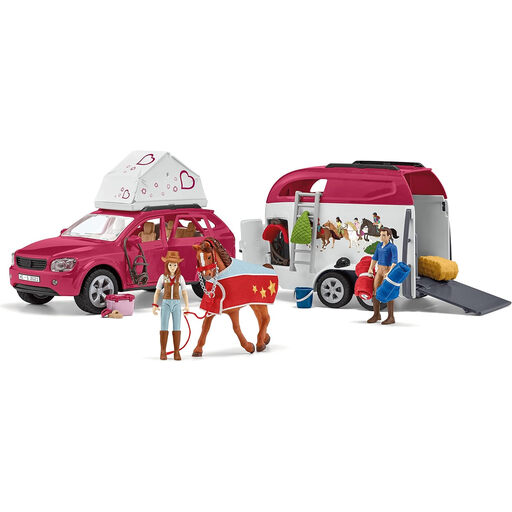
Why this product suits this profile: This set is aimed at children aged 5 to 12 who enjoy role play, horses and imaginative storytelling scenarios.
The target age group and the 18 included parts are clearly stated. Because it contains small parts, the set is expressly unsuitable for children under 3 years of age.
The car, horse trailer, tent and figures encourage role play; according to the product details, the parts are made from plastic and can be hand-washed.
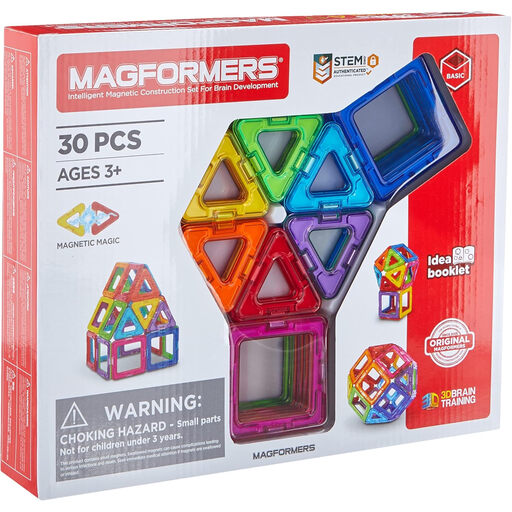
Why this product suits this profile: With 30 magnetic building pieces, this set is suitable for children aged 3 and over who enjoy creating shapes, structures and their own models.
The warning about small parts and strong magnets is clearly stated. Supervised use and safe storage are required.
Neodymium magnets, 30 pieces, no batteries required and repeatable building with 2D and 3D shapes.
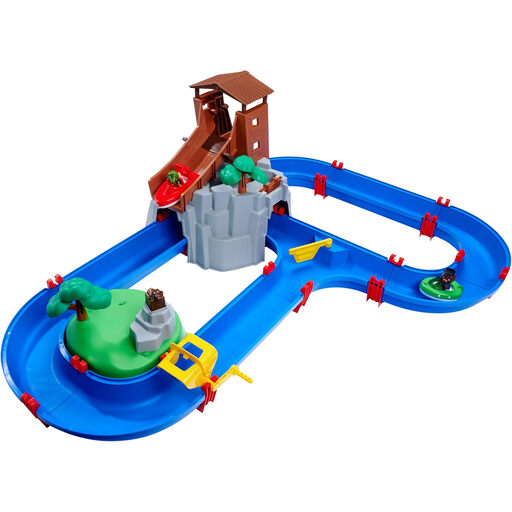
Why this product suits this profile: This water track is designed for children aged 3 and over and is suitable for outdoor use where there is sufficient space and a level surface.
Its large dimensions make the space required clear. Small parts and water mean that the stated age limit and adult supervision are essential.
Hand crank for controlling the water flow, lift, slide, two boats and two animal figures according to the product description.
We have put together a complete, regularly updated list of products that fully meet these strict selection criteria and the safety regulations applicable in the EU.
A toy’s benefits do not come from its features alone. Start by providing just a few elements and observe what the child chooses to play with independently. With an activity cube, adults can demonstrate individual functions without directing every action. For construction toys, open-ended prompts such as “What would you like to build?” are more helpful than aiming for a fixed result.
For sensory and musical toys, a moderate volume is recommended. Battery-powered products should be checked regularly for damaged casings, loose battery covers and leaking batteries. Water tracks should be emptied, dried and stored clean after use.
For toys for children aged 1 and over, choose large, easy-to-grip elements without small parts that could be swallowed. Motor skills toys with turning, pressing or inserting functions, as well as a simple baby play table, may be suitable options. The specific age recommendation for each product remains the deciding factor.
Lifespan depends on the materials, construction, care and intensity of use. Products without electronics, such as building toys or a marble run, generally do not require batteries. With electronic toys, the battery compartment, switches and moving parts should be checked regularly. Dry, organised storage helps reduce wear and tear.
A suitable birthday gift for children does not need to be chosen based on the number of features. First compare the child’s age, number of parts, materials, space required and ongoing costs for batteries or accessories. When choosing a gift, it is also worth considering whether the child already owns compatible sets or whether a standalone toy would be a better fit for the household.