
Lieferung heute & morgen

Qualitätsgarantie

Willkommens-Angebote freischalten: KOSTENLOSE Lieferung | Bis zu 80 % RABATT | Kostenlose 30-Tage-JoyPlus-Testphase
App herunterladen
Educational toys for children should suit their age, interests and the space available. At the same time, parents, grandparents and other family members want to avoid paying too much for something that will only be played with for a short time. As a Joybuy Product Recommendation Officer, I therefore assess product details using clear, verifiable criteria and distinguish practical features from marketing claims.
“From 3 years” does not automatically mean that every child can use the product independently. With construction toys, magnetic building blocks and board games, fine motor skills, attention span and tolerance for frustration can vary considerably. Small parts may also pose a risk. The age recommendation on the packaging is therefore only the first step in checking suitability.
A set with 128 or 783 pieces may appear extensive. However, what matters is whether it includes clear instructions, suitable storage and a sufficiently varied selection of building pieces. With a marble run, it is also important to know whether the construction can be built securely and whether the marbles roll reliably once it is assembled.
Lights, music and sensors attract attention, but they require batteries or regular charging. When buying a gift, shoppers should therefore check whether batteries are included, what type of power supply is needed and whether the toy remains useful without its electronic functions. A manual children's vehicle or a classic board game is easier to plan in this respect.
For babies and toddlers, rounded shapes, easy-to-grip elements and clear manufacturer information are important. A motor skills toy for babies with moving or illuminated parts should only be used by the stated age group. Products containing small parts require direct supervision. Magnetic pieces deserve particular attention: swallowing magnets can lead to serious injuries. Damaged building pieces should be removed from the play area immediately.
For plastic toys, material information such as ABS, along with details about smooth edges and intended use, can be helpful. However, these do not replace checking for cracks, loose parts or sharp edges. Parents should also check the dimensions of larger sets: a marble run or construction toy needs a stable, level surface. For a child's bedroom with limited storage space, foldable play mats or boxes with built-in storage are more practical.
A useful selection criterion is the question: what can the child actually do? Children's building blocks encourage free construction, while a vehicle with a tipping body or crane is more suited to a specific type of role play. STEM toys should not simply use terms such as “science” or “technology”; they should offer concrete activities, such as building, sorting, rolling or observing cause and effect.
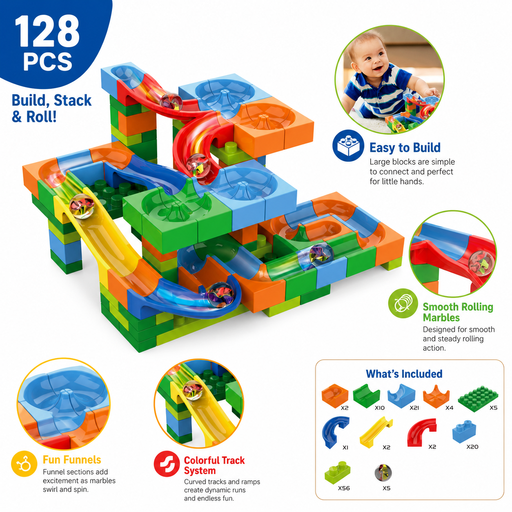
Why this product suits the profile: This set combines building and rolling in one package and can be used for family activities or as a gift.
The product description clearly states the number of pieces and the way the toy works. Before buying, check the recommended age and marble size as well.
128 pieces, manual assembly and a combination of a construction toy and marble run.
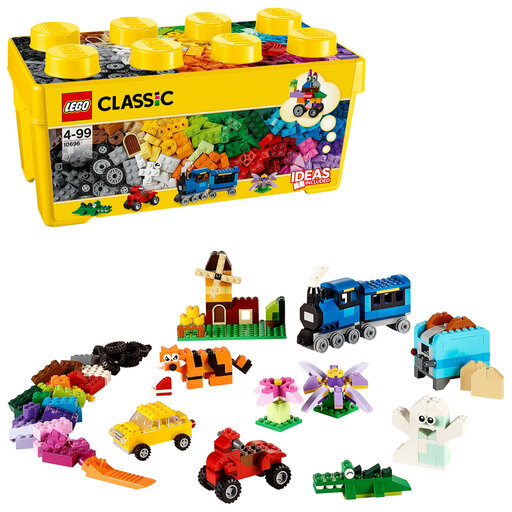
Why this product suits the profile: According to the product details, the box is designed for children aged 4 and over and includes building bricks, wheels, windows, eyes and a storage box.
The box contains a specified total of 484 elements and a manufacturer age recommendation. Small parts still require supervision.
484 elements, 35 listed colours, wheels and a plastic storage box.
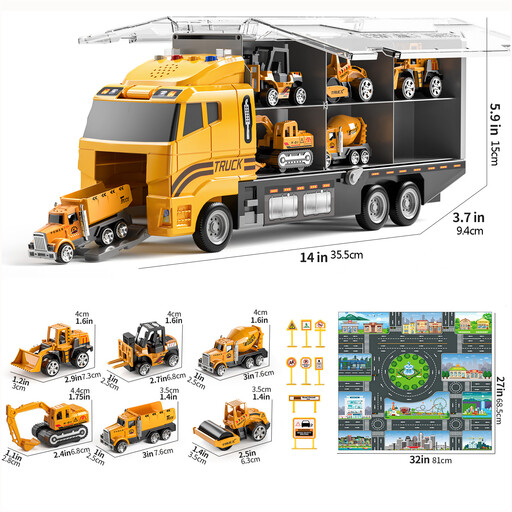
Why this product suits the profile: This set combines several children's vehicles, a foldable play mat, and sound and light effects for themed role play.
The description specifies the contents, including several types of vehicle, as well as the mat's dimensions. Check the battery requirements for the effects before buying.
Eight listed components, a foldable play mat and suitability for indoor and outdoor use according to the product description.
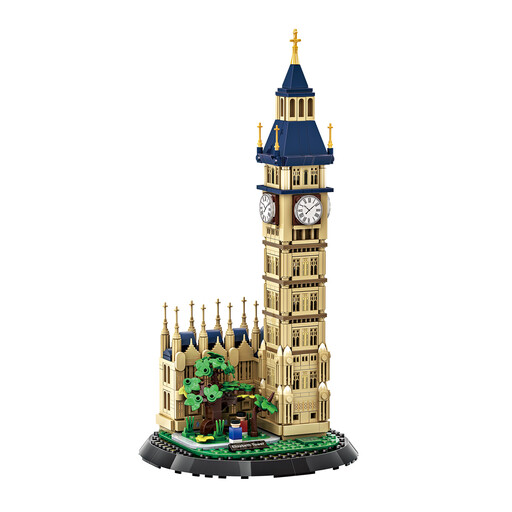
Why this product suits the profile: This architectural model is suitable for building together and for adults or older children who are interested in models and structures.
The product details specify 783 pieces, ABS as the material and a recommendation for ages 6 and over with full supervision. This makes it easier to assess the time and space required.
783 ABS pieces, architecture-themed model building and listed box dimensions of 40 × 25 × 8,7 cm.
We have put together a complete, regularly updated list of products that fully meet these strict selection criteria and the safety regulations applicable in the EU.
A quick check before paying is worthwhile:
With magnetic building blocks, check regularly that the casing, welded seams and magnet compartments are undamaged. For vehicles with moving parts, inspect axles, doors, tipping bodies and cranes for cracks or loose connections.
From age 3, larger building blocks, simple children's board games, role-play accessories and robust children's vehicles may be suitable, depending on the child. Small parts, magnets and complex construction sets should only be used in accordance with the manufacturer's instructions and under supervision. For younger children, straightforward play sequences are usually easier to engage with than extensive sets.
Their lifespan depends on the material, construction, care and how they are played with. Products without electronics have fewer components that are susceptible to wear. With construction toys, good storage can help prevent missing pieces and damage. For plastic vehicles, joints, wheels and moving functions should be checked regularly.
Manual construction toys, children's building blocks and classic board games do not normally incur ongoing energy costs. Electronic products, on the other hand, require batteries or charging time. Before buying, parents should check whether batteries are included and whether the toy can still be used without its light or sound functions.