
Lieferung heute & morgen

Qualitätsgarantie

Willkommens-Angebote freischalten: KOSTENLOSE Lieferung | Bis zu 80 % RABATT | Kostenlose 30-Tage-JoyPlus-Testphase
App herunterladen
Educational toys for children should do more than hold their attention for a short while. Parents, grandparents and carers often look for Montessori toys, sensory stimulation, activities that develop motor skills or creative construction opportunities. However, attractive product images and broad claims about development can obscure what a toy actually offers.
Three common buying misconceptions are particularly worth bearing in mind:
The recommended age is a useful first filter, but it shouldn’t be the only reason to buy. Large, easy-to-grip pieces without loose small parts are suitable for babies. Sensory toys for babies should also be easy to clean and have no accessible battery compartments or detachable components.
Take particular care with magnetic building blocks. Swallowing more than one magnet can cause serious injury. Sets with small parts and magnets should therefore be kept out of the hands of children under three. It’s also sensible to check them regularly for cracks, loose parts or exposed magnets, even when older children are using them.
Look for clear information about the materials and construction:
If a seller states that a product meets CE or EN71 requirements, this is a claim about the manufacturer or product. Also check the warnings, the EU-based responsible person and the specific age recommendation.
Fine motor skills toys should encourage a clear action: sorting, slotting, turning, grasping, threading or guiding. Activity cubes often bring several of these tasks together in a compact space. Musical toys can encourage rhythm and hand-eye coordination, but should have adjustable volume and shouldn’t be left playing constantly in the background.
For children aged around three and over, STEM construction toys and magnetic sets offer open-ended challenges. Building, comparing and making changes can help develop spatial thinking without dictating a set result. The key is to choose a size and difficulty level that suit the child, and to follow the magnet warnings.

Why this product suits this profile: This compact fabric book is designed for children aged around 1 to 3 and is ideal for quiet play at home or on the go. It combines zips, laces, buttons and hook-and-loop fastenings.
Rather than relying on lots of electronic effects, it focuses on familiar everyday actions. The product information mentions reinforced seams and securely attached elements; adult supervision is still recommended.
Lightweight, quiet to play with and includes several activities for grasping, opening and matching.
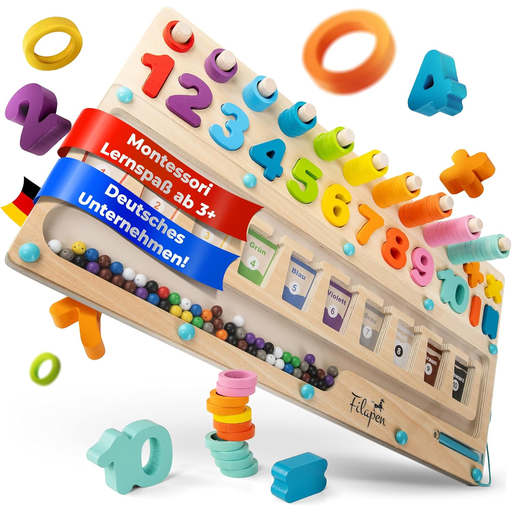
Why this product suits this profile: This wooden board combines a magnetic maze with colour matching and numbers from 1 to 10. It’s a good choice for families looking for a durable, battery-free motor skills toy with clear activities.
The product description specifies solid wood, a securely attached magnetic pen and an age recommendation of three years and over. There are no ongoing battery costs.
Combines fine motor skills, colours and early number learning; packaging dimensions: 23 × 43.5 × 4 cm.
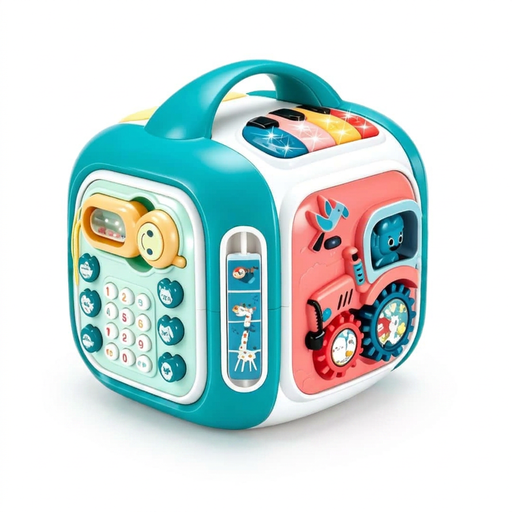
Why this product suits this profile: Designed for children aged around 1 to 3, this 23 × 23 × 24 cm cube has several play sides featuring a piano, guitar, gears and a telephone function. The carry handle is handy for trips.
The functions are clearly listed and brought together in a compact cube. According to the product information, the surfaces are made from BPA-free ABS with rounded edges. Adults should still take the volume and play environment into account.
Eight clearly listed play modes, no loose small parts according to the product description, and manual operation without batteries.

Why this product suits this profile: According to the product information, this set is intended for children aged three and over. It contains 76 transparent pieces, each with a side length of 3.75 cm, and is suitable for open-ended building at home or in a childcare setting.
The piece count and individual size are specified, along with a warning about small parts and strong magnets. This makes it easier to compare the set with building blocks you already own and check that it’s suitable for your child’s age.
76 pieces, a transparent design and magnets securely enclosed according to the product description; regular visual checks are still necessary.
We’ve put together a complete, regularly updated list of products that meet these strict selection criteria and fully comply with the safety regulations in force in the EU.
Even babies can explore cause and effect with large, safe toys that they can grasp and feel. Simple sorting, turning and slotting activities are suitable for toddlers. Sets with small parts or strong magnets are generally intended for children aged three and over and must be used under appropriate supervision.
Lifespan depends on the materials, how often a toy is used and how well it’s cared for. Wooden and plastic toys without electronic components can last a long time when stored carefully. For electronic products, the battery compartment, buttons, cables and speakers are all worth checking. Don’t continue using damaged parts.
Battery-free Montessori and construction toys don’t have any additional running costs. Musical toys and electronic activity cubes with lights may need batteries, depending on the model. Before you buy, check whether batteries are included and whether the functions can be used independently.