
Lieferung heute & morgen

Qualitätsgarantie

Willkommens-Angebote freischalten: KOSTENLOSE Lieferung | Bis zu 80 % RABATT | Kostenlose 30-Tage-JoyPlus-Testphase
App herunterladen
Educational toys should do more than keep children occupied. They should give them opportunities to grasp, sort, build, move and explore in ways that suit their age. But choosing the right toy isn’t always easy for parents, grandparents and other family members. Many products are marketed as “Montessori”, “STEM” or “early learning”, yet provide little essential information about age suitability, materials or supervision.
This guide explains what to look for when buying and which types of products suit different everyday situations.
A toy labelled for children aged 3 and over isn’t automatically suitable for younger siblings. Small parts, magnets, cords and detachable accessories can present a choking risk. Even a product labelled for ages 6 to 36 months should be chosen with the child’s stage of development in mind.
Lights, music and multiple play modes can be engaging, but they don’t replace an age-appropriate play concept. For electronic baby activity toys, volume control, the battery compartment and sturdy construction are important things to check. With an activity toy for toddlers, it should also be clear which actions a child can carry out independently.
Magnetic building blocks and construction toys can encourage creative building. However, swallowing powerful magnets can pose a serious health risk. Magnetic toys should never be given to children below the stated age limit. Check the pieces regularly for cracks, loose connections and exposed magnets.
Check the manufacturer’s specific age recommendation and the size of the individual pieces. For babies, larger elements that are easy to grasp and have no loose small parts are a better choice. Toys for children aged 3 and over could include simple sorting activities, magnetic tiles or motor skills board games.
Also consider where the toy will be used:
For plastic products, details such as ABS, BPA-free, rounded edges and burr-free surfaces can be useful product information. Wooden toys should have a smooth finish and securely fitted components. The CE marking is required in the European Union, but it is not an independent quality assessment. References to EN 71 relate to European safety requirements for toys.
Before buying, read the warnings, manufacturer’s information and details of the responsible person in the EU. Claims such as “non-toxic” or “especially safe” should not be considered on their own. Check them against the specific material and age information.
Sensory toys can combine visual, audio and tactile stimulation. For babies and toddlers, volume control is useful, particularly in flats or shared spaces. With rattles, musical instruments and activity cubes, adults should check the noise level themselves first.
A toy is most educational when it lets children take an active role: pressing, turning, sorting, connecting, sliding or naming things. These actions can help keep children engaged without making any claims of medical or therapeutic benefits.

Why it suits this type of shopper: This compact activity cube has several play sides and easy-to-grip features. It’s a versatile option for families short on space.
The product description gives an age range of 1 to 3 years and specifies BPA-free ABS and rounded edges. Check the battery requirements and warnings before buying.
Eight described play modes, including buttons, gears, phone and music features; compact design with a carry handle.
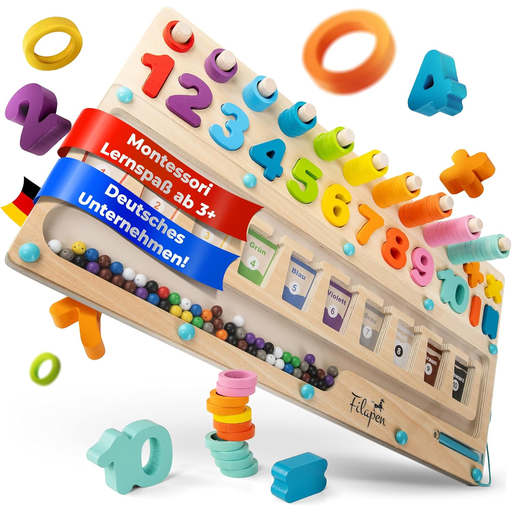
Why it suits this type of shopper: This wooden board combines a magnetic maze with colour and number matching. It’s a good fit for families looking for a battery-free educational toy.
The age recommendation of 3 years and over and the advice to use under direct supervision make its suitability clearer than broad claims about learning benefits.
Solid wood, no batteries, a magnetic pen and numbers from 1 to 10, according to the product description.

Why it suits this type of shopper: This set is designed for children aged 3 and over who enjoy building regularly and combining different shapes to create their own designs.
The description specifically warns about small parts and powerful magnets. Damaged tiles still need to be checked for regularly.
76 pieces, a stated tile size of 3.75 cm and magnetic connections for 2D and 3D constructions.
We’ve put together a comprehensive, regularly updated list of products that meet these strict selection criteria and comply fully with the safety regulations in force in the EU.
For babies from around 6 months, consider larger elements that are easy to grasp, simple activity toys and soft motor skills toys. The key things to check are the manufacturer’s specific age recommendation, the absence of loose small parts and use under supervision. Electronic products should have adjustable volume.
Lifespan depends on the materials, construction, how intensively the toy is used and how well it is cared for. Check plastic parts for cracks, wooden surfaces for splinters and magnetic toys for damaged casings. Batteries, textiles and electronic components can also limit how long a toy can be used. Keeping it somewhere dry and clean can help it last longer.
Price alone says little about whether a toy is suitable. First compare the age recommendation, materials, number of pieces, storage options and safety warnings. A smaller motor skills toy that’s a good fit may be more useful day to day than a large set with features a child can’t yet use independently.