
Lieferung heute & morgen

Qualitätsgarantie

Willkommens-Angebote freischalten: KOSTENLOSE Lieferung | Bis zu 80 % RABATT | Kostenlose 30-Tage-JoyPlus-Testphase
App herunterladen
Educational toys for children should do more than keep them occupied. They should also suit their age, stage of development and family routine. Learning games, Montessori toys, logic games and interactive educational toys can vary considerably in how they work, what they’re made from, how long they take to play and how much supervision they need.
Many disappointing purchases aren’t down to a product being unsuitable in principle, but to choosing the wrong one. Three common pitfalls are worth keeping in mind:
The age recommendation is a useful starting point, but it can’t replace an assessment of your child’s individual development. For toddlers aged 1 to 3, simple cause-and-effect games, turning and fitting pieces, and motor skills toys with easy-to-grip parts are usually a good choice.
Educational toys for children aged 3+ can focus on colours, numbers, matching and simple rules. A maths learning game for children aged 5+ should specify whether it covers addition, subtraction, multiplication or division. For older children, a logic game, puzzle game or spatial puzzle with gradually increasing difficulty can be a good option.
The key is whether your child can get started independently and complete the tasks in manageable steps. Games that are too easy can quickly lose their appeal, while tasks that are too difficult are more likely to cause frustration than encourage regular play.
For wooden toys, check the material details, rounded edges and quality of construction. With electronic toys, parents should also check the charging method, battery life, volume and how the toy should be handled around liquids.
The CE mark indicates that the manufacturer declares the product complies with relevant EU requirements. However, it isn’t an independent quality mark. Buyers should also read the specific age recommendation, warnings and information about small parts. The EN 71 series of standards concerns toy safety; any reference to it should be clearly relevant to the product.
Small parts are unavoidable in many learning and puzzle games. Even if a game is recommended for ages 3+ or 6+, take extra care if there are younger siblings in the home. Always follow the guidance on the product packaging.
Interactive educational toys with lights, sounds or a remote control generally need batteries or a rechargeable battery. Check whether batteries are included, what battery life is quoted and whether a suitable charging cable comes with the toy.
For travel, compact dimensions, light weight and easy storage are useful. A toy for keeping children occupied on the go should work without complicated set-up. For children’s board games, it’s also worth checking whether they can be played alone, with two players or in a group.
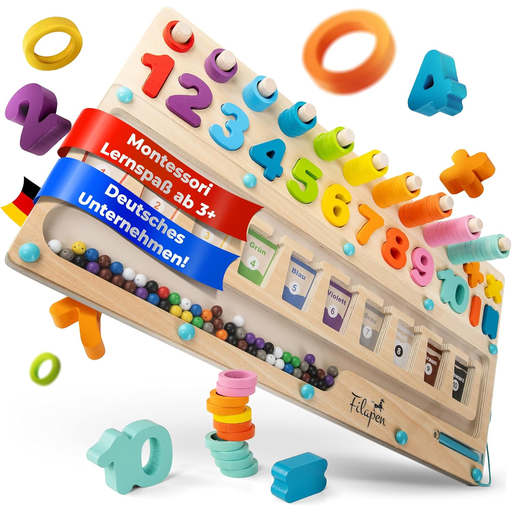
Why it suits this profile: This board combines a magnetic maze, colour sorting and numbers 1 to 10 in a battery-free game for children aged 3+.
The features are clearly described, and there’s no app or need for batteries that could run out during everyday use or add ongoing costs.
Wooden construction, magnetic pen, number-fitting pieces and product dimensions of around 23 × 43.5 × 4 cm.

Why it suits this profile: Designed for children aged 1 to 3, this activity cube brings together eight described play areas in a compact space.
The age range, dimensions of around 23 × 23 × 24 cm and ABS material are specified. You should still follow the warnings and supervision guidance.
Piano, guitar, phone, gears and other play elements, plus an integrated handle for carrying it around.

Why it suits this profile: According to the product description, this portable maths learning game covers addition, subtraction, multiplication and division for children aged 5 to 12.
Five modes and 19 games are clearly listed. The device works without a screen and charges via USB-C; the stated play time is up to six hours.
Audio feedback, 50,000 maths questions listed and compact dimensions of around 30 × 23 × 6 cm.
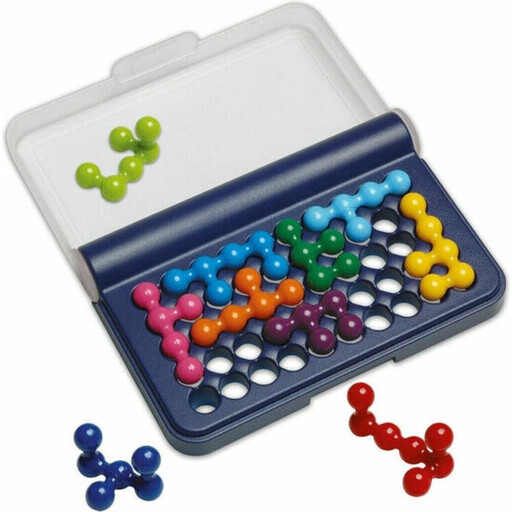
Why it suits this profile: This single-player logic game for ages 6+ needs no batteries and is compact enough to take on trips.
The steps are clear: choose a challenge, arrange the pieces and check the solution. There’s no charging and no ongoing cost for batteries.
Single-player format, plastic pieces, dimensions of around 9.8 × 3.2 × 14.4 cm and product information in multiple languages.
It depends on the type of game. Activity cubes and simple motor skills games are often designed for ages 1 to 3. Montessori toys with number and colour sorting often start from age 3. Maths, logic and puzzle games are generally aimed at children aged 5, 6 or 8 and over, depending on the tasks. Always follow the manufacturer’s guidance and warnings about small parts.
Lifespan depends on the materials, how heavily the toy is used, how it’s stored and how well it’s cared for. Wooden toys should be kept dry, while electronic products should only be cleaned with a soft, dry cloth. For rechargeable devices, regular charging and storage at moderate temperatures can affect how long they remain practical to use. A toy with gradually increasing difficulty may hold a child’s interest for longer than one with just a single task.
Products that run on batteries will need replacement batteries. A built-in rechargeable battery usually means no regular battery purchases, but the device will need charging. Before you buy, check whether an app, subscription or extra accessories are required. If you’d rather avoid these ongoing costs, battery-free logic games, wooden games and classic children’s board games are straightforward alternatives.
We’ve put together a complete, regularly updated list of products that meet these strict selection criteria and fully comply with the safety regulations in force in the EU.