
Lieferung heute & morgen

Qualitätsgarantie

Willkommens-Angebote freischalten: KOSTENLOSE Lieferung | Bis zu 80 % RABATT | Kostenlose 30-Tage-JoyPlus-Testphase
App herunterladen
Educational toys for children should offer more than bright colours and lots of features. For parents, grandparents and other family members, the most important thing is whether a toy suits the child’s age, abilities and everyday routine. An educational toy for a one-year-old has different requirements from a construction toy for pre-schoolers.
A toy with music, lights, buttons and dials may seem versatile at first glance. What matters, though, is whether your child can use the features independently and whether they’re appropriate for their age. Too much stimulation can mean that your child only tries out each feature briefly.
An age recommendation is more than a marketing claim. For educational toys for children aged one and over, check particularly carefully for small parts, detachable elements and sturdiness. Magnetic building blocks are generally intended for children aged three and over, as small parts and magnets can be dangerous if swallowed.
A CE mark is a legally required conformity marking, not an independent quality seal. Buyers should also check the warnings, manufacturer details, material information and whether the age recommendation is clear. For products containing magnets, it’s important to check regularly for cracks or loose magnets.
For children aged between one and three, large, easy-to-grip pieces with no loose small parts are usually a good choice. For example, an activity cube measuring 23 × 23 × 24 cm can offer several different ways to play in a compact space. With motor skills toys, check that buttons, rotating parts and shape sorters are easy for little hands to reach and use.
For children aged three and over, more complex activities come into play: sorting shapes, matching colours, recognising numbers and planning constructions. Montessori toys and construction toys should be challenging without being too difficult or too easy.
Smooth, rounded edges and a sturdy design help reduce the risk of injury during normal use. For plastic toys, details such as ABS or BPA-free are relevant product information, but they don’t replace checking the toy for damage. Wooden toys should be free from splinters; for painted surfaces, information about materials and compliance can be helpful.
For modelling dough and creative toys, parents should also check the ingredients and allergy information. Play-Doh products, for example, contain wheat, so they may not be suitable for children with a wheat allergy without further checks.
Musical instruments for young children should have adjustable volume if they include electronic sounds. Keep batteries out of children’s reach, and only insert or replace them under supervision.
Magnetic building blocks need particular care. Before buying, check the age recommendation, size of the pieces, secure encapsulation of the magnets and warnings. Discard damaged pieces straight away. If magnets are swallowed, seek medical help immediately.
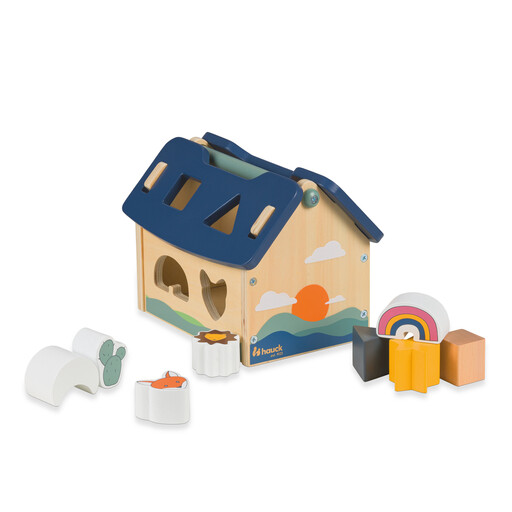
Why this product suits this need: Designed for children aged 12 months and over, this shape sorter combines shapes, colours and stacking in a simple, manageable design.
The clearly defined activity avoids an overwhelming range of features. The pieces can be stored inside the house.
FSC-certified wood according to the product details, 8 building blocks and a carry handle; suitable from 1 year.
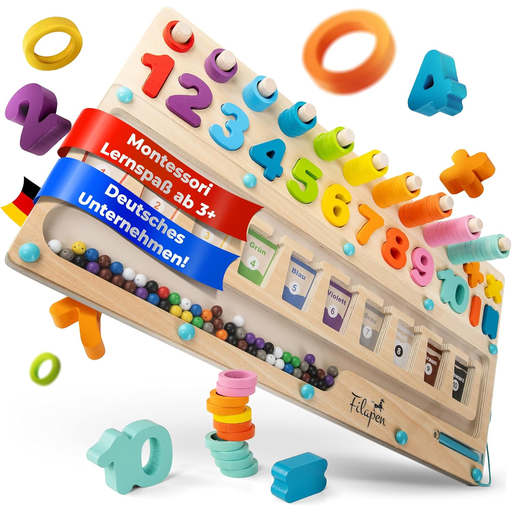
Why this product suits this need: This wooden board combines a magnetic maze with colour matching and numbers from 1 to 10. It’s designed for children aged three and over.
The activities are clearly described and don’t rely solely on lights or sound effects. Remember to take note of the warning about small parts.
Solid wood according to the product details, no batteries required and stated to be made in Germany.

Why this product suits this need: This compact cube is a good option for families who want to offer a variety of motor skills and sensory activities in a small space or on the go.
The age range and dimensions are provided. Even so, parents should check before buying whether the music and lights are suitable for their home.
8 play modes, ABS plastic according to the product details, rounded edges and a carry handle; described as having no loose parts.

Why this product suits this need: Designed for children aged three and over who enjoy building freely and discovering basic geometric and spatial relationships.
The piece size of 3,75 cm and the age limit are stated. Because the set contains small parts and magnets, children must use it under supervision.
76 pieces, a transparent ABS design and magnets described as securely encapsulated; no batteries required.
We’ve put together a complete, regularly updated list of products that meet these strict selection criteria and fully comply with the safety regulations in force in the EU.
For children aged one and over, large, sturdy peg, sorting and stacking toys are worth considering. Educational toys shouldn’t contain small parts that can come loose easily, and should be easy to use with minimal help. A clear age recommendation and regular checks for damage are important.
Turning, grasping, inserting, sorting and threading all involve controlled hand movements. Motor skills toys encourage these kinds of activities without requiring a specific learning outcome. For children aged three and over, you could also introduce magnetic mazes, construction toys or age-appropriate STEM toys.
How long a toy holds a child’s interest depends on their age, abilities and the ways they can play with it. Open-ended toys such as magnetic building blocks or creative toys can often be used in different ways. Interest in electronic toys may fade more quickly if their features can’t be varied. So, when choosing a gift for a child, consider not just their current age but also the next stages of their development.