
Lieferung heute & morgen

Qualitätsgarantie

Willkommens-Angebote freischalten: KOSTENLOSE Lieferung | Bis zu 80 % RABATT | Kostenlose 30-Tage-JoyPlus-Testphase
App herunterladen
Educational toys should be fun while also providing age-appropriate activities. However, choosing the right product is not always easy for parents, grandparents and other family members. Many products use terms such as “Montessori”, “educational toy” or “early development” without clearly explaining what features they actually offer.
Three common purchasing misconceptions are particularly widespread:
The age recommendation is an important safety and selection factor. Toys for ages 3 and up may contain small components that are unsuitable for younger children. This applies in particular to magnetic building blocks, marbles, miniature accessories and construction toys.
For products containing magnets, you should also look for information about strongly enclosed magnets. Damaged parts should no longer be given to children. For babies and toddlers up to three years old, large, firmly connected elements and easy-to-grip controls are generally more practical.
For plastic toys, details such as ABS, rounded edges and regular checks for cracks or loose parts are relevant. Claims such as “BPA-free” should be stated directly in the product information. For fabric or felt products, secure stitching and firmly attached elements are important.
A CE mark indicates that the product is intended to meet the relevant EU requirements. However, the mark is no substitute for checking the age information, instructions for use and warnings. For wooden toys, parents should look for splinter-free surfaces and clear care instructions.
Baby activity toys with buttons, rotating parts or simple cause-and-effect responses are particularly suitable for short periods of independent play. Electronic or musical toys should have a volume control or silent mode, especially when used in homes or while travelling.
For everyday use, the following points also matter:
The term “Montessori-inspired” does not automatically describe a defined educational concept. What matters are the specific play activities: grasping, sorting, building, balancing, role play or experimenting with rhythm.
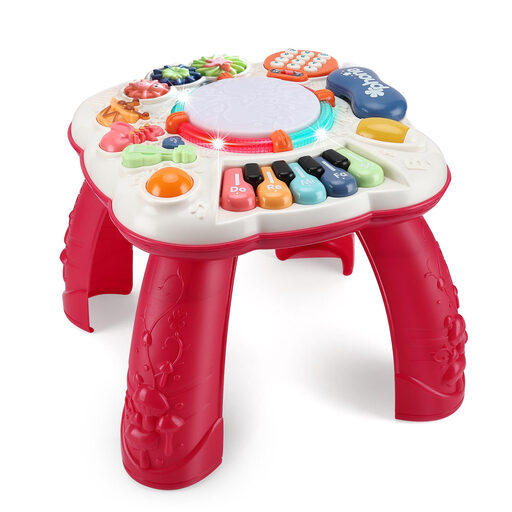
Why this product suits this profile: This table combines several play zones in one product and can be used as a floor play panel with the legs removed. This is practical as your child’s preferred play position changes.
The product details specify the age range, ABS material, rounded edges and volume control. Batteries are not included and need to be purchased separately.
Six play areas, a volume control and use as either a floor table or a standing table.
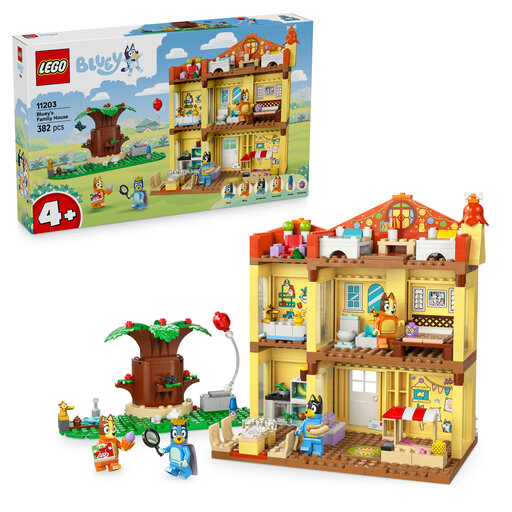
Why this product suits this profile: This set is designed for children aged 4 and over and combines building with role play. The product description lists 382 pieces, four figures and a modular house with several areas.
The age recommendation and warning about small parts are clearly stated. This makes it easier to assess before buying whether the set is suitable for the child and the supervision arrangements.
382 pieces, four figures and removable rooms for changing play scenarios.

Why this product suits this profile: This 126-piece set is designed for children aged 3 and over and is ideal for repeated building, rebuilding and playing together. The marble run adds an extra play concept to classic magnetic tiles.
The warning about small parts and strong magnets is clearly stated. Regular checks for damaged elements are still required.
126 pieces, transparent 3D elements and a battery-powered illuminated track; batteries are not included.
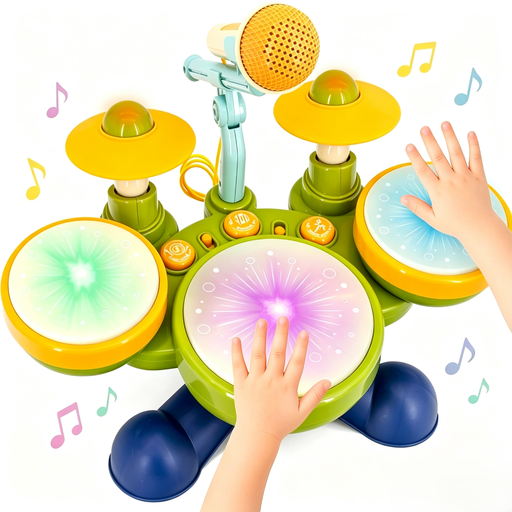
Why this product suits this profile: According to the product details, this musical toy is intended for children aged 1 to 3 and features drum pads, cymbals, a microphone, several melodies and animal sounds.
The volume can be adjusted. The product information also specifies the age range, ABS material and that batteries are not included.
Adjustable volume, removable stand and microphone for making music together.
We have put together a complete, regularly updated list of products that fully meet these strict selection criteria and the safety regulations applicable in the EU.
For babies and toddlers, large, firmly connected elements without easily detachable small parts are suitable. Appropriate categories include activity tables, developmental toys, simple sorting games and fabric activity toys. The manufacturer’s specific age recommendation should always be taken into account.
The product lifespan depends on the materials, construction and how intensively the toy is used. With construction toys, a large selection of pieces can extend the play possibilities. Electronic products, on the other hand, require batteries and should be checked regularly for damaged housings, loose parts and secure battery compartments.
Running costs are usually limited to batteries. Before buying, check which type of battery is required and how many batteries are needed. A volume control or silent mode can also make the toy more practical for everyday use, particularly when it is used indoors, while travelling or in shared living spaces.