
Lieferung heute & morgen

Qualitätsgarantie

Willkommens-Angebote freischalten: KOSTENLOSE Lieferung | Bis zu 80 % RABATT | Kostenlose 30-Tage-JoyPlus-Testphase
App herunterladen
Educational toys for babies should do more than keep little ones occupied: they should suit their age, physical development and family routine. However, with so many options ranging from flashing activity centres and Montessori toys to wooden puzzles and musical toys for babies, choosing can be difficult. Product descriptions often list numerous features, while important details such as volume control, small parts and how the toy will actually be used can receive less attention.
This buying guide explains what parents, grandparents and other relatives in Germany should look out for. The selection ranges from toys for babies aged 6 months and over to educational toys for children aged 1 year and over, taking different budgets and everyday situations into account.
A toy with lights, music, buttons, shapes and animal sounds may seem versatile. For babies, however, too many stimuli can be confusing. What matters is whether each function is easy to access and whether the child can trigger a response independently – for example by pressing, turning, tapping or grasping.
With a baby activity centre, you should therefore check whether the play areas are accessible when the child is lying down, sitting or standing. Removable legs or a flat play element can extend the toy’s useful life in everyday situations.
‘6 months and over’ does not mean that every function is suitable for every six-month-old baby. Developmental stage, ability to grasp and mobility vary from child to child. Small plug-in pieces may be unsuitable for younger children, while a simple motor-skills toy for babies may already be easy for them to use.
The age recommendation is therefore only the first filter. Safety warnings, part size and the recommended level of supervision should also be considered when making your decision.
Musical toys for babies can quickly seem permanently loud in a flat. Adjustable volume or a quiet mode is therefore a practical feature, particularly in apartment buildings, when the family keeps shared sleeping hours or while travelling. Volume control does not replace appropriate use and supervision, however.
For toys suitable from 6 months, choose accessible elements for tummy time, sitting and those first grasping movements. A rolling toy can encourage babies to look around and crawl, but it should only be used on a clear, level surface.
From around 12 months, more complex tasks become suitable: matching shapes, inserting pieces, turning, sorting and solving simple puzzles. Educational toys for children aged 1 year and over should have sufficiently large elements that are easy to hold. With a wooden puzzle for babies, knobs and rounded edges are practical; small parts require direct adult supervision.
Look out for:
CE and EN 71 should not be understood as blanket statements of quality. They provide information about conformity and requirements relating to toy safety, respectively. Claims such as BPA-free, FSC-certified wood or ‘Made in Germany’ should be verifiable directly in the product information.
Sensory toys for babies can combine colours, sounds, movement and touch. The play actions they offer can be assessed objectively: pressing, turning, inserting, tapping, grasping or tracking. Statements such as ‘supports development’ should not be taken as a guarantee of developmental progress.
For fine motor skills, shape sorters, peg puzzles, gears and moving play elements are particularly relevant. With musical toys, consider instrument buttons, drum surfaces, the microphone, melodies and volume control.
Why this product suits this profile: This compact toy combines drum surfaces, lights, animal sounds, and shape and colour sorting for children in the stated age range of 6 to 36 months.
The functions are divided between separate controls. The product information states that it is made from BPA-free ABS, with rounded edges and a non-slip base; batteries are not included.
Five geometric shape buttons, two drum surfaces and several sound responses offer a variety of play actions.
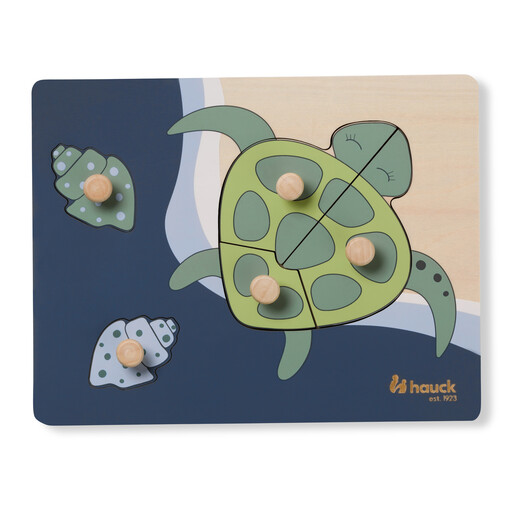
Why this product suits this profile: According to the product information, this wooden puzzle with an animal theme is designed for children aged 12 months and over and focuses on a manageable matching task.
It does not rely on electronic stimulation. The rounded shape, wooden knobs and clearly defined age recommendation make it easier to supervise.
FSC-certified wood according to the product description, six animal shapes and compact dimensions of 22 × 17 cm.
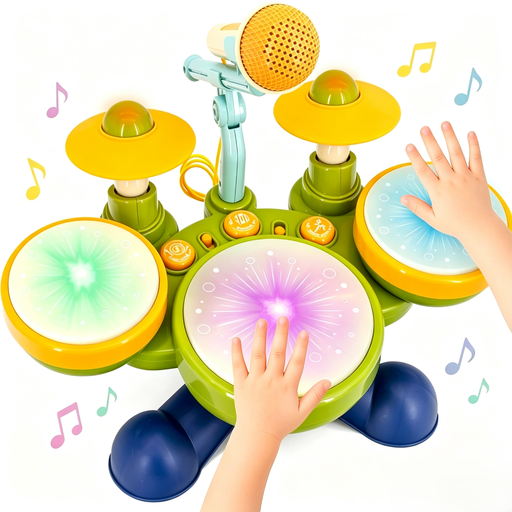
Why this product suits this profile: For families specifically looking for musical toys for babies to sing and drum together, this set offers a microphone, illuminated drum surfaces and height-adjustable cymbals.
According to the supplier, the volume can be adjusted. The stand is removable, allowing the set to be used as a flat floor play element.
Microphone, three illuminated drum surfaces, two liftable cymbals and ABS material with a BPA-free claim.

Why this product suits this profile: Measuring 23 × 23 × 24 cm, this cube is compact and suitable as an activity toy for toddlers at home, when visiting others or while travelling.
The different play surfaces are combined in a single cube. The age recommendation is 1 to 3 years; small parts and the condition of the product should be checked regularly.
Eight play modes featuring a piano, guitar, telephone, gears and music; integrated carry handle.
We have put together a complete, regularly updated list of products that fully meet these strict selection criteria and the safety regulations applicable in the EU.
Electronic educational toys for babies require batteries, which are not included with some of the products mentioned. Before buying, check the battery compartment, the type of battery required and whether the toy has an automatic switch-off function or volume control. Batteries should be changed and stored out of children’s reach.
Wooden toys can usually be cleaned with a slightly damp cloth. Electronic products should not be cleaned under running water. Check seams, screw connections, plug-in pieces and surfaces regularly. Damaged or loose parts should no longer be used.
From 6 months, easy-to-reach grasping, tapping and turning elements are useful. A sensory toy for babies at this stage should remain stable whether standing or lying down and should not contain accessible small parts. Use should be adapted to the child’s individual development and supervised.
From 1 year, simple matching tasks become suitable. Wooden puzzles for babies, shape sorters, plug-in elements and activity cubes develop a range of actions through grasping, inserting, turning and removing. A clear age recommendation and information about small parts are important.
How long a toy remains engaging depends on the number of play actions, the child’s developmental stage and adult involvement. A 2-in-1 product with floor and stand functions can cater to different stages. Even a simple wooden toy remains relevant when parents introduce new words, colours or shapes during play.