
Lieferung heute & morgen

Qualitätsgarantie

Willkommens-Angebote freischalten: KOSTENLOSE Lieferung | Bis zu 80 % RABATT | Kostenlose 30-Tage-JoyPlus-Testphase
App herunterladen
Educational toys for children should offer more than a short-lived distraction. Parents, grandparents and relatives often look for creativity, safety and clear educational value. At the same time, there is a huge range to choose from: construction toys, STEM toys, 3D puzzles, magnetic building blocks, DIY toys and themed building sets differ considerably in their recommended age, number of pieces and level of difficulty.
Before buying, it is worth taking a close look at the product details. Some products promote a wide range of features, even though the toy may be too complicated for its target age group or lack important information about small parts, batteries and materials.
A building set with 120 or more pieces can offer plenty of creative possibilities. For younger children, however, a large number of individual elements can be confusing. What matters is whether the set includes clear instructions, suitable templates or an easy way to get started. A set with fewer pieces may be a better choice if the child is building for the first time.
The term alone does not describe a measurable product feature. More useful details include the number of pieces, intended age group, material, construction principle and ways to play. Magnetic building blocks, for example, may encourage open-ended construction, while a 3D puzzle is more focused on following a specific sequence.
Electronic features can enhance play, but they also raise further questions: Are batteries included? Who is allowed to insert them? Is a USB connection required? Safety information is particularly important for small components, balls and strong magnets. The features should be suitable for the recommended age and the level of supervision available.
The manufacturer’s age recommendation is an important starting point. According to the product information, the dinosaur building set is intended for 3 to 6 years. The CUBIC-FUN Empire State Building model, by contrast, is intended for children aged 8 and over and includes a warning about small parts. The 124-piece Book Nook model is designed for people aged 10 and over, while the Robotime marble-run model is only recommended for those aged 14 and over.
The indication “from age 3” does not mean that a child can use every feature independently and without assistance. Direct supervision is advisable when magnets, batteries, balls and small connecting elements are involved.
For plastic toys, material information such as ABS or BPA-free components is useful, but it does not replace checking the specific safety information. According to the product details, the dinosaur building set is made of ABS plastic, has rounded edges and is advertised as compliant with CE and EN71 standards. When buying, consumers should still compare the information on the product page with that on the packaging.
With magnetic building blocks, it is important that the magnets are fully enclosed. According to the product description, the XINQIYUAN set is supplied with sealed magnets and smooth edges. The TOKKY set also includes warnings about small parts and strong magnets. Damaged components should be removed from use regardless of the child’s age.
Not every educational toy is suitable for every child’s bedroom. A 3D puzzle can be used as a decorative item once assembled, but it will then need a permanent place to stand. The assembled Empire State Building model is listed as measuring 25 × 20 × 66 cm. According to the product data, the Robotime model measures 31,2 × 25,1 × 23 cm and requires a stable surface for the marble run.
Construction sets with geometric pieces are suitable for creative play without a fixed finished model. If you would like to give a gift that creates a visible end result, you could choose an architectural model, a Book Nook or a DIY model with a predefined shape.
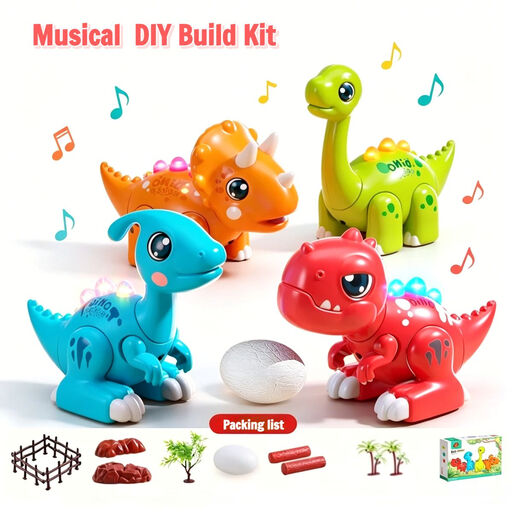
Why this product suits this profile: According to the product information, this building set is designed for children aged 3 to 6 and combines four dinosaurs with landscape accessories for role play.
The age group, simple plug-in mechanism and package contents are clearly stated. This makes it easier to assess whether the set is suitable before buying.
Four figures, landscape elements, plus light and sound functions according to the product description.
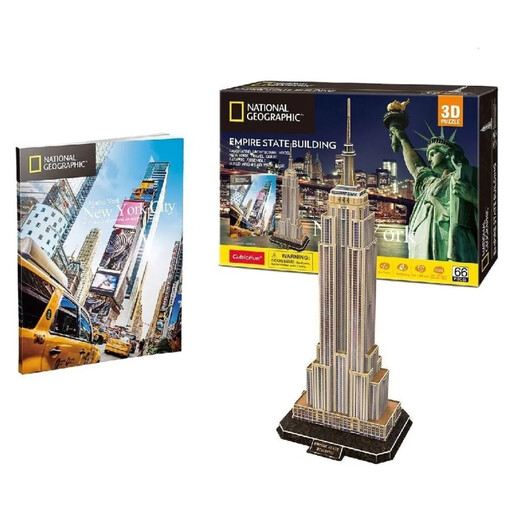
Why this product suits this profile: 66 numbered pieces, wood and printed card, along with an assembly time of approximately 120 to 220 minutes, provide clear guidance.
The pieces are numbered and the model can be assembled without tools or glue. This reduces the need for additional craft materials.
66 pieces, model dimensions of 25 × 20 × 66 cm and the option to use it as a display piece, according to the product data.
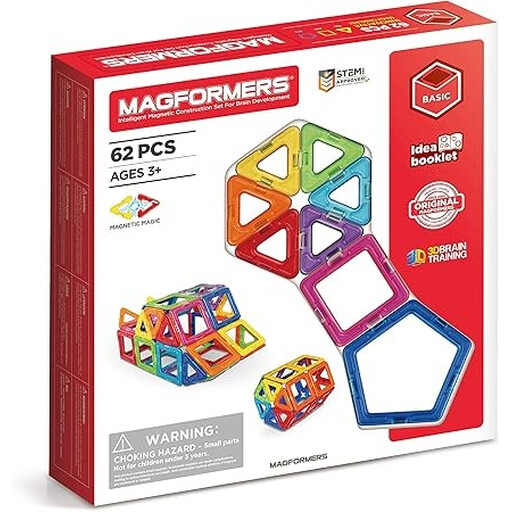
Why this product suits this profile: According to the product data, the set is suitable for children aged 3 and over and is ideal for repeated open-ended building without batteries or fixed assembly.
The set contains 62 pieces that can be combined without tools. The play concept is not tied to a single figure or a fixed finished model.
62 magnetic building pieces, no batteries required, plus features designed to support creative thinking and spatial awareness.

Why this product suits this profile: According to the product information, the model is intended for ages 14 and over and combines wooden model building, a marble run and a USB-powered motor.
The age recommendation, power supply, dimensions and warnings about small parts are clearly stated. This makes it possible to check the space and supervision requirements in advance.
Multi-level tracks, gears, ten steel balls and an included USB cable, according to the product description.
We have put together a complete, regularly updated list of products that fully meet these strict selection criteria and the safety regulations applicable in the EU.
Products with a clear age recommendation, larger components and a simple play concept are suitable. Before buying, read the warnings about small parts, magnets and batteries. Adult supervision is advisable for more complex building sets.
Their lifespan depends on the material, connection mechanism and storage conditions. Plastic pieces should be checked regularly for cracks and damaged edges. Magnetic sets are easier to keep organised when they are stored complete and dry after play. For 3D puzzles made from card or wood, a dry location helps prevent warping.
Mechanical construction sets generally do not require additional consumable materials. Electronic products may need batteries or a USB power source. For example, the TOKKY set requires three AA batteries for its light function; according to the product data, these are not included. A 3D pen, on the other hand, requires suitable filament, which must be replaced once used up.