
Lieferung heute & morgen

Qualitätsgarantie

Willkommens-Angebote freischalten: KOSTENLOSE Lieferung | Bis zu 80 % RABATT | Kostenlose 30-Tage-JoyPlus-Testphase
App herunterladen
Educational toys for children should do more than keep them occupied. They should suit their age, stage of development and family routine. But there are significant differences between marketing terms such as ‘Montessori’, ‘Early Learning’ and ‘sensory’. The most useful information is practical product detail: age guidance, materials, dimensions, how the toy works, how to clean it and any safety advice.
A toy with lights, music, buttons and moving parts may seem versatile. But for babies, an overcrowded control panel can be confusing. Check whether the features are appropriate for the child’s age and whether the volume can be adjusted. For musical toys for babies, it’s also worth checking the batteries, battery compartment and whether there’s a quiet mode.
‘From 3 years’ is not just a suggestion. Small parts can pose a choking risk for younger children. A toy for children aged 1 and over should only be used if the child can grip, sit or stand safely, depending on the product and how it’s being used. For role-play toys for children aged 4 and over, bear in mind that accessories are often small, and adult supervision may be sensible during assembly.
‘Montessori-inspired’ or ‘supports development’ doesn’t automatically mean a toy meets a recognised educational standard. Look instead at the specific ways a child can play with it: pressing buttons, matching shapes, turning, balancing, rolling dice or making up stories together. These activities can offer opportunities to practise perception, coordination and language skills, but they don’t replace an individual assessment of a child’s development.
Start by considering what the child can do independently. Babies often enjoy grasping, exploring different textures and cause-and-effect play. An activity cube for ages 1 to 3 can bring together several simple ways to play. For children aged 4 and over, more complex building sets, role-play toys or first board games may be suitable. A board game for children aged 6 and over should have clear rules and a playing time that fits your family’s routine.
Consider these questions:
For baby toys, rounded edges, a stable base and a secure battery compartment are useful things to check. Product details such as ABS or EVA describe the material, but don’t on their own tell you whether a toy is suitable for every play situation. For foam modules, also check whether the surface can be wiped clean and whether there’s enough room to use them safely.
If a product is second-hand or used frequently, check it regularly for cracks, loose parts, damaged wires and sharp edges. Care instructions should be suitable for cleaning at home. Electronic components should generally not be cleaned under water.
The CE mark is a legally required conformity marking for many products sold in the European Economic Area. The EN 71 series covers safety requirements for toys. Even so, check the specific product description, warnings and what’s included. According to the relevant product details, the musical drum toy and activity cube are described as featuring BPA-free ABS, rounded edges and CE and EN 71 compliance. Batteries are not included with these products.
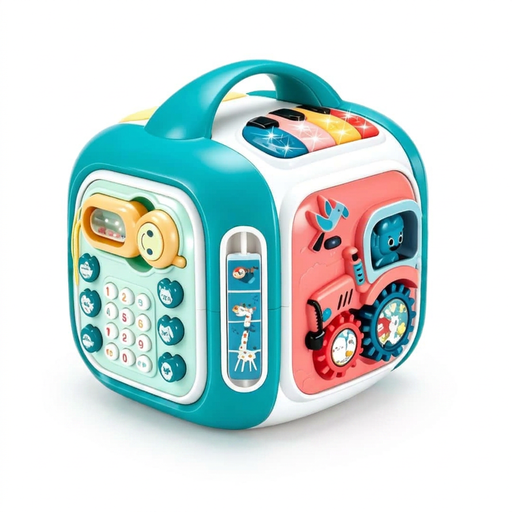
Why it suits this family: This compact cube offers several ways to play for children aged 1 to 3, taking up less space than several separate toys.
The age group, dimensions (23 × 23 × 24 cm) and intended ways to play are clearly stated, making it easier to work out how much space you’ll need before buying.
Eight described play modes, a carry handle and, according to the product details, BPA-free ABS with rounded edges.
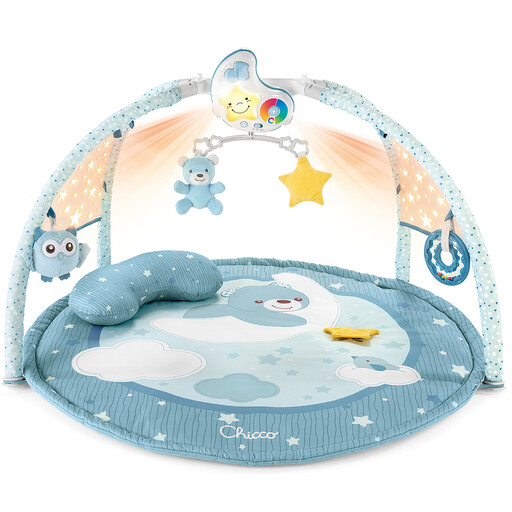
Why it suits this family: Combining a play mat, projection and a detachable unit, this toy is a good fit for families who value clear care instructions and different ways to use it.
According to the product description, the mat and cushion are washable at 30 °C. The 15- or 30-minute timer makes it easier to plan playtime.
Play mat with an 83 cm diameter, detachable projector and several grasping toys; stated as suitable from birth.
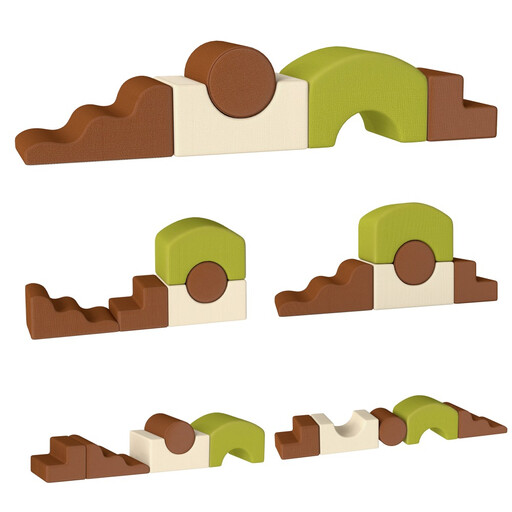
Why it suits this family: These five soft modules are a good option for families who want to create flexible play spaces in a child's bedroom or a childcare setting.
Rather than lots of separate small accessories, the focus is on a coordinated set of foam pieces. Before buying, check the room size and available space for movement.
Five-piece modular set with soft foam construction and a multicoloured corduroy cover, according to the product name.

Why it suits this family: This cooperative board game is stated as suitable for children aged 6 and over, combining shared decision-making with clear rules.
The minimum age of 6 and the warning about small parts are clearly stated. This can help prevent unsuitable purchases for younger children, as long as the guidance is followed.
For 1 to 4 players, with a rotating game board, dice and cooperative gameplay; no batteries required.
We’ve put together a complete, regularly updated list of products that meet these strict selection criteria and fully comply with the safety regulations in force in the EU.
Depending on their stage of development, babies may enjoy grasping toys, play gyms, sensory toys and simple musical toys. Look for suitable age guidance, sturdy parts and a flat surface for play. For toys with lights or sounds, the volume shouldn’t be uncomfortably loud. Keep small detachable parts out of babies’ reach.
Lifespan depends on the materials, how often a toy is used and how well it’s cared for. Check moving parts, seams, battery compartments and surfaces regularly. Signs of wear may appear sooner on toys used frequently to develop motor skills. Stop using damaged products, even if they’re still suitable for the child’s age group.
For electronic baby toys, the main costs are batteries or, where applicable, rechargeable batteries. Product details should tell you whether batteries are included. According to the product descriptions, the musical drum toy, activity cube and play table are supplied without batteries. Before buying, it’s also worth checking for volume controls, an automatic shut-off and the option to use the toy without sound.