
Lieferung heute & morgen

Qualitätsgarantie

Willkommens-Angebote freischalten: KOSTENLOSE Lieferung | Bis zu 80 % RABATT | Kostenlose 30-Tage-JoyPlus-Testphase
App herunterladen
Educational wooden toys should not only look appealing, but also suit your child’s age, stage of development and everyday routine. Montessori toys, wooden puzzles for babies, wooden motor skills toys and larger climbing equipment can differ significantly in terms of materials, safety requirements and how they are used.
Many unsuitable purchases result from three common pitfalls:
When choosing educational toys from 1 year, parents should pay particular attention to the size of handles and individual parts. A wooden puzzle with large knobs is usually easier to grasp than a puzzle with loose, small shapes. Even so, an age recommendation does not replace supervision.
The same applies to a wooden sorting game or stacking toy: as soon as individual elements could be put into the mouth, your child should be watched closely while playing. Safety warnings are particularly important for products containing magnets, balls or mechanical components.
Wooden toys may be made from solid wood, engineered wood or a combination of wood, plastic and metal. Important points include:
According to the product descriptions, several Hauck products use wood from FSC-certified forests. This statement relates to the relevant manufacturer’s information and should not automatically be applied to every educational wooden toy.
A baby play arch is often used on a play mat or rug. A climbing triangle or an outdoor play kitchen, on the other hand, requires more permanent floor space. Before ordering, you should therefore check the dimensions, weight, assembly requirements and storage options.
For indoor use, it is also worth checking whether the product can be folded flat after playtime. With outdoor toys, parents should establish whether the item needs to be stored somewhere dry or covered. Water containers and mud kitchens must be emptied and cleaned after use.
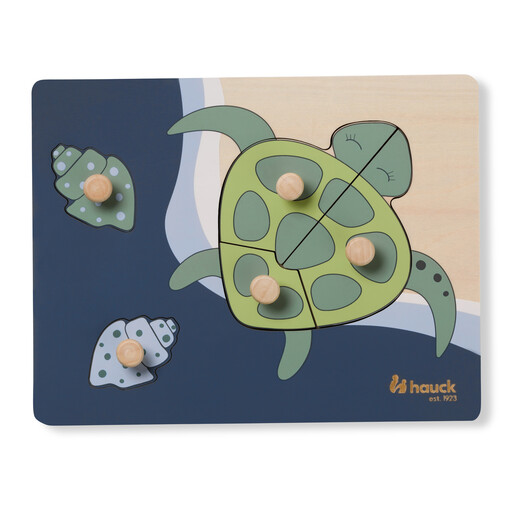
Why this product suits this profile: Measuring 22 × 17 cm, this compact puzzle is ideal for children’s first attempts at fitting and matching pieces on a table or floor.
The from-12-months age recommendation and easy-to-grasp wooden knobs make its intended use clear. Direct supervision is still required.
A wooden board with animal shapes, a rounded design and straightforward shape matching.
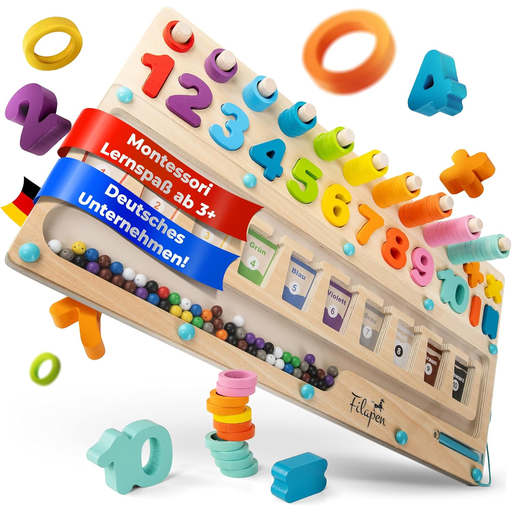
Why this product suits this profile: This multifunctional board combines a magnetic maze, colour sorting and numbers from 1 to 10 in one product.
The play activities are clearly defined: balls are guided with a magnetic pen, and numbers are placed into the matching recesses. The product is expressly not suitable for children under 3 years.
Solid wood, no batteries required and a range of activities from colour recognition to simple counting tasks.
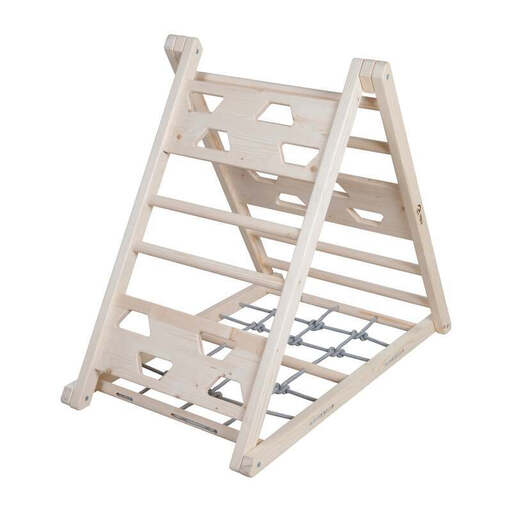
Why this product suits this profile: Measuring 85 × 63.5 × 97.5 cm, this climbing frame is designed for families with enough space and a need for varied movement activities.
The three sides are clearly described: rungs, a climbing rope and gripping surfaces. It must only be used on a level, stable surface and under direct supervision.
Solid wood, a stated load capacity of up to 50 kg, and a compatible slide and gym mat, available separately.

Why this product suits this profile: Featuring a marble run, gears and a USB-powered motor, this model is aimed at teenagers and adults looking for a challenging construction project.
The from-14-years recommendation is clearly qualified by the warning about small parts and moving mechanisms. It is not suitable for younger children.
A completed model measuring 31.2 × 25.1 × 23 cm, with ten steel balls and USB power instead of batteries.
For babies, a baby play arch with wipe-clean surfaces and securely attached play elements may be suitable. According to the product information, the roba Montessori Baby Play Arch measures 52 × 70 × 50.5 cm and is intended for babies from 3 months. It should only be used on a level surface and under supervision.
From around one year, a wooden peg toy, sorting game or stacking toy may be suitable. The Hauck sorting game in the shape of a house contains eight building blocks and also provides storage space. The Hauck Wooden Stacking Tower combines stacking, sorting and recognising animal motifs.
For the garden, an outdoor play kitchen belongs to a different product category from traditional tabletop toys. The roba Mud Kitchen measures 124 × 89 × 34 cm, is intended for children from 18 months and includes a tub, a water container with tap and various accessories. Water should be removed after every use; when not in use, dry storage is recommended.
We have put together a complete, regularly updated list of products that fully meet these strict selection criteria and the safety regulations applicable in the EU.
For children aged 12 months and over, large wooden puzzles, simple peg toys, sorting games and stacking toys may be suitable. Look for easy-to-grasp elements, rounded edges and the instruction “use under supervision”. Small parts should not be given to children who still frequently put objects in their mouths.
Their lifespan depends on the quality of the workmanship, the level of use, moisture and care. Tabletop toys should be stored in a dry place and cleaned with a slightly damp cloth. With climbing equipment, screws, connections and surfaces should be checked regularly. Damaged, loose or splintered parts should no longer be used.
Many simple wooden puzzles, peg toys and sorting games require neither batteries nor electricity. Larger products may incur additional costs for assembly accessories, a suitable mat or a slide available separately. The Robotime 3D model requires a 5-volt USB connection for its motor; according to the product description, a USB cable is included.