
Lieferung heute & morgen

Qualitätsgarantie

Willkommens-Angebote freischalten: KOSTENLOSE Lieferung | Bis zu 80 % RABATT | Kostenlose 30-Tage-JoyPlus-Testphase
App herunterladen
Vitamin and mineral effervescent tablets are convenient: drop a tablet into water, let it dissolve and you're done. Even so, choosing the right one isn't always straightforward. Terms like "high-dose", "complex" or "for energy and immune system" can quickly distract you from the crucial details: nutrient amounts, age suitability and composition.
If you're looking to buy dietary supplements as effervescent tablets, you shouldn't just compare flavour and packaging design. What really matters are the actual nutrients per daily serving, any potential overlap with other supplements you're taking, and whether the product suits your personal needs.
With magnesium effervescent tablets, the amounts can range from 300 mg to 400 mg or even 500 mg per tablet, depending on the product. A higher dose isn't suitable for everyone. According to product information, magnesium portions over 250 mg can have a laxative effect in sensitive individuals. If you take medication regularly, have impaired kidney function, or already use several mineral supplements, you should discuss taking them with a doctor or pharmacist beforehand.
The same applies to vitamin C with zinc or vitamin D-containing products: the daily portion is more important than a marketing claim like "high-dose". Check whether other supplements you're already taking provide the same nutrients.
Multivitamin effervescent tablets can combine various vitamins in one serving. That's handy for general supplementation, but it isn't automatically the right solution if you specifically want magnesium, calcium or vitamin C. A product with 21 vitamins and minerals, for example, contains different amounts of each nutrient compared with a targeted magnesium or calcium formula.
Gluten-free effervescent tablets and lactose-free effervescent tablets are important selection criteria for many consumers. However, you shouldn't assume a product is "vegan" – this needs to be explicitly confirmed on the packaging or product page. It's also worth checking the sweeteners, flavourings and allergen information.
Pay attention to the information per tablet or daily serving. The NRV (Nutrient Reference Value) shows the legally defined reference value for adults. A high percentage describes the amount contained, but it isn't an individual dosage recommendation.
Examples from our selection:
The recommended serving for the products featured here is usually one tablet daily. However, the amount of water needed for dissolving differs: depending on the product, 200 or 250 ml of water is specified. You should follow this guideline so that the taste and concentration of the daily serving match the product information.
Not every product is suitable for teenagers aged 12 and over. The Doppelherz Magnesium + Calcium + D3 variant is intended for adults and children aged 12 and over, according to the product description. In contrast, the Sunlife vitamin C product is explicitly stated as not suitable for children and teenagers. The information on the packaging always takes precedence.
For physically active people, a product with Magnesium Potassium Sport could be of interest if you also want potassium and B vitamins. For bone and dental concerns, calcium D3 effervescent tablets may be suitable. If you only want to supplement vitamin C, you don't necessarily need a multivitamin formula.
Also look out for information such as:
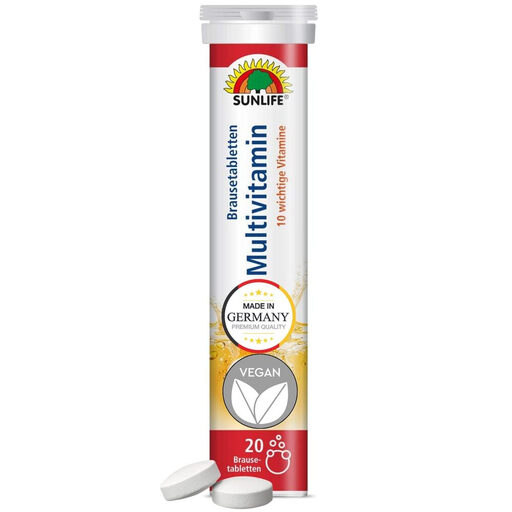
Why this product fits the profile: The formula combines ten vitamins in one daily effervescent tablet and is described as gluten-free and lactose-free. This makes it suitable for consumers looking for a general supplement rather than a single mineral.
The nutrient list states the amounts per daily serving rather than just referring to a generic "complex". Vitamin C, B vitamins, vitamin E, folic acid and biotin are all listed individually.
Ten vitamins, orange flavour, and gluten-free and lactose-free product claims; one tablet dissolves in 200 ml of water.

Why this product fits the profile: According to the product information, the formula contains 21 vitamins and minerals, including vitamin C, D, zinc, calcium and magnesium. This allows you to compare a broad range of nutrients in one daily serving.
The individual amounts and NRV percentages are listed. This makes it clear that calcium and magnesium are dosed lower than in targeted mineral products.
Broad combination of vitamins and minerals, daily serving of one tablet, and dissolves in 200 ml of water.

Why this product fits the profile: For physically active adults who want to combine magnesium and potassium in one serving. The product information states 300 mg of magnesium, 300 mg of potassium, plus vitamin B6 and B12.
The electrolytes are clearly listed separately. In addition, gluten-free, lactose-free and vegan suitability are stated in the product description.
Magnesium-potassium combination, vitamin B6 and B12, vegan and gluten-free and lactose-free product claims; one tablet daily in 200 ml of water.
We've put together a complete, regularly updated list of products that fully meet these strict selection criteria and the safety regulations in force in the EU.
The best-before date is printed on the packaging. After opening, the tubes or containers should be kept tightly sealed, dry and cool. Moisture can cause the tablets to react prematurely. Follow the manufacturer's specific storage instructions, often at or below 25 °C.
That depends on the product. Some preparations are intended for ages 12 and over, while others are aimed exclusively at adults. Before buying, check the age recommendation, daily serving and any warnings. If you have existing medical conditions or take medication regularly, it's advisable to speak with a doctor or pharmacist.
To compare, divide the pack price by the number of recommended daily servings. A pack of 15 tablets, at one tablet daily, usually corresponds to 15 servings. Delivery costs and price differences between single packs and multi-packs can also play a role. What matters isn't just the price per tablet, but the nutrient amount per daily serving.