Class leaders serving a group
If you need to serve several soft-boiled eggs at the same time, capacity per batch is a key planning factor. Compare it with the size of your group and plan for multiple batches if necessary.


First, choose an egg boiler based on how many eggs need to be ready at the same time during the class: for larger groups, consider models with six or seven slots; for smaller stations, a model with up to three slots may be more suitable. An adjustable doneness setting does not automatically guarantee evenly cooked soft-boiled eggs, so test the setting with the eggs you plan to use in the class. Also check whether the manufacturer permits the intended use in your cookery class.
If you need to serve several soft-boiled eggs at the same time, capacity per batch is a key planning factor. Compare it with the size of your group and plan for multiple batches if necessary.
If you’re comparing soft-boiled and medium-soft eggs, test the setting with the eggs you’ll use in class and allow time for a trial run.
A model with up to three slots may be enough if you only need to cook a few eggs at each station. Also check how easy it is to remove the egg holder and what the instructions say about cleaning.
First, work out how many eggs you need to cook at once. Then check the specific model’s doneness settings, ease of use and cleaning requirements.
| Criterion | What to check before buying | Who is this important to? |
|---|---|---|
| Cooking a batch together | Compare the specific model’s capacity with the number of eggs you’ll serve at once, and plan for any additional batches. | If I want the group to taste the eggs at roughly the same time, the number of eggs per batch matters. Around 36% of consumers say that serving portions together is their main concern. |
| Soft-boiled doneness | Check the adjustment method in the instructions and do a trial run using eggs of a similar size and temperature, with a similar load. | If we’re comparing different soft-boiled eggs in class, I want to be able to repeat the process under similar conditions. Around 29% of consumers say achieving consistent doneness is their main concern. |
| Safe removal | Follow the instructions for opening the appliance, escaping steam and handling the egg holder, and choose a suitable place to use it. | If several people are using the appliance, I want to organise the removal of hot eggs carefully and take account of the steam. Around 21% of consumers say safe handling in a group is their top priority. |
| Small station and cleaning | Compare the space available, the number of eggs and the cleaning instructions for each part of the specific model. | If only a few eggs are being cooked at a small station, I’d prefer a simple set-up to a large batch capacity. Around 14% of consumers say a compact set-up and easy care are their main concerns. |
The CHIP practical test points out that electronic controls alone do not guarantee greater accuracy in every case. Doneness can vary if egg size, temperature or the number of eggs changes.
Before the class, test the controls under conditions that are as similar as possible, then remove the eggs when the signal sounds, following the instructions.
An appliance that holds up to three eggs won’t be enough on its own for a larger batch to serve together. Cooking several batches may mean the eggs are not ready at the same time.
Plan according to the number of portions you need at once and the capacity of the specific model.
The instructions for the WMF Stelio and Rommelsbacher ER 400 restrict commercial or exclusively commercial use. Whether a particular class falls into this category depends on how the appliance is used.
Clarify the nature of the class and read the terms of use for the specific appliance before buying.
WMF states that the Stelio is not dishwasher-safe. Cleaning instructions can vary between parts and models.
Check the instructions for the egg holder, lid and heating plate rather than assuming that the casing material determines how every part should be cleaned.
According to WMF, the Stelio holds up to seven eggs and has an adjustable cooking time with an audible signal.
According to the manufacturer, the ER 400 holds one to seven eggs and the ER 300 holds one to three; both have a timer-controlled doneness setting.
According to the manufacturer, the EK 3169 holds up to six eggs, while the EK 3163 is a version for up to three eggs.
According to Krups, the Ovomat Super EG2301 holds seven eggs and has cooking and keep-warm modes.
The following products are worth considering when planning a batch of up to six eggs. Compare their doneness settings and ease of use with the needs of your class.
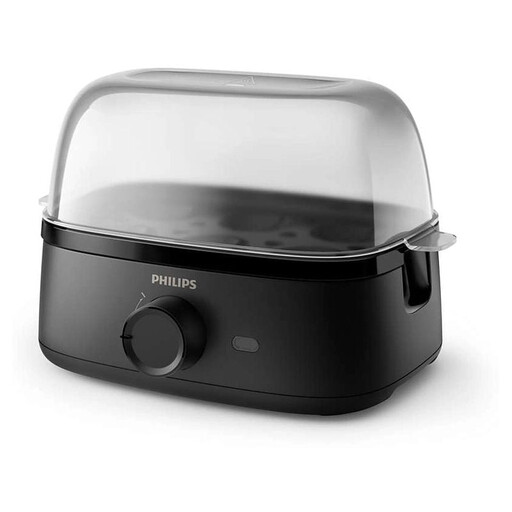 No image available
The stated capacity of six eggs is useful when planning a batch for the whole class; the description also lists soft-boiled eggs as a cooking option.
Capacity: up to six eggs. Water-level markings for soft, medium or hard-boiled eggs; audible ready signal. Includes a measuring cup and an insert for up to three poached eggs. Rated power: 400 W.
Hot steam may escape when you open the lid; the product description advises opening it carefully and warns that some parts will be hot.
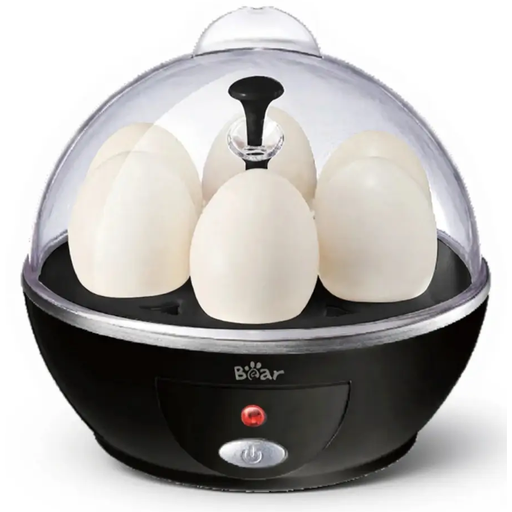 No image available
The stated capacity of six eggs can be taken into account when planning a batch for the whole group.
Capacity: six eggs. According to the instructions, the amount of water determines the desired level of doneness; one-button operation and automatic shut-off when the water has evaporated. Rated power: 360–430 W.
The product description advises against operating the appliance without water and says to unplug it before cleaning.
Divide the number of eggs you need at the same time by the capacity of the specific appliance, then plan for whole batches. Depending on the model, the capacities mentioned range from three to six or seven eggs. The number of participants alone is not enough to plan around.
For the Severin EK 3169, the manufacturer lists egg size, the number of eggs and their starting temperature as factors that affect the result. Test the setting under conditions as close as possible to those in your class, and remove the eggs when the signal sounds so they don’t continue cooking in the residual heat.
There is no one-size-fits-all answer for every appliance and every class. The WMF instructions rule out exclusively commercial use of the Stelio; the Rommelsbacher instructions state that the ER 400 is not intended for commercial use. Check how your class is classified and review the terms of use for the specific model.
The German Federal Institute for Risk Assessment warns of the risk of salmonella from eggs that have not been heated sufficiently, and notes that the risk is higher for small children and people with weakened immune systems, among others. Take any particular dietary safety needs into account when planning food and, if appropriate, offer a thoroughly cooked alternative.
New mains-powered appliances placed on the German market that fall within the voltage range of the EU Low Voltage Directive must meet the relevant safety and conformity requirements. These include checking the CE marking, the required documentation and clear safety information. A product description alone does not prove that a specific listing is compliant.