Planners of freezer lunch boxes
You want to prepare cooked eggs as a ready-to-eat part of a frozen lunch box. First, consider whether freezing is right for the quality you want – the cooker’s maximum egg capacity comes second.


If you want whole, cooked eggs to go straight into a lunch box after defrosting, an egg cooker won’t solve the main quality issue: cooked egg whites can become soft, chewy or spongy when frozen, according to the University of Georgia’s National Center for Home Food Preservation. For lunch boxes with chilled eggs, choose a capacity that matches how many you actually need to cook at a time. Ease of use, safe removal and cleaning matter too.
You want to prepare cooked eggs as a ready-to-eat part of a frozen lunch box. First, consider whether freezing is right for the quality you want – the cooker’s maximum egg capacity comes second.
You regularly cook several eggs ahead for lunch boxes and need enough spaces per batch, as well as a practical plan for chilling and transporting them.
You usually cook just a few eggs at a time. In that case, a cooker that fits your available space, is easy to use and simple to clean may matter more than a high stated capacity.
Suitable if: you want your lunch box to contain whole eggs that are ready to eat after defrosting.
The trade-off: An egg cooker won’t change the fact that cooked egg whites can lose their texture after freezing.
Suitable if: you want to cook several eggs at a time for lunch boxes that will be kept chilled.
The trade-off: The cooker’s capacity may reduce the number of batches you need, but it doesn’t replace chilling or checking that the eggs have reached your preferred doneness.
Suitable if: you plan to use the eggs later in a dish that will be thoroughly cooked.
The trade-off: The Federal Centre for Nutrition describes freezing raw egg mixture without the shell. This is a different kind of preparation from cooking eggs in an egg cooker.
First decide whether the eggs will go into your lunch box chilled or frozen. For chilled portions, choose a capacity that suits the number of eggs you usually cook at a time.
| Key consideration | What to check before buying | Who should pay particular attention? |
|---|---|---|
| Suitability for freezing | Before buying, decide whether you plan to freeze whole cooked eggs, keep eggs chilled or use them later in thoroughly cooked dishes. | If I want to freeze cooked eggs that are ready to eat, their quality after defrosting must come first. Around 33% of consumers would make suitability for freezing their top buying consideration. |
| Capacity per batch | Compare the number of eggs you need with the model’s stated capacity, for example three, six or eight eggs. | If I prepare several lunch boxes at once, the number of eggs per batch matters. Around 27% of consumers would put batch size first. |
| Doneness and handling | Check whether the cooking time or amount of water can be adjusted, whether there’s an end-of-cycle signal and how easy the egg tray is to handle. | If I need to adjust doneness and remove hot eggs, I look for clear controls and an easy-to-handle egg tray. Around 20% of consumers would prioritise doneness and handling. |
| Cleaning | Check the instructions to see which parts can be removed and which should only be wiped clean with a damp cloth. | If I use the appliance regularly, easy care is important to me. Around 20% of consumers would make ease of cleaning their top buying consideration. |
A larger capacity won’t improve the texture of cooked egg whites after defrosting. The University of Georgia’s National Center for Home Food Preservation describes possible changes, including a soft, chewy or spongy texture.
First decide whether you’ll keep the portions chilled or use the eggs later to make other dishes that will be thoroughly cooked.
The Federal Centre for Nutrition notes that a sudden change in temperature can encourage small cracks in the shell. So, manufacturer instructions on cooling eggs for removal or serving don’t automatically answer the question of how to store them.
When preparing portions ahead, consider whether the shells are intact and choose a storage method that suits when you plan to eat them.
In its practical test on 26 October 2026, CHIP noted that electronic controls alone don’t guarantee a better result.
Choose controls that suit your routine, and check the doneness with the egg size and quantity you usually cook.
According to the manufacturer, the E9 is designed to cook up to eight eggs, making it suitable for larger batches.
According to the manufacturer, the ER 600 holds up to six eggs, while the ER 300 is designed for up to three.
According to the manufacturer, the Stelio is designed for seven eggs and offers an adjustable cooking time.
According to the manufacturer, the EK 3163 is designed for up to three eggs and the EK 3166 for up to six.
According to the manufacturer, the 6070 is designed for up to seven eggs and has a keep-cooking function.
The appliances below are designed to cook several eggs at a time, ready to be chilled for lunch boxes. They don’t make cooked eggs suitable for a ready-to-eat frozen lunch box.
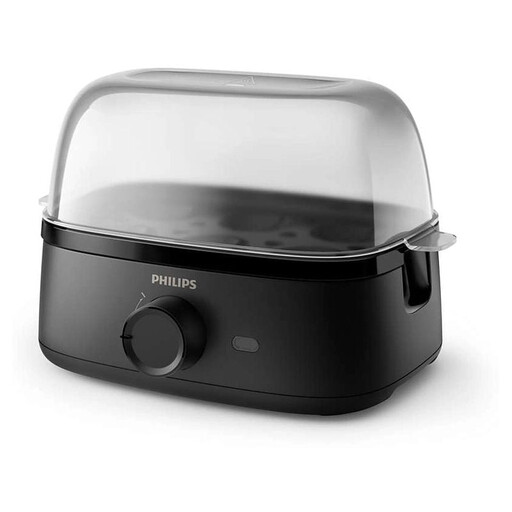 No image available
For several chilled lunch box portions: this egg cooker is designed to cook up to six eggs at a time.
Features an audible signal, 400 W power and an insert for up to three poached eggs.
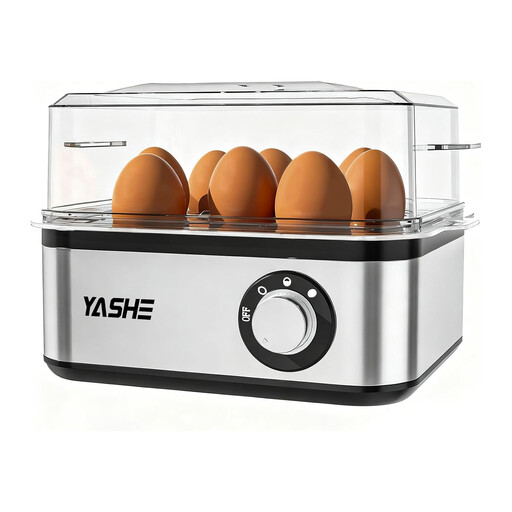 No image available
For larger batches of chilled lunch box portions: the stated capacity is up to eight eggs at a time.
The product name lists three cooking settings for soft, medium and hard eggs, as well as overheat protection.
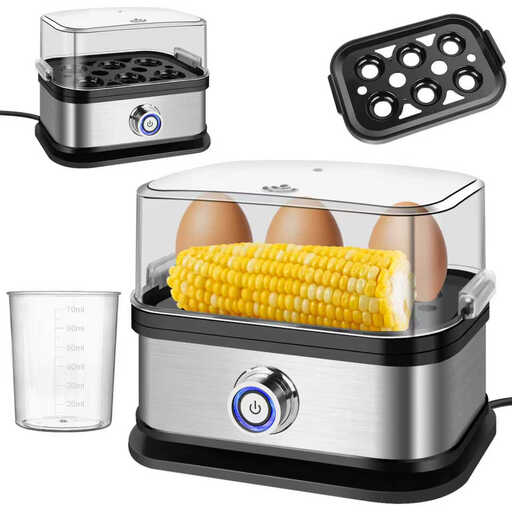 No image available
For several chilled lunch box portions: the stated capacity is up to six eggs.
The product name lists boil-dry protection; the description mentions doneness options, an audible signal and automatic switch-off.
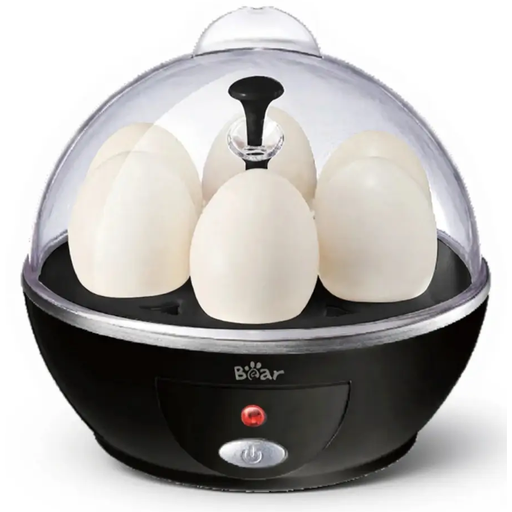 No image available
For several chilled lunch box portions: this model is designed to cook up to six eggs.
The stated power is 360–430 W. According to the description, you can adjust doneness by changing the amount of water; a measuring cup and automatic switch-off are also listed.
For whole eggs that are ready to eat, freezing isn’t a reliable way to get the texture you want: cooked egg whites can become soft, chewy or spongy after defrosting. The Federal Centre for Nutrition describes freezing raw egg mixture without the shell for later use in thoroughly cooked dishes. That’s not the same as freezing cooked eggs for a lunch box.
The Federal Centre for Nutrition says hard-boiled eggs can keep for around two weeks at fridge temperature, but notes that cracks caused by rinsing them in cold water can shorten their shelf life. Keep them properly chilled during transport; an insulated bag without a cold source won’t keep them at fridge temperature.
Choose a capacity that matches the number of eggs you usually want to cook at once. A model with three slots may require several batches for larger quantities. A capacity of six or eight is only useful if you regularly need to cook that many eggs at a time.
Follow the instructions for your specific model. For the Severin EK 3166, the manufacturer advises unplugging the appliance, letting it cool, removing any remaining water and wiping the cooking plate with a damp cloth. For limescale, it recommends using water and vinegar. Don’t immerse the whole appliance in water, and don’t assume a stainless steel part is dishwasher-safe.
If you buy from a business seller, EU consumer information states that you have a minimum two-year legal guarantee from the seller, starting when you receive the goods. Any additional manufacturer’s guarantee is separate, so check the terms of the specific offer.