Lunch box prepper with a small kitchen
If you usually prepare just a few eggs, consider the appliance’s footprint and the extra space you’ll need to lift off the lid.


If you’re short on worktop space, consider a cooker for one or two eggs, or one that holds up to three, provided its dimensions leave room for the lid and escaping steam. A higher-capacity model may mean fewer cooking rounds when you’re preparing several lunch boxes, but it will still need a suitable spot. Whatever the size of the appliance, check how easy it is to use and remove the eggs, and make sure you can keep them safely chilled for transport.
If you usually prepare just a few eggs, consider the appliance’s footprint and the extra space you’ll need to lift off the lid.
If you want to cook several eggs at once, compare the quantity you need with the stated capacity and the space available.
If you’re preparing eggs to take with you, plan how you’ll store and chill them as part of your lunch box routine; the appliance’s keep-warm function is no substitute.
First, work out how many eggs you actually cook at once. Then compare the dimensions, how the controls work, and what’s involved in storing and transporting your eggs.
| What matters | What to check before buying | Who it matters to |
|---|---|---|
| Worktop space | Check the appliance’s dimensions, and allow room for the cable, lid and safe steam release for the specific model. | If you have limited worktop space, remember to allow room to open and remove the lid too. Around 36% of consumers prioritise the appliance’s footprint. |
| Eggs per cooking round | Compare the number of eggs you need to cook at a time with the stated capacity; models are available in different sizes for smaller and larger batches. | If you’re preparing several lunch boxes at once, a higher capacity could save you extra cooking rounds. Around 29% of consumers prioritise batch size. |
| Storage and transport | Plan how you’ll keep eggs chilled while you’re out, separately from appliance features such as keeping them warm. | If you’re taking cooked eggs with you, storage and transport conditions matter, whatever the cooker’s capacity. Around 21% of consumers prioritise taking lunch on the go. |
| Controls and egg removal | Check whether you set the desired firmness using a measuring cup or a timer, and whether the egg tray can be removed. | If you use the appliance regularly, make sure its controls and egg-removal process suit your preferences. Around 14% of consumers prioritise ease of use. |
Even a slim appliance needs enough room for the lid and steam when you open it and cook.
Measure the available space and check the dimensions of the specific model, including the room needed to use it.
In a hands-on test of eight appliances, CHIP found that electronic controls alone don’t guarantee better cooking results.
Compare how the controls work and look for useful details about the exact model, rather than assuming the type of controls determines the result.
An appliance’s keep-warm function won’t chill prepared food for you to take with you later.
Plan storage and transport separately from your choice of egg cooker. For taking food on the go, the German consumer advice centre lists insulated bags, cool boxes and ice packs as options.
The KÜCHENminis is an option for smaller quantities if one or two eggs per cooking round is enough.
The ER 300 holds up to three eggs and combines a slim design with timer-controlled firmness settings.
The EK 3163 is a three-egg option with electronic cooking-time monitoring.
The Ovomat Trio F23470 is designed for up to three eggs and uses a measuring cup to set the water level.
The SIXCOOK 303721 is designed for larger quantities to fill several lunch boxes.
The Joybuy products below are designed for larger quantities of eggs to fill several lunch boxes. Compare the stated capacity with your needs and check that the appliance, with enough room to use it, will fit on your worktop.
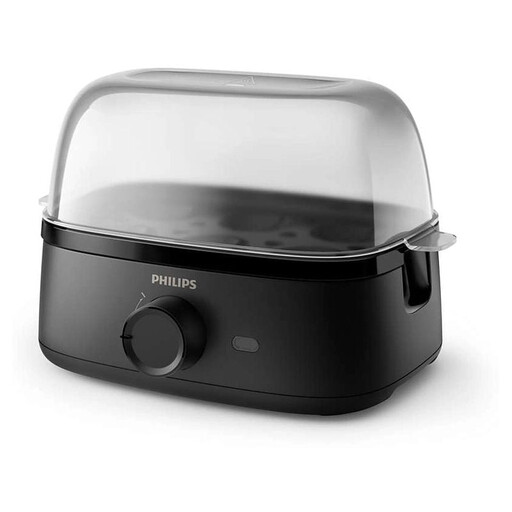 No image available
The stated capacity may suit larger batches and several lunch boxes.
Holds up to 6 eggs; includes an insert for up to 3 poached eggs, an audible ready signal and removable dishwasher-safe parts.
Dimensions: 16 × 17 × 23 cm. Power consumption: 400 W.
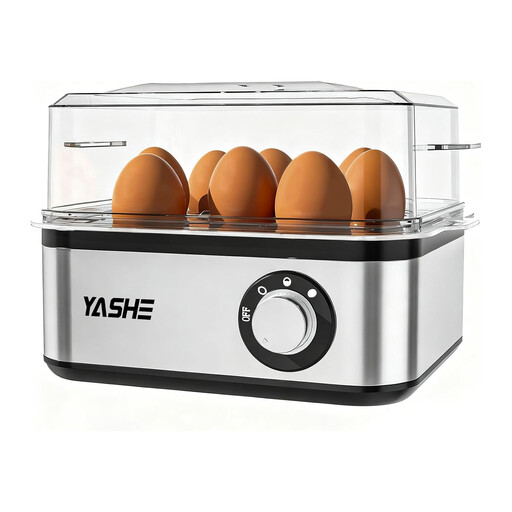 No image available
The stated capacity is intended for larger batches; make sure it suits the worktop space available.
Holds up to 8 eggs; includes 3 cooking settings, a measuring cup, an omelette pan and overheat protection.
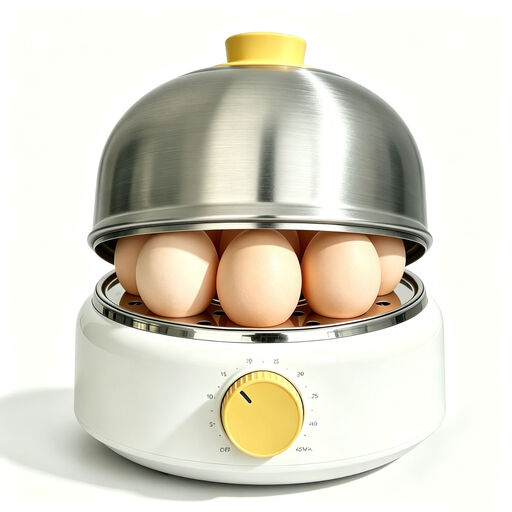 No image available
The capacity may suit a larger batch for lunch boxes, provided you have enough room for the appliance and to use it.
Holds 7 eggs; features adjustable firmness settings, a 45-minute timer and overheat protection.
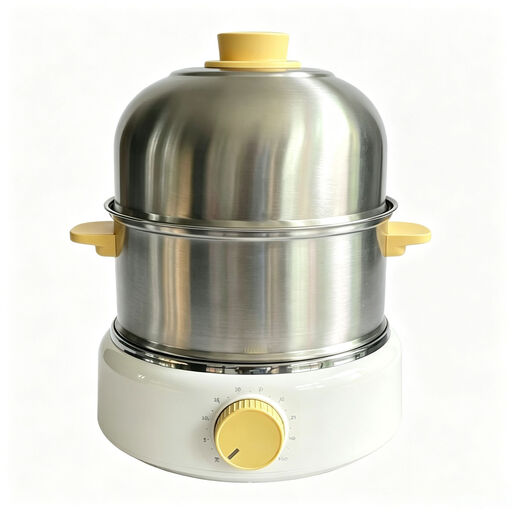 No image available
The high stated capacity could suit a batch for several lunch boxes; check that you have enough worktop space.
Holds up to 18 eggs across two tiers; features adjustable firmness settings and a timer. Power consumption: 400 W.
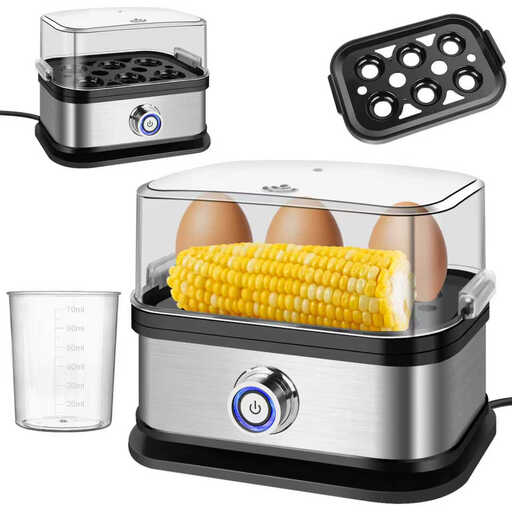 No image available
The stated capacity is intended for larger batches; the dimensions help you check whether it will fit on a limited worktop.
Holds up to 6 eggs; features boil-dry protection, an audible signal and automatic shut-off. The description gives approximate dimensions of 13,5 × 13 × 18,5 cm.
Power consumption: 350 W.
Start by counting how many eggs you want to cook at once. The appliances described here range from models for one or two eggs to those holding up to three, six or more. Then compare the quantity you need with the dimensions of the specific appliance.
The German consumer advice centre recommends storing eggs in the fridge; eggs that have been cooled in cold water don’t keep as long as those that haven’t. Check the shells for damage and make sure you have a suitable way to keep them chilled during transport. A keep-warm function doesn’t tell you how long they can be transported safely.
Leave enough room beside the appliance to remove the lid without coming into contact with hot steam. Read the cleaning and safety instructions for the specific model; a removable egg tray doesn’t mean that electrical parts can be washed.
No. The German consumer advice centre distinguishes statutory rights relating to faulty goods from a guarantee, which is an additional voluntary promise subject to its own terms and conditions.
For an appliance covered by Germany’s Electrical Equipment Regulation, you should check for the required CE marking and accompanying documentation in German. The German Federal Network Agency highlights the need for documents such as an instruction manual and safety information. A CE marking is not an independent quality mark, so check the details for the specific product listing.