Preparing a batch for the week
If you cook eggs for several lunchboxes after your shop, the right capacity per batch is key. WMF and Rommelsbacher offer models in different sizes.


If you prepare several eggs for lunchboxes after your weekly shop, choose a capacity that suits the amount you usually cook. An appliance that cooks several eggs at once saves you extra batches, while a compact model takes up less space. Also consider how you prefer to use it, and plan for chilled storage and transport separately from your egg cooker purchase.
If you cook eggs for several lunchboxes after your shop, the right capacity per batch is key. WMF and Rommelsbacher offer models in different sizes.
If the eggs will be eaten later, think beyond cooking and plan for intact shells, chilled storage and transport. Verbraucherzentrale, Bundeszentrum für Ernährung and Bundesinstitut für Risikobewertung all cover these aspects.
If you usually cook just one or two eggs, a smaller appliance may suit your cooking routine better. According to the manufacturer, the WMF KÜCHENminis is designed for one or two eggs.
First, count how many eggs you usually cook at once. Then consider how the appliance works, as well as how the cooked eggs will be stored and transported before lunchtime.
| Priority | What to look for when buying | Who is this most important to? |
|---|---|---|
| Capacity for a weekly batch | Compare the amount you usually cook with the capacity of the specific model. WMF lists a capacity of up to seven eggs for the Stelio, while Rommelsbacher lists up to six for the ER 600. | When I prepare several lunch portions after my shop, I want to keep the number of cooking batches to a minimum. Around 36% of consumers for whom a weekly batch is the deciding factor are likely to prioritise capacity. |
| Storage and transport | Plan for chilled storage and the journey until the eggs are eaten; an appliance’s capacity tells you nothing about how they should be stored afterwards. BfR highlights the importance of temperature during transport. | If the eggs will be eaten later, I want to know how to store and transport them safely until lunchtime. Around 29% of consumers are likely to consider this their main priority. |
| Size for smaller portions | Check the capacity and make sure the appliance fits the space you have available. WMF lists a capacity of one to two eggs for the KÜCHENminis, while Rommelsbacher lists one to three for the ER 300. | If I only cook one or two eggs occasionally, I don’t want to choose a larger appliance for a portion I rarely need. Around 21% of consumers are likely to see smaller batches as their main reason for choosing a model. |
| Controls and cleaning | Check the instructions for the specific model to see how to set the cooking level and water quantity, and how to clean the heating plate. | If I use the appliance regularly, I want to know what I’ll need to do each time I cook and how to clean it. Around 14% of consumers are likely to place particular importance on ease of use and care. |
Models such as the WMF KÜCHENminis are designed for one or two eggs, while other appliances can cook larger quantities at once. A capacity that’s too small may mean extra batches; a larger appliance could take up more space than you need for your usual portions.
First, note how many eggs you normally cook at once, then compare this amount with the capacity of the specific model.
A larger weekly batch may need several rounds in a compact appliance. A larger model, meanwhile, may permanently take up more worktop space.
A buzzer tells you when a cycle has finished, but it doesn’t prove that the eggs will reach your preferred cooking level every time. CHIP points out that electronic controls alone don’t guarantee a better result.
Compare how the specific appliance works and follow its instructions on timing or water quantity.
Advice on storing eggs in the fridge doesn’t automatically apply when they’re transported without refrigeration. Bundesinstitut für Risikobewertung stresses that the temperature during transport matters too.
Check the shells before packing the eggs, and plan storage and transport to suit the conditions until they’re eaten.
You may need a suitable way to keep the eggs cool during transport.
The KÜCHENminis and Stelio ranges cater for different portion sizes.
According to Rommelsbacher, the ER 300 is designed for one to three eggs, while the ER 600 is designed for one to six.
According to Krups, the Ovomat Special F23370 is designed for up to seven eggs and uses water measurement to control cooking.
Severin offers the EK 3163 for up to three eggs and the EK 3166 for up to six.
The Joybuy models featured here are designed to cook several eggs at once; the capacities stated in their product names range from six to 18 eggs.
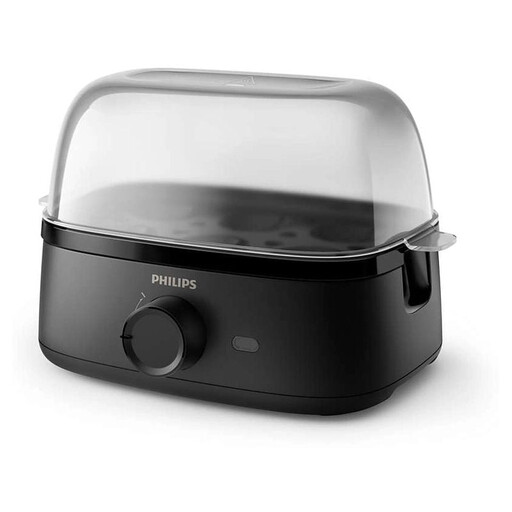 No image available
A good choice if you want to cook several eggs at once.
For up to six eggs; includes a poaching insert, an audible end-of-cycle signal and 400 W of power.
Hot steam may escape when you open the appliance; the heating plate and inserts get hot. Unplug it before cleaning and never immerse it in water.
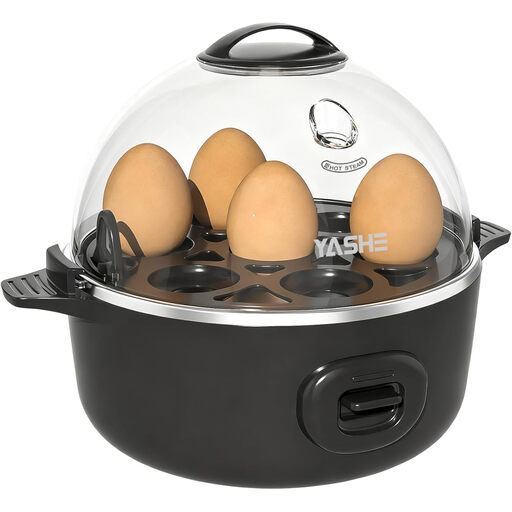 No image available
A good choice if your usual batch fits within the stated capacity for one cooking cycle.
For up to seven eggs.
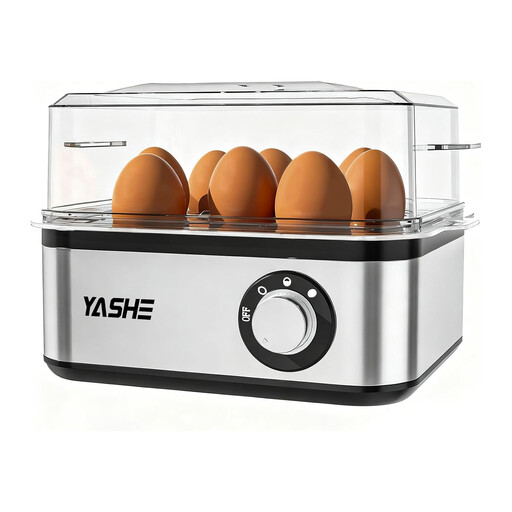 No image available
A good choice if you cook several eggs at once and want to choose between the stated cooking levels.
For up to eight eggs; three cooking levels: soft, medium and hard.
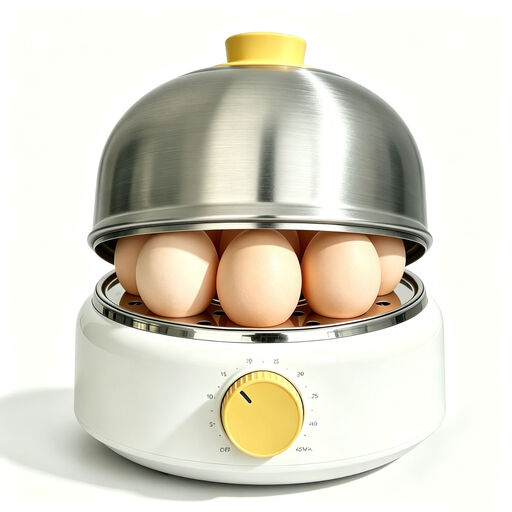 No image available
A good choice if you cook a larger batch and want to use a cooking-level setting.
For seven eggs; includes a 45-minute timer.
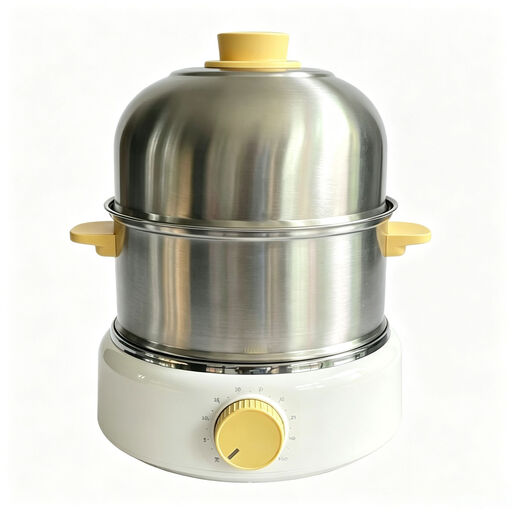 No image available
A good choice if you want to cook a larger quantity at once.
For up to 18 eggs on two levels; 400 W.
Keep them chilled and make sure the shells are intact. Verbraucherzentrale says that hard-boiled eggs which haven’t been cooled under cold water and have intact shells can keep for up to four weeks at 2 to 6 °C; Bundeszentrum für Ernährung gives a guideline of around two weeks at fridge temperature. These figures aren’t a guarantee of how long eggs will keep in a lunchbox without refrigeration, or if they’re damaged. Bundesinstitut für Risikobewertung also points out that the temperature during transport matters.
For longer storage, Bundeszentrum für Ernährung advises against it, as small cracks in the shell can shorten the eggs’ shelf life. Verbraucherzentrale also distinguishes between eggs that have and haven’t been cooled under cold water. Advice to cool eggs for immediate serving applies to a different situation.
Follow the instructions for your particular model. For the EK 3166, Severin recommends unplugging the appliance before cleaning, allowing it to cool and wiping the cooking plate with a damp cloth only. The manufacturer recommends using water and vinegar to remove limescale.
It is relevant for appliances covered by the applicable EU regulations. The European Commission lists household appliances operating at 50 to 1,000 V AC as an example covered by the Low Voltage Directive. Where the relevant EU rules require CE marking, the manufacturer is responsible for conformity and marking. The marking alone is not an independent quality mark.
No. Umweltbundesamt explains that electrical and electronic waste must be collected separately from unsorted household waste. Local collection points accept it free of charge.