Several portions in one go
If you’re making several portions of salad, check how many eggs the specific model can hold at once. Compare this figure with the quantity you usually need for your recipe.


If you’re preparing several portions of salad, start by choosing a cooker based on how many eggs it can cook at once. According to their manufacturers, the Severin EK 3165 and Rommelsbacher ER 600 can cook up to six eggs, while the WMF Stelio and Rommelsbacher ER 400 can cook up to seven. Then compare the cooking-level controls and care instructions for the exact model; a buzzer or cooking-level scale doesn’t guarantee a particular result. If you’re making salad ahead of time, plan to chill it appropriately — that’s separate from the egg cooker’s performance.
If you’re making several portions of salad, check how many eggs the specific model can hold at once. Compare this figure with the quantity you usually need for your recipe.
If you want the eggs to have a particular texture for your salad, check the model’s controls and cooking-level settings. A setting alone can’t guarantee a specific result.
If you’ll be cooking multiple batches, compare how easy the lid and egg tray are to handle, along with the care instructions for each part.
First, work out how many eggs you usually cook in a batch. Then you can weigh up the cooking-level settings, care requirements and availability of spare parts.
| What matters to you | What to check before buying | Who’s most likely to prioritise it |
|---|---|---|
| Capacity per batch | Count the eggs you need for your usual recipe and check the maximum capacity of the specific model. | If I want to cook the eggs for my usual quantity of salad in one go, capacity matters. Around 36% of consumers would put this first. |
| The right level of doneness | Check the instructions and match the setting to the size of eggs you usually use. | If the recipe calls for eggs with a particular texture, I want to check the settings on the specific model. Around 29% of consumers would prioritise their preferred level of doneness. |
| Cleaning and handling | Compare the removable parts and care instructions for each model. | If I’m cooking batches regularly, I want to know how easy the egg tray and lid are to handle and clean. Around 21% of consumers would put care and handling first. |
| Spare parts and long-term use | Check spare parts against the exact model number, and distinguish between a guarantee and your statutory rights. | If a part needs replacing later, I’d check the model number first. Around 14% of consumers would prioritise spare parts and servicing. |
A cooker with six slots can’t hold a planned batch of seven eggs all at once, so you’d need to cook them in a second batch.
Count the eggs you usually need for your salad and compare the amount with the capacity of the exact model, rather than basing your choice only on the number of people you’re serving.
In its practical test, CHIP found differences between the appliances and cooking levels it tested. You can’t draw conclusions about every model mentioned here from those findings.
Follow the instructions for your specific appliance and try the setting first with the size of eggs you usually use.
A removable egg tray or folding lid doesn’t mean that the part is dishwasher-safe. WMF states that the Stelio is not dishwasher-safe.
Check the care instructions for the appliance and each individual part before buying.
Prepared salad contains other ingredients and needs to be handled differently from a whole, cooked egg.
Make sure you have suitable refrigeration for salad prepared in advance, and don’t base its shelf life solely on guidance for whole eggs.
According to WMF, the Stelio can cook up to seven eggs, making it a possible option for a salad batch of that size.
According to Rommelsbacher, the ER 600 is designed for up to six eggs, while the ER 400 can cook up to seven.
According to the manufacturer, the Severin EK 3165 can cook up to six eggs.
According to the manufacturer, the Cloer 6070 can cook seven eggs and offers extra features for different cooking preferences.
According to the manufacturer, the Cook@Home 14048-56 can cook up to seven eggs or steam up to three.
The selection ranges from appliances for six or seven eggs to a two-tier model for 18. What matters is whether the stated capacity suits the size of your usual salad batch.
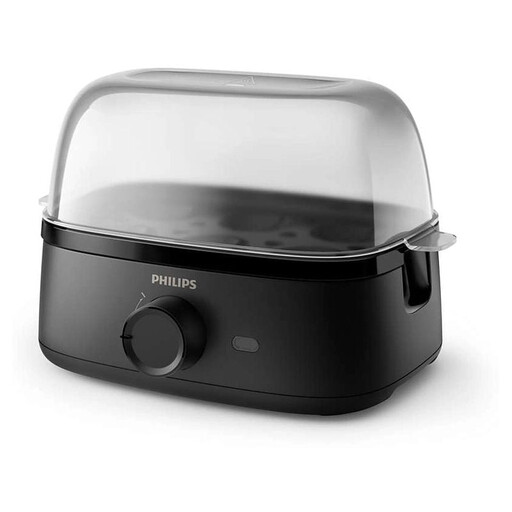 No image available
For a salad batch of up to six eggs, the stated capacity is a good place to start.
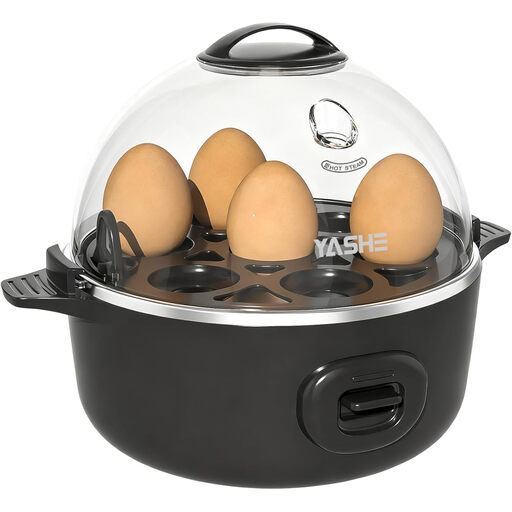 No image available
If your usual salad batch includes up to seven eggs, the stated capacity matches the amount you need.
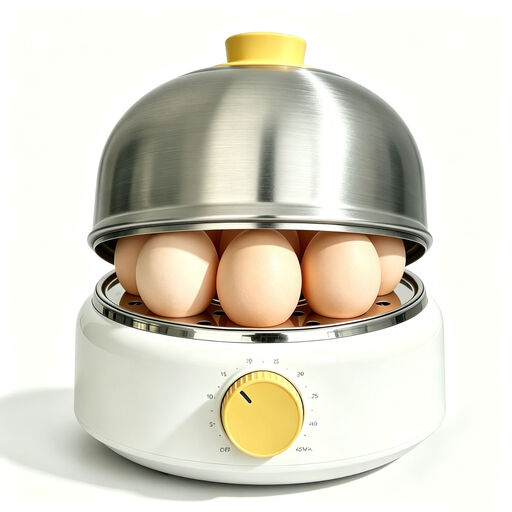 No image available
For a batch of up to seven eggs, this model combines the stated capacity with a cooking-level setting.
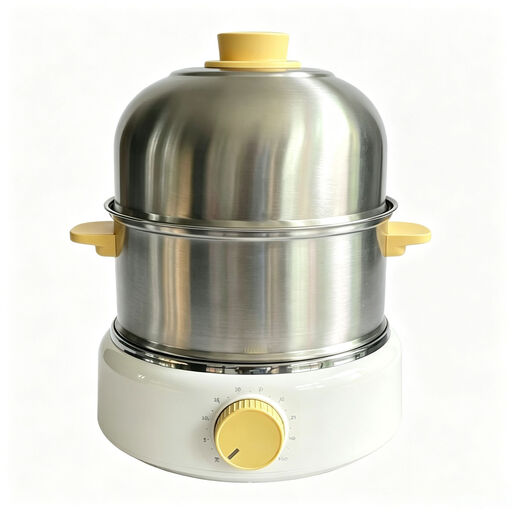 No image available
If you’re planning particularly large batches, the stated capacity of 18 eggs is worth considering.
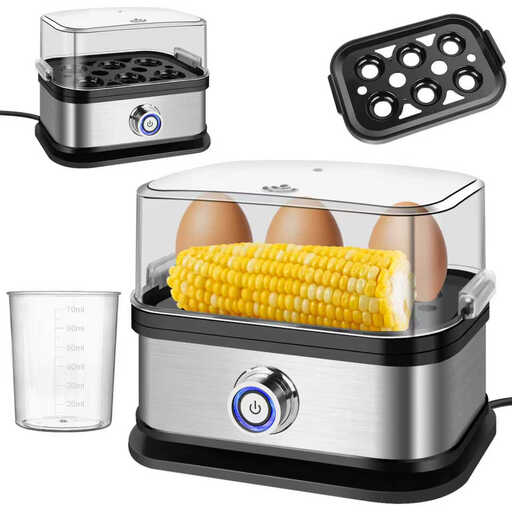 No image available
For a salad batch of up to six eggs, the stated capacity matches the usual quantity.
First, work out how many eggs you usually need for your recipe and compare this with the capacity of the exact model. If you need seven eggs, an appliance with a maximum capacity of six would mean cooking a second batch.
Don’t assume this is always safe, as the buzzer, keep-cooking function and automatic shut-off vary by model. For example, the Russell Hobbs Cook@Home 14048-56 is listed as switching off automatically after two hours. Follow your appliance’s instructions and take care when removing the eggs, as the surfaces and steam may be hot.
For perishable foods, the German Federal Institute for Risk Assessment recommends refrigeration at 2 °C to a maximum of 7 °C. This general food-safety advice doesn’t determine how long prepared salad will keep; take the other ingredients into account too.
Your statutory rights apply against the seller, while a guarantee is an additional voluntary promise with its own terms. If there’s a fault, you can initially ask for it to be put right. For accessories, also check that any spare parts are compatible with the exact model number.
No. The German Environment Agency explains that waste electrical equipment must be collected separately. Local collection points generally accept it free of charge; the conditions for returning it to a retailer depend on the relevant take-back point.