Hosts planning quantities
If you want to work out how many batches you’ll need for your guests before the meal, compare the units used for each batch size. Depending on the appliance, manufacturers give quantities for flour or finished pasta.


If you want the machine to handle as much of the dough preparation and shaping as possible, consider an automatic pasta press that specifically lists an egg pasta programme. A motorised roller is better suited to you if you want to roll out the dough yourself and control its thickness; you’ll still need to prepare the dough separately. Plan quantities using the unit given by the manufacturer: the weight of the flour and the weight of the finished pasta are not directly comparable.
If you want to work out how many batches you’ll need for your guests before the meal, compare the units used for each batch size. Depending on the appliance, manufacturers give quantities for flour or finished pasta.
If you want to prepare and extrude egg pasta dough as automatically as possible, look for a specifically named egg pasta programme and check which steps the appliance handles. Also check how the parts can be cleaned afterwards.
If you want to control the thickness of the dough sheets yourself and cut them into ribbons, a motorised roller could be a good fit. You’ll still need to prepare the dough separately.
A good fit if: you want to automate several steps for your dinner party and make pasta using shaping discs.
Consider: The pasta is shaped using a disc, rather than individually rolled and cut sheets of dough.
A good fit if: you mainly want to plan for your guests using the stated quantity of finished pasta per batch.
Consider: Check which programme is intended for your egg pasta recipe; the programmes available can vary by model.
A good fit if: you want to roll out the dough sheets yourself and control their thickness for cut egg noodles.
Consider: The motor powers the roller, but does not automatically prepare the dough.
When planning quantities, it’s important to check whether the stated amount refers to flour or finished pasta: Springlane gives the flour quantity per fill for the Nina, while Rommelsbacher gives the fresh pasta quantity per batch for the PM 220.
| Consideration | What to check when buying | Who is it important to? |
|---|---|---|
| Quantity and batches | Compare the unit and basis of the stated batch size with the total quantity you’re planning. For the Nina, Springlane gives 200–600 g of flour per fill; for the PM 220, Rommelsbacher gives up to 800 g of fresh pasta per batch. Philips bases its estimate of up to eight portions on 800 g of pasta. | When I’m planning for several guests, I want to know whether the capacity refers to flour or finished pasta. Around 36 % of consumers give the quantity needed and number of batches top priority. |
| Automation | Check whether an egg pasta programme is listed and which dough preparation steps the specific model handles. For the Nina, Springlane lists programmes for pasta with and without egg; for the HR2665/93, Philips lists a setting for egg or flavoured pasta. | When I have other things to do while preparing a meal, I want the machine to take over as much of the mixing and shaping as possible. Around 27 % of consumers prioritise automating the preparation of egg pasta dough. |
| Shape and thickness | For ribbon pasta, check the roller, thickness settings and which cutting attachments are actually included; for presses, check the shaping discs included with the specific set. Marcato lists ten thickness settings for the Atlasmotor+. | If I care more about rolling out the sheets myself or cutting ribbons than automating as much of the preparation as possible, I’ll check how much control I have over the dough thickness. Around 19 % of consumers prioritise the shape and thickness of their egg noodles. |
| Cleaning | Check the manual to see which individual parts are dishwasher-safe. For the Nina, Springlane says all removable parts are dishwasher-safe; for the HR2665/93, Philips excludes the front cover and accessories from its statement about removable parts. | After the meal, I want to know which parts need cleaning and how they should be cleaned. Around 9 % of consumers put cleaning first. |
| Hygiene and spare parts | Check the cleaning instructions and the discs that fit; according to the manufacturer, you need to check the F-number for an additional PM 220 disc set. You should also follow the German Federal Institute for Risk Assessment’s guidance on handling eggs. | When preparing food with raw eggs, I want to work hygienically and make sure I can find the right accessories later on. Around 9 % of consumers prioritise hygiene and planning for spare parts. |
A stated flour weight does not tell you the weight of the finished egg noodles. Treating the two figures as equivalent could lead you to miscalculate how many batches you’ll need for a meal with guests.
Note the unit used by the manufacturer, then plan for your desired total quantity.
The motor powers the roller; it does not automatically replace the separate preparation of the dough. Depending on the model, presses can handle additional steps.
Before you buy, decide whether you want to roll out the dough sheets yourself or automate as much of the dough preparation and extrusion as possible.
Accessories and cleaning recommendations do not automatically apply to every model or all removable parts. Rommelsbacher points out that an additional disc set must have the correct F-number; Philips lists exceptions among the removable parts of the HR2665/93.
Check the model number, accessory compatibility and cleaning instructions for the specific appliance.
The Nina is an automatic press for buyers looking for features such as a pre-set programme for egg pasta.
The 7000 Series Pastamaker HR2665/93 is an automatic press with a setting for egg or flavoured pasta.
The PM 220 Pastarella is an automatic press for buyers comparing the stated quantity of finished pasta and the options for manual intervention.
The Atlasmotor+ combines a motorised roller with the option to roll out dough sheets to different thicknesses.
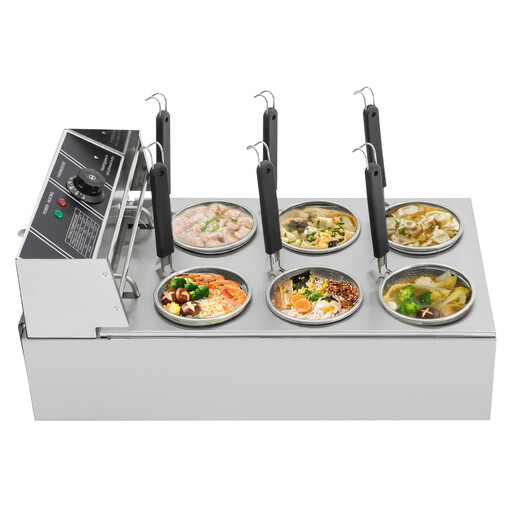
The products below include automatic pasta machines and an electric pasta maker with adjustable dough thickness. Their names describe either a household appliance or a commercial pasta cooker; before buying, check that the type of machine, its suitability for egg noodles and its batch size are right for your dinner party.
 No image available
The product name describes a commercial appliance for restaurant kitchens. Check whether a pasta cooker is right for your needs; the name does not identify it as an automatic press for egg pasta dough.
It lists a 20 L capacity and a temperature setting of 140–392 °F. No power rating is given here.
 No image available
Adjustable dough thickness can be useful if you want to shape sheets or cut noodles yourself. Check that the appliance is suitable for your egg pasta recipe and see which attachments are included in the set.
The instructions say not to immerse it in water; use a dry cloth and brush for cleaning.
 No image available
The automatic design and shaping discs listed in the product name could be a good fit if you want to make different types of pasta. First, check whether a disc and programme are intended for your egg noodles.
The product name describes it as a household machine and lists nine interchangeable shaping discs.
 No image available
The 200 g of dough per fill listed in the product name may suit smaller batches. Plan for several batches if you need a larger quantity for your guests.
The instructions say not to rinse the main unit. Check the cleaning instructions before cleaning it after use.
First, compare the units used in the manufacturers’ figures. For the Nina, Springlane gives 200–600 g of flour per fill; for the PM 220, Rommelsbacher gives up to 800 g of fresh pasta per batch. Philips bases its estimate of up to eight portions on 800 g of pasta. Decide how much you need in total, then plan using the figures for the specific model rather than treating them as equivalent.
The German Federal Institute for Risk Assessment recommends good kitchen hygiene and keeping perishable foods refrigerated. For eggs, it recommends refrigerator temperatures of 4 to 6 °C and, as a guide when heating food, a core temperature of at least 70 °C for at least two minutes. This is hygiene guidance, not a recommendation for the cooking time of every type of noodle.
No, dishwasher-safe guidance does not apply to every model and every part. Springlane describes all removable parts of the Nina as dishwasher-safe; Philips excludes the front cover and accessories from its statement about removable parts for the HR2665/93. Follow the instructions for your specific appliance.
For statutory claims relating to faults, the seller is generally responsible, not automatically the manufacturer. The Verbraucherzentrale explains the general two-year statutory warranty and how it differs from a voluntary guarantee, which may have different terms.
Products covered by harmonised EU rules that require CE marking must carry it before being placed on the market. The marking is the manufacturer’s declaration that the applicable requirements have been met; it is not a quality seal awarded by a central EU body. The rules that apply to a specific appliance must be checked on a product-by-product basis.