
Lieferung heute & morgen

Qualitätsgarantie

Willkommens-Angebote freischalten: KOSTENLOSE Lieferung | Bis zu 80 % RABATT | Kostenlose 30-Tage-JoyPlus-Testphase
App herunterladen
An egg cooker can make preparation easier when time is short in the morning or when you need to cook several eggs at once. However, appliances vary considerably in capacity, operation, cleaning and intended use. Singles will often find that a small electric mini cooker is sufficient, while families may benefit from an egg cooker for 6 eggs.
The product description alone should not determine your purchasing decision. Some specifications may sound versatile but reveal little about practical use. The key factors are clear technical details and features that suit your everyday routine.
An appliance for six eggs is not automatically more useful than a compact egg cooker for two or three eggs. If you live alone, you may need less worktop space and use less water per preparation with a smaller model. For families, house shares or guests, on the other hand, a higher capacity can save time.
So check whether the stated capacity refers to whole eggs, poached eggs or additional accessories. An egg poacher often takes up fewer slots than the egg holder for boiled eggs.
Some models only emit an audible signal, while others feature an automatic shut-off. With an egg cooker with automatic shut-off, the heating process ends once the water has evaporated or the specified cooking process has finished. This reduces the risk of the appliance continuing to heat, but it does not replace supervision during operation.
Also check whether overheating protection or boil-dry protection is specified. These features are particularly relevant when the appliance is used in small kitchens, student accommodation or the office.
A multifunction cooker can prepare pasta, soup, porridge or hot pot dishes. However, that does not automatically mean it can completely replace a traditional egg cooker. A larger pot usually requires more space, more water and a different cleaning routine.
The coating should also be examined carefully: with a non-stick cooker, suitable wooden or silicone kitchen utensils are advisable, as metal cutlery can damage the surface. With coated appliances, the outer housing and power connection must not be immersed in water.
Three questions can help you make the right choice:
An egg cooker for soft-, medium- and hard-boiled eggs often controls the cooking level through the amount of water used. An egg cooker with measuring cup supplied with the appliance makes measuring easier. Markings for soft, medium and hard are more practical than a simple time setting, as egg size and starting temperature can affect the result.
Power is specified in watts and affects how quickly the water heats up. The models listed in the product data, for example, range from 360 to 430 watts for traditional egg cookers and from 600 to 1,000 watts for larger multifunction cookers.
A higher wattage is not, on its own, an indicator of quality. For everyday egg cooking, an appliance with moderate power is often sufficient. An electric multifunction cooker with 1,000 watts is more likely to be designed for additional tasks such as cooking pasta, soup or steaming. In Germany, you should also ensure that the specified mains voltage of 220–240 volts is compatible with the household supply.
Removable egg holders, measuring cups and poaching inserts make cleaning easier. According to the product descriptions, certain accessories supplied with some products are dishwasher-safe. Follow the relevant manufacturer's instructions before putting them in the dishwasher.
Stainless-steel surfaces are best cleaned with a soft sponge. Coated interiors should not be treated with wire wool or abrasive products. Hot steam and heated surfaces are produced during use. The lid should therefore be opened carefully and directed away from your face. Before cleaning, unplug the appliance and allow it to cool down completely.
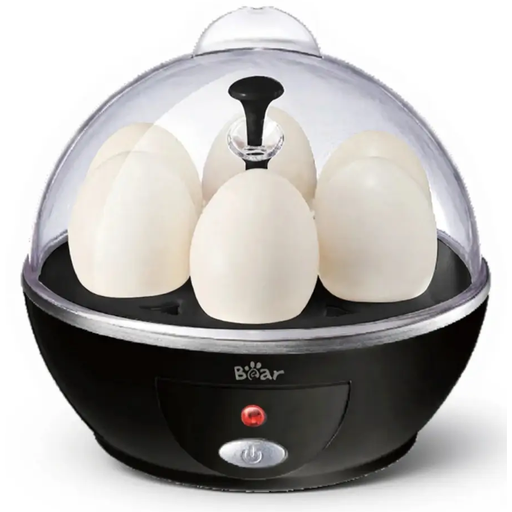
Why this product suits the profile: One-button operation and the supplied measuring cup are ideal for shoppers looking for straightforward basic functionality for up to six eggs.
The product data specifies automatic shut-off when the water has evaporated, as well as overheating protection. The desired cooking level is set through the amount of water used.
Capacity for up to six eggs, one-button operation, measuring cup and integrated egg piercer according to the product details.
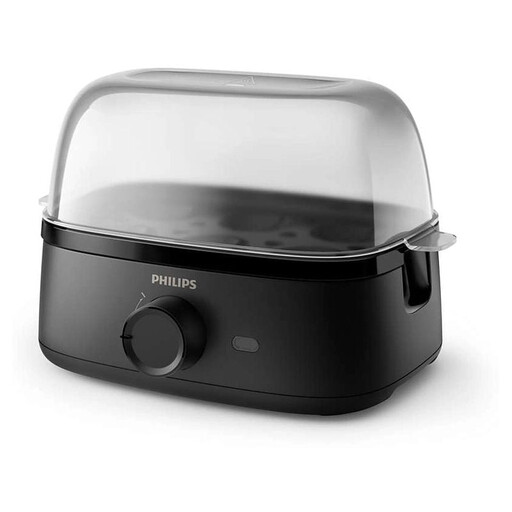
Why this product suits the profile: This model combines six slots for boiled eggs with an insert for up to three poached eggs, making it suitable for households with different breakfast preferences.
The product data explicitly lists an operating indicator, an audible ready signal and automatic shut-off.
400 watts, capacity for six eggs, a poaching insert for up to three eggs and removable parts that are dishwasher-safe according to the product description.

Why this product suits the profile: Students, professionals and people with small kitchens get additional options for ramen, pasta, soup and hot pot dishes alongside egg-based meals.
Its compact 1.6-litre capacity is combined with boil-dry protection and automatic shut-off. This keeps its functionality clearly focused on small portions and portable use.
600 watts, 1.6-litre capacity, non-stick interior and four cooking functions according to the product description.
We have put together a complete, regularly updated list of products that fully meet these strict selection criteria and the safety regulations applicable in the EU.
An egg cooker usually requires only a limited amount of water per cycle. When it comes to electricity costs, the wattage alone is therefore not the only relevant factor; the actual operating time matters too. Approximate costs can be calculated as follows:
Power in kilowatts × operating time in hours × electricity price per kilowatt-hour
An appliance rated at 400 watts is equivalent to 0.4 kilowatts. If it runs for 10 minutes, that equates to around 0.067 kilowatt-hours. The actual cost depends on your individual electricity tariff and the appliance's actual running time.
For a long service life, regular descaling, careful handling of the lid and egg piercer, and cleaning once the appliance has cooled are important. Limescale deposits on the heating plate can affect heat transfer. Only use the descaling products recommended by the manufacturer and follow the relevant instructions for use.
The amount of water depends on the model, the number of eggs and the desired cooking level. Use the measuring cup supplied and follow the markings for soft, medium or hard. For appliances without a measuring cup, the instructions should be followed.
Automatic shut-off ends the heating process once the specified cycle is complete and can limit unintended continued heating. Nevertheless, you should not operate the appliance unattended, place it on a stable, dry surface and open the lid carefully because of the hot steam.
It is not possible to give a generally applicable fixed service life. It depends on how often the appliance is used, descaling, material care and how the cable, lid and heating plate are handled. Choosing a suitable model with easy-to-clean parts and straightforward controls can make regular use easier.