
Lieferung heute & morgen

Qualitätsgarantie

Willkommens-Angebote freischalten: KOSTENLOSE Lieferung | Bis zu 80 % RABATT | Kostenlose 30-Tage-JoyPlus-Testphase
App herunterladen
Setting up an ergonomic workspace in your home office is an investment in your health and productivity. An electric height-adjustable desk is often at the heart of these considerations. However, the market is flooded with options whose technical specifications and marketing promises often confuse more than they help. Before you make a decision, it's crucial to know the most common pitfalls that can lead to a poor purchasing decision.
Two central problems repeatedly occur with entry-level models:
This guide will help you avoid these problems and identify the features that are crucial for a durable and functional sit-stand desk.
To find a suitable ergonomic desk, you should focus on objective, technical features rather than marketing claims. Three aspects are of particular importance here.
The heart of any electric adjustable desk is its motor. Models with dual motors (one per leg) generally offer greater lifting capacity, faster adjustment speed, and better synchronisation, which increases stability. A single motor can reach its limits with uneven weight distribution. Pay attention to specifications for noise level (often under 50 dB) and lifting speed (e.g., 25-35 mm/s). Quiet and swift operation is a clear hallmark of quality.
Stability, especially in the standing position, depends directly on the construction of the desk frame. A decisive factor is the maximum static load capacity, which is specified in kilograms (kg). A value of 70 kg or more is sufficient for most home office setups with two monitors and accessories. The frame should be made of robust steel. Three-stage lifting columns often allow for a wider height adjustment range and typically offer more stability than two-stage versions. Adjustable feet are also important to compensate for uneven floors.
The size of the tabletop should suit your available space and requirements. A width of 140 cm is a good compromise for compact workspaces, while 180 cm provides ample room for multiple monitors and documents. The material, usually a particleboard or MDF top with a durable finish, should be scratch-resistant and easy to clean.
A desk with a memory function is particularly practical: it allows you to save several preferred heights (e.g., for sitting and standing), which can be accessed at the touch of a button. Additional features like integrated cable grommets, hooks for headphones, or even USB charging ports can further improve organisation and functionality at your workspace. The style, for example a vintage brown desk, can also be integrated well into modern living concepts.
Here are some recommendations tailored to specific user profiles and their requirements.
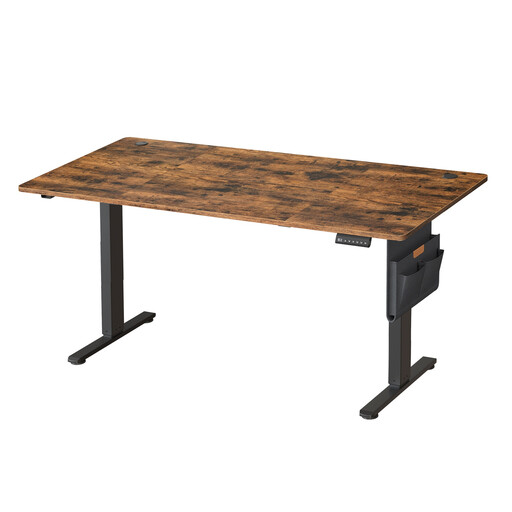
Why this model is a great fit: Ideal for users who need a spacious and stable workspace for multiple monitors and extensive projects. The large tabletop offers maximum freedom in designing the setup.
The robust steel frame and high static load capacity of 70 kg counteract the problem of an unstable, wobbly frame, even when the standing height is fully utilised.
Spacious 180 x 80 cm tabletop; memory function for 4 heights; integrated USB-C port for charging devices.
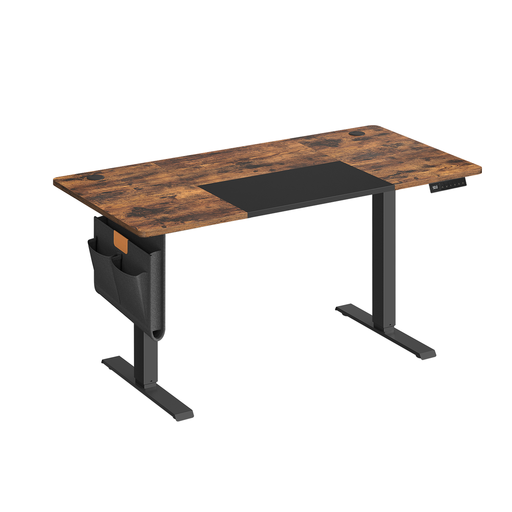
Why this model is a great fit: Perfect for users with limited space who still want ergonomics and modern features. Its compact size fits well into smaller rooms or multi-functional living areas.
The motor, described as quiet, addresses the problem of disruptive operational noise. The simple operation and memory function prevent frustration during daily use.
Compact dimensions (140 x 60 cm); 4 memory presets and reminder function; includes a storage pouch and hook for accessories.
We have compiled a complete, up-to-date list of products that fully meet these strict selection criteria and comply with German safety regulations.
A desk with a memory function allows you to save multiple height positions (usually 2 to 4). Instead of having to manually adjust the height with the up and down buttons each time, you can move directly to your preset sitting or standing height at the touch of a button. This saves time and encourages regular use of the standing function.
For optimal performance and longevity, a system with two motors is recommended. In this setup, a motor is integrated into each table leg, which ensures a more even and stable lifting motion, especially under heavier loads. Models with only one motor are often cheaper but can be more prone to instability and have a lower lifting capacity.
The maximum static load capacity varies depending on the model and construction. A solid figure for a home office desk is around 70 to 100 kg. This is usually sufficient to safely support multiple monitors, a laptop, books, and other accessories. Check this specification before purchasing to ensure the desk is suitable for your planned setup.