
Lieferung heute & morgen

Qualitätsgarantie

Willkommens-Angebote freischalten: KOSTENLOSE Lieferung | Bis zu 80 % RABATT | Kostenlose 30-Tage-JoyPlus-Testphase
App herunterladen
An electric air pump can be the difference between getting back on the road quickly and a long, forced stop. Whether for a car tire, a bicycle, or a stand-up paddleboard (SUP), the right pump saves time and effort. However, the market is flooded with models whose performance claims often create more confusion than clarity. Before you make a purchase, it's crucial to understand the typical pitfalls that can lead to the wrong choice.
This guide will help you objectively evaluate technical specifications and find a model that is precisely tailored to your needs.
Many devices look powerful at first glance but reveal their weaknesses only in real-world use. Watch out for these three common problems:
To avoid these problems, you should focus on the following three core features. These determine whether a portable air pump is suitable for your purpose.
The choice of power source is fundamental and depends directly on your primary use case.
These two values are often more critical than the raw wattage.
Modern electric air pumps offer more than just inflation.
Based on these objective criteria, we have identified a few models that are particularly well-suited for specific user groups.
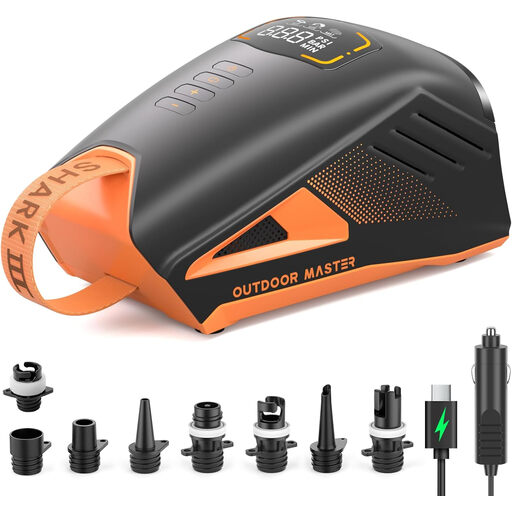
Why it's a great fit: Specifically designed for the demands of inflatable SUPs and boats. The powerful battery and high airflow rate allow for inflating multiple boards without being connected to a vehicle.
The integrated cooling system prevents overheating during continuous use. The 74 Wh battery bypasses the issue of weak battery performance, capable of inflating up to four SUP boards per charge according to the manufacturer.
Very fast inflation time (approx. 3 min 50 sec for a 10.6-foot board to 15 PSI, according to OutdoorMaster) and a practical deflation function.
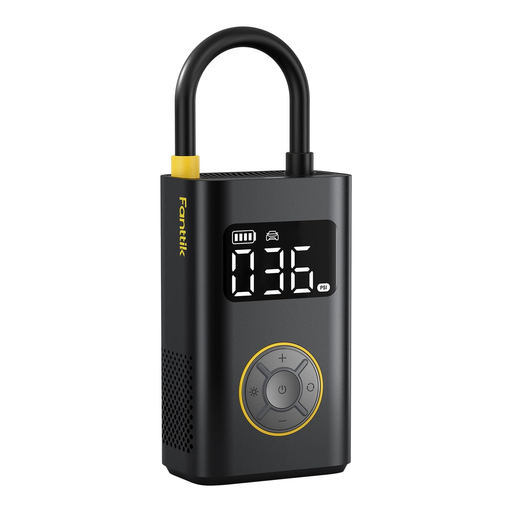
Why it's a great fit: A compact and powerful cordless compressor that is ideal for regular tire pressure checks and emergencies. Its wireless design offers maximum flexibility.
Addresses the problem of inaccurate measurements with a digital pressure pre-set and auto-stop. The integrated accessory compartment prevents the loss of adapters and hoses.
Fast performance (approx. 1 minute to top off a compact car tire from 30 to 35 PSI, according to Fanttik) and preset modes for various applications (car, motorcycle, bicycle, ball).
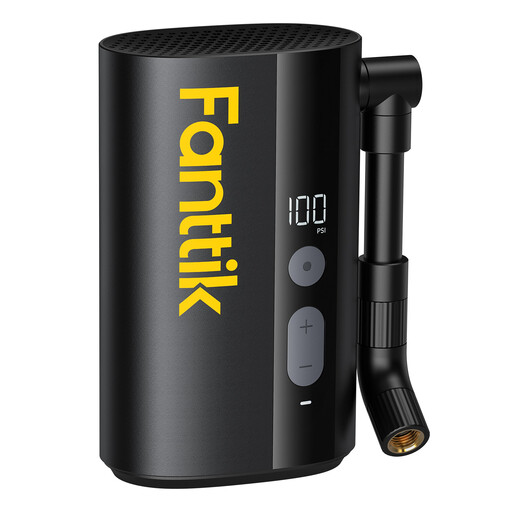
Why it's a great fit: Extremely compact and lightweight, it fits into any backpack or jersey pocket. Specially designed for the high pressures of road and mountain bike tires.
Solves the trade-off between portability and power. Despite its small size, it reaches up to 150 PSI. The all-in-one design with an integrated hose and valve head avoids fumbling with loose parts.
The 360° rotating hose makes it easy to connect to hard-to-reach valves. The 5000 mAh battery allows for inflating up to 8 bicycle tires on a single charge, according to the manufacturer.
We have compiled a complete, up-to-date list of products that fully meet these strict selection criteria and relevant safety standards.
Accuracy can vary by model. High-quality devices are often calibrated to industry standards (e.g., ANSI) and offer an accuracy of ±1 to ±2 PSI. For precision applications like road bikes or for adhering to manufacturer specifications for car tires, this level of accuracy is recommended. The auto-stop function further contributes to precision.
Yes, in most cases, this is possible, provided the pump comes with the correct valve adapter (Schrader for most cars and mountain bikes, Presta for road bikes). Many modern pumps like the Fanttik X9 Pro are supplied with adapters for both valve types. Be sure to set the correct, higher target pressure for your bicycle.
Battery life heavily depends on the capacity (mAh/Wh), the required pressure, and the volume of the object being inflated. A good cordless compressor should be able to top off four to five car tires from 2.0 to 2.5 Bar (approx. 29 to 36 PSI) or fully inflate several bicycle tires. Models for SUPs often have even more powerful batteries designed for multiple boards. Check the manufacturer's specifications, which often describe performance in specific use cases (e.g., "inflates 5 car tires on a single charge").